|
|
STORMO! © 2005 5 (2005) 1-2
Aerial Operations in the Greek Campaign October 1940 - April 1941
Giulio Gobbi
June, 2005
This is the translation of an article first published on Modellismo Piu.
This article covers the aerial operations during the Italian Campaign of Greece in 1940/41. Of interest are several references to historical
documents and letters.
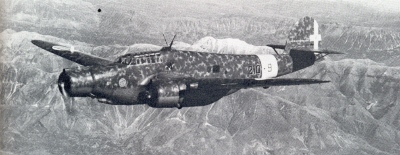
On 28 October 1940, the beginning of operations in Greek territory, Comando Aeronautico Albania della Regia Aeronautica was based at Tirana, Albania and had at its disposition 38° Stormo da bombardamento at Valona with SM.81s, 105° Gruppo da bombardamento at Tirana with SM.79s and 160° Gruppo Caccia CT (Fighter Squadron) with two squadrons of Fiat CR.32s at Drenova and the 72° Gruppo Osservazione Aerea providing aerial observation with the IMAM Ro.37 composed of the 25°, 42° and 120° Sq. based at Coriza, Valona and Argirocastro. On 5 November these small forces were increased with the addition of the 104° Gruppo da bombardamento at Tirana with SM.79s and the 24° and 154° Gruppo Caccia CT operating from Berati with two squadrons of Fiat G.50s and the 150° Gruppo Caccia with 363°, 364° and 365° Sq. each equipped with the Fiat CR.42 at Tirana, Valona and Argirocastro. In all on 5 November, the Regia Aeronautica could support the movements of the Regio Esercito with the following forces in Albania:
31 SM79
24 SM81
47 Fiat G50
46 FIAT CR42
14 FIAT CR32
25 IMAM Ro37
In Puglia Italy, maritime forces that could participate in the invasion of Greece included the 4° Zona Aerea Territoriale which would eventually become the 4° Squadra Aerea with the 35° Stormo da bombardamento marittimo (Maritime Bombers) using the Cant Z. 506 based at Brindisi. On land, 37° Stormo da Bombardamento with SM.81s and Fiat BR.20s were at Lecce, the 47° Stormo da bombardamento at Grottaglie with the CANT Z.1007 bis, and the famous "Picchiatelli" of the 96° Gruppo bombardameto a tuffo at Lecce with Junkers Ju87B/R2. Fighter cover was provided by the 2° Gruppo Caccia with Fiat G.50s and Fiat CR.42s with the two squadrons 150a and 152a Sq. at Grottaglie and Bari. The 41° Gruppo da bombardamento with CANT Z.1007bis and the 372 Squadriglia Caccia with Macchi MC.200s were based at Brindisi. In total airbases in Puglia could support operations in Greece with the following forces:
60 CANT Z.1007bis
23 CANT Z.506
20 Ju.87B/R2
12 Macchi MC.200
33 FIAT G.50
9 FIAT CR32
In total, from airbases bases in Albania and Puglia there were 135 bombers, 151 fighters and 25 reconnaissance aircraft.
Greece could not oppose this air force on an equal footing. The fighters available to the Greek Air Force included 36 PZL P24F of Polish design
divided into three Squadrons the 21st, 22nd and 23rd with ten aircraft each and in which the defense of Salonicco, Kastoria, Kozane and Larisa
were entrusted. There were 9 Bloch MB.151 of French design equipping the 31st Squadron to protect Athens. Greek bombers included 9 modern French
designed Potez 633 equipping the 31st Squadron, 12 Bristol Blenheim Mk I equipping 32nd Squadron and 10 Fairey Battle Mk I equipping the 33rd Squadron.
Reconnaissance units were equipped with 16 German Henschel Hs.126 and the navy had 10 Avro Ansons and 9 obsolete fighter biplanes, the Fairey IIIF.
On paper the disparity was remarkable, not just in quality, but even modern equipment such as the Potez and the Bloch were hardly available due
to pilot training and limited supplies of spare parts. Thus the Regia Aeronautica expected to sweep the Greek Air Force in a maximum of 5 days and
then concentrate its support on army operations undisrupted, however this did not happen (due mainly to British intervention), and until the German
participation the combined Greek and British Air Forces continued to harass the Regia Aeronautica.
The Regia Aeronautica and the Regia Marina were held outside of operations planning and consequently Superaereo received "enigmatic" demands such
as the letter from Benini Undersecretary of State for Albanian Operations Planning to Gen. Pricolo Chief of the General Staff of the Regia
Aeronautica dated 6 September 1940:
"6 September 1940 : n. 195520/2784 – Dear Pricolo, please be informed of preparations to be carried out at the soonest possible moment for
signed actions against Albanian territories subject to Greece (I emphasize the "signed action" n.d.r.), the points are summarized as follows:
a) to prepare air borne units for air assaults on Ciamuria and to prepare the necessary units with arms and supplies.
b) have the R.Ministero dell'Aeronautica study the possibility of the use of airborne units to assault Ciamuria. To such a purpose it is
suggested to rapidly train Albanians who wish to join such an action. On the whole the Ecc. Ciano has approved of such proposals, provided they
are thought feasible from the R.Ministero dell'Aeronautica. Please let me know your thoughts - Affez.mo Benini."
To such a strange letter, Pricolo replied of only knowing of indirect ways of attacking Greece and that while he thought feasible the plan of
an airborne drop of troops and ammunition, he expressed strong doubts on the ultimate effectiveness of such an operation. Fortunately the
operation did not come to pass due to time and cost constraints. On 9 September Superesercito officially contacted Supermarina and Superaereo
in order to agree to operations against Epiro and the Joniche islands and on 12 September was transmitted the following letter:
“ ... 1 – OPERATIONS AGAINST YUGOSLAVIA (Emergency "E") the political situation in Jugoslava requires the operations be executed swiftly as
indicated by the Duce. Therefore by the end of October the operations must be completed so as to be in a position to profit from the eventual
internal turmoil in Jugoslava.
2- OPERATIONS AGAINST GREECE (Emergency "G") We must consider the possibility of an armed intervention in order to occupy Ciammuria, Epiro and
the Joniche islands. The transport of troops must be carried out by the end of September..."
To gain their first successful campaign the Army wanted to be sure that the Air Force and Navy played a marginal part and informed their
two respective general staffs only at the last possible moment. In mid October 1940 at Tirana, HQ did not fully understand the condition
of some of its airfields for example at Valona, Durazzo and Argirocastro there did not exist lodging and shelter for staff and ostensibly
referred to existing barracks as an "air terminal". The fuel reservoirs amounted 1500 drums, spare parts were insufficient, there was only
2500 tons of ammunition, some supplies of clothing, a few motor vehicles and only a single unit of engineers at Tirana. Outside those airfields
equipped with telegraphic or telephone lines, communications were conducted via radio or via aerial courier. Radiometric assistance was done from
Brindisi, Italy. Moreover efforts of shipment of material from the mother land were hampered due to sinkings by Royal Navy submarines which
sunk the Chisone, Hermada and Olympia cargo ships with precious communications equipment, fuel and supplies.
The choice of the date for the beginning of operations was particularly unfortunate, the start of winter which benefited the Greeks tremendously:
Until 1 November the weather was so bad to render whatever type of flight activity impossible and on 2 November with weather worsening the
Albanian air fields were reduced to marshes and therefore, bombers and ground attack aircraft operating from Puglia alternated themselves on
important objectives such as the Corinto canal, the railway port of Salonicco and the ports of Corfù, Kastoria and Gianina without appreciable
results. On 3 November "strategic targets" had to be abandoned and Italian bombers were employed on secondary targets in an attempt to check
the Greek counter-offensive. The engagement of Italian pilots was remarkable during this time, according to various sources flying as many as 200
to 400 sorties in a single day. All Ju.87s available were diverted to the Greek Front at the cost of neglecting the important task of anti-shipping
and attacking Allied supply convoys directed toward Libya, tasks in which they were more adapted to. The SM.79 and the CANT Z.1007 could do little
not having true targets to strike. On 2 November Greek P24Fs shot down an SM.81 north of Giannina. In the succeeding days, Italian bombers bombed
Greek supply lines losing 2 Cant Z.1007bis, a SM.79 and a CR.42, against the loss of a P24F. On 15 November all missions were concentrated on
Corciano. Although the few Greek bombers did little damage and with a sacristy of forces they found the courage to push their attacks to Bari
although enduring very serious losses. British reinforcements arrived at Valona on 15 November with 6 Vickers Wellingtons and without escort
attacked and were intercepted by Fiat G.50s losing four planes, two shot down and two that forced landed. The British supported the Greek counter
offensive with the 33rd Fighter Squadron composed of Gloster Gladiators and the 30th Bomber Squadron composed of Bristol Blenheims. At the end of
the month Blenheims of the 84th and the 211th Squadrons arrived together with the 80th and the 112th Squadrons of Gladiators.
The weather conditions worsened and up to the beginning of December the few remaining SM.81s were transferred to Lecce where they were converted
to transports in order to try to alleviate the situation regarding fuel supplies that was becoming dramatic. Other aircraft were transferred to
airbases in Puglia or were concentrated on the Albanian air fields of Berati, Devoli, Argirocastro and Tirana again to deal with fuel shortages.
In Puglia on 23 November arrived Macchi MC.200s of the 373° and 374° Sq. arriving from Veneto to Bari. There were 27 SM.79 of the 42° Stormo at
Grottaglie and at Lecce 14 Ju.87Bs of 97° Gruppo Tuffatori and 8 MC.200s of the 370° Sq. were transferred to Foggia. The 95° Stormo transformed
to a land unit abandoning its CANT Z.506s for the CANT Z.1007bis, while 12 SM.79s and 21 Fiat G.50s were transferred to Libya. The first large
scale engagement between the Regia Aeronautica and the RAF occurred on 19 November when 20 Gladiators of the 80° Squadron clashed with 5 Fiat CR.42s
shooting down 4. On the 27 November 7 Gladiators attacked 3 CR.42s shooting down 1 CR.42, and the day after, another duel in which 4 Gladiators
were shot down for the lose of 3 CR.42s. Aerial combat intensified to the end of the month with about 20 or 30 aircraft lost on each side before
the forced pause of December. During this time the Italian pilots were gallant and in those few days in which weather permitted, never did the
RA respite in carrying out close support of ground troops when it was required. For example the pilots of the 97° Sq. on 9 December succeeded
in carrying out 23 missions/day/crew with a total of 150 sorties without suffering losses while slowing down the Greek counter-offensive,
and giving a much need break to Italian troops in which the front was less than twenty minutes flying time from Italian airfields.
In February 1941 with an improvement in weather conditions, air combat between the Regia Aeronautica and the RAF resumed. On 9 February, 24 CR.42s
escorting BR.20s met with a mixed formation of Gladiators and PZLs, both sides losing two fighters each. On 13 February, 12 Blenheims on a mission
to Tepeleni were attacked by 12 G.50s with five Blenheims shot down. On 20 February arrived the first Hurricanes. At the beginning of March SM.81s
of 38° Stormo were replaced by BR.20s. The CR.42s of 150° Gruppo were replaced by MC.200s. Also arriving were 12 Ju.87Bs at Valona as well as 32
Macchi MC.200s and 8 Ro.37s. On 4 March, 11 CR.42s attacked a formation of Blenheims protected by Hurricanes and in the ensuing clash two CR.42s
were shot down for the loss of one Hurricane. Between the 9 and 14 March losses included 2 MC.200s, a Gladiator and a Hurricane. On the 16 March,
2 Wellingtons were shot down at Tirana. On 22 March the RA executed a surprise attack on the Greek air port of Paramythia in which two Blenheims
and a Wellington were destroyed on the ground. In sight of the impending invasion of Yugoslavia, on 2 April at Tirana arrived 9 Ju.87Bs of
208° Squadriglia, 9 Caproni Ca.311 of 87a Squadriglia Osservazione Aerea and an equal number of Ro.37s of the 35° Sq.
On 6 April the German participation in the Balkans began with VIII FliegerKorps of Luftflotte 4 in Bulgaria commencing attacks in Greece and
Yugoslavia with Ju.87Bs of the I and III St.G, Messerschmitt Me 109Es of the II and III JG.27 and Me 110Cs of the II/ZG26. Reconnaissance was
provided by Hs.126 and Storch of the I(H)/4, transport was provided by Ju.52s of the IV/KGzbVI. Other units in Austria, Hungary and Sicily were
ready. The Jugoslava air force was rendered ineffectual in 48 hours and for the Greeks things didn't go much better in which a (un)fortunate
blow on a ship loaded with 250 tons of explosive was hit by a Ju.87 and completely devastated the port of Athens sinking 10 ships with a single bomb.
On the 9 April, the Germans were at Salonicco and after 5 days the Greek Air Force ceased operations, 113° Squadron of the RAF was destroyed on the
ground and the same fate awaited the remaining RAF air bases. On the evening of 14 April the RAF could count only 35 aircraft in flying condition.
German losses up to this point were only two fighters! On 6 April CANT Z.1007s attacked the port of Mostar in Yugoslavia losing one aircraft while
shooting down two, at Spalato one Ju.87B was lost. On the 13 April 300 fighters and bombers of the Regia Aeronautica attacked Mostar and the
arsenal of the Cattaro, losing one Ju.87B. On 26 April the last day of the Greek campaign, 13 Hurricanes were destroyed on the ground by Me.110s thus
destroying the final elements of the RAF in Greece. The next day came the signing of the armistice. For the Regia Aeronautica the strategic task
ended and now began the equally hard task of anti-guerrilla warfare.
A short analysis is worthwhile of the statistics of the operations carried out during the campaign, beginning from the days available for the
missions in relation to the time of operations:
November, 17 days up to the 31st November
December, 14 days up to the 31st December
January, 10 days up to the 31st January
February, 9 days up to the 28th February
March, 25 days up to the 31st March
April 11 of 22 days.
Also when it rained the cloud ceiling remained quite low and so rendered impossible for bombers to identify targets accurately and consequently
to act in order to avoid collateral damage. Thus reduced about half the effective employable aircraft in actions that were of some war value. An
idea of the conditions of airbases in Albanian is provided in the following letter dated 28 October 1940:
"Tirana: reduced 700X200 wet. - new Scutari: PROHIBITED. - Drenova: PROHIBITED. - Coritza: reduced 500X300, flooded, PROHIBITED HEAVY. Valona:
reduced 900X300 wet, bad. - BERAT: PROHIBITED. - PROHIBITED Devoli."
On the first day of the Greek Campaign there was only a single airfield available of seven! Its interesting to note that Papagos mentions
clearly in his book "Greece at War" that hundreds of Italian Aircraft swarmed the skies on the 28 October 1940 in support of ground operations.
I would like to know from where these supposed hundreds of aircraft had taken-off from? In all, the Regia Aeronautica carried out 7777 missions,
bombing missions of which 5560 were tactical support, with total bombs dropped equaling 4547 tons, of this load 3539 tons were dropped by
Italian Ju.87s. The activities of transport and refueling were quite notable, above all airborne drops of fuel totaled 200 tons to isolated units,
often with antiquated aircraft whose crews accepted missions without fighter support and metrological equipment. It can be said the Regia
Aeronautica played a critical role in allowing the Regio Esercito to successfully reform their lines in Albania. The cooperation between the Army
and the Air force was at times strained and can be summarized in the following letter dated 15 January 1941 addressed to Rome:
"Letter 021202 from Armed Forces High Command FFAA Albania and p.c. to the Aeronautical Command in Albania: Please note the general situation
and in particular the operations of our troops and the enemies, and draw attention to the following facts:
1) impossibility of counter offensives due to the remarkable and tenacious efforts of the enemies rested troops who are at peak efficiency;
the lack of availability of Italian reserves for continued field operations.
2) deficiency of the availability of medium-caliber guns and artillery and the near absence of long range artillery.
3) serious deficiencies in the means of transport that for a long time has rendered the re-supply and refueling of our troops at long
distances problematic or impossible, thus limiting offensive operations.
4) material conditions of combat units for long months go unanswered and are having serious repercussions on moral.
All this has induced me to request the air arm all that it is capable of to help remedy this situation. Although the air arm has conducted
itself with the maximum spirit of sacrifice and dedication to the common cause; it turns out the results are less than expected.
Areas of concern:
a) the lack of timeliness of the participation.
b) the lack operating necessities in action.
The first cause is easily understood, knowing the procedures and the demands for participation. In the second case I will say instead that
the understanding of the operating necessities is a result to which detailed study can only be reached through one and to one exact appraisal
of our situation and that of the enemy; in such an appraisal the understanding of the particular conditions of the actions and of the material
employed by the staff enter into question. Now I also believe that the close cooperation of the air arm with the land forces can not occur if
such conditions lack. In order to obtain the best results the Commander of the Air forces is destined to concur in the tactical field and should
reside at the side of he who leads the action. In this way both the commander of the air would benefit from understanding clearly the necessities
of ground operations and vice versa. The air arm would better be able to succeed in carrying out immediate actions at vital points at the front
at opportune moments. In order to obtain close cooperation between the two armed services, I propose the following:
a) put under the direct control of the Army, air units that are located near the center of the Armed Command of: one squadron of Junkers Ju.87 and
a group of G.50s.
b) that the commander of these forces resides with the Comando d'Armata under my direct control."
According to this letter Aerial Command and not the army was at fault since it did not acquire the proper knowledge of land operations. Was it
necessary for Air Command to always be present and how if the action developed in two various places? If the task of the Air Arm was to attack
and to destroy the enemy on the ground, the army had to establish where. Would the Regia Aeronautica make up for the deficiencies the army lacked
in reserves, refueling, guns and thus raise the moral of the troops?
However whatever mistakes there were are not entirely one-sided and Comando Aeronautico is partly to blame as it did not do enough to assure
valid communications with the other branches, even if the other branches we’re ostensibly unwilling to cooperate.
Giulio Gobbi, Roma, Italy, Modellismo Piu
REFERENCES:
[1] AA.VV. - MACH1 Encyclopedia of Vol.4 Aviation - EDIPEM Giuseppe Santoro - the Italian Air Force in the Second World War - Ed.Danesi 1960.
[2] Alberto Borgiotti, Cesar Gori, 97° Independent Group Dive bombing 1940-1941 Athenaeum & Bizzarri 1980.
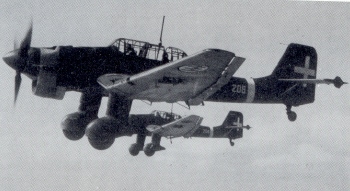 208° Sq., 101° Gruppo Ju.87s. This unit was active over Greece.

|
Giulio Gobbi is 43 years old and is a Senior Software Analyst who lives and works in Rome. Giulio has been married to his wife
Nadia for 15 years and is the proud father of two beautiful children, Elena (12) and Leonardo (8). His many interests include Italian
history, aircraft, modeling, math and music. Giulio is also a Webmaster of Modellismo Piu, M+ (www.modellismopiu.com), the largest online
modeling website in Italy. Giulio spends his free-time on historical research, static modeling and playing the guitar.
|
|
|

|