|
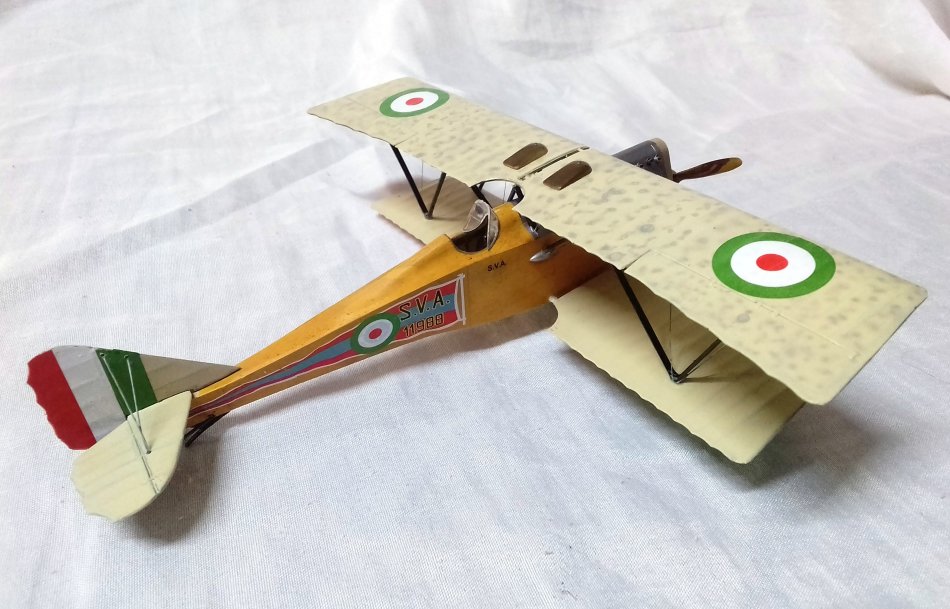
Fly Models 1/48 Ansaldo S.V.A.5 Late Reconnaissance by Vince Fiore |
|

Click the STORMO! Eagle to return to the Gallery |
|
After a flight of 3.5 hours, eight planes of the L'Aviazione Italiana 87a Squadriglia appeared in the sky over Vienna at 9.20 am on August 9, 1918. For half an hour the planes flew in close formation over the Austrian capital, dropping leaflets and taking photographs. At 12:40pm, seven of the eight S.V.A.s returned to their base at San Pelagio. They had flown more than 620 miles (1,000 km), almost 500 (800) of them over enemy territory. The plane flown by Lieutenant Giuseppe Sarti had engine trouble and had to land near Wiener-Neustadt just outside Vienna. This flight was arranged by the poet Gabriele d'Annunzio. One of the S.V.A. 5s had been modified from a single-seater into a two-seater to accommodate d' Annunzio and the pilot, Captain Natale Palli. The other planes were all single-seaters. An extra 66-gallon (300-litre) fuel tank had to be installed for this flight. Much of the S.V.A.'s renown is linked to that peaceful air raid over Vienna, but the plane was outstanding in its own right. It was generally considered one of the war's best light bomber and reconnaissance planes. It was designed by Umberto Savoia and Rodolfo Verduzio, with the assistance of Celestino Rosatelli, who was later to design many famous planes himself. The prototype made its first flight on March 19, 1917. In military evaluation trials, it proved to be very fast and strong, but not sufficiently manoeuvrable (the preference of Italian pilots) to make it a fighter plane. As a result, the S.V.A. was assigned to reconnaissance duty. The first version was the S.V.A.4, which was followed by the S.V.A.5. The main difference between the two models was the fuel capacity (four hours endurance for the S.V.A. 4, six for the S.V.A. 5) and the armament. In service from February 1918, the single-seater S.V.A. equipped six reconnaissance squadrons. Its performance was excellent, and the plane completed many outstanding flights, carrying out such exceptional missions including the reconnaissance flight of Locatelli and Ferrarin over Friedrichshafen on May 21, 1918, a flight of about 435 miles (700 km). Two new versions of the plane were developed at the same time, both of them two-seaters: the S. V.A.9 and the S.V.A. 10. The S.V.A.9, a trainer, was without armament had double controls and had a shorter range than the S.V.A.5. The S.V.A.10 was designed for armed reconnaissance and light bombing, and went into action during the last months of the war. About 2,000 S.V.A.s. were built, and they saw service until the 1930s. In 1920 Ferrarin and Masiero flew an S.V.A. from Rome to Tokyo. Source: Angelucci, E. and P. Matricardi, Origins-World War 1, Sampson Low Guides, Berkshire, 1977 |


|
|
|

|

|
|
|
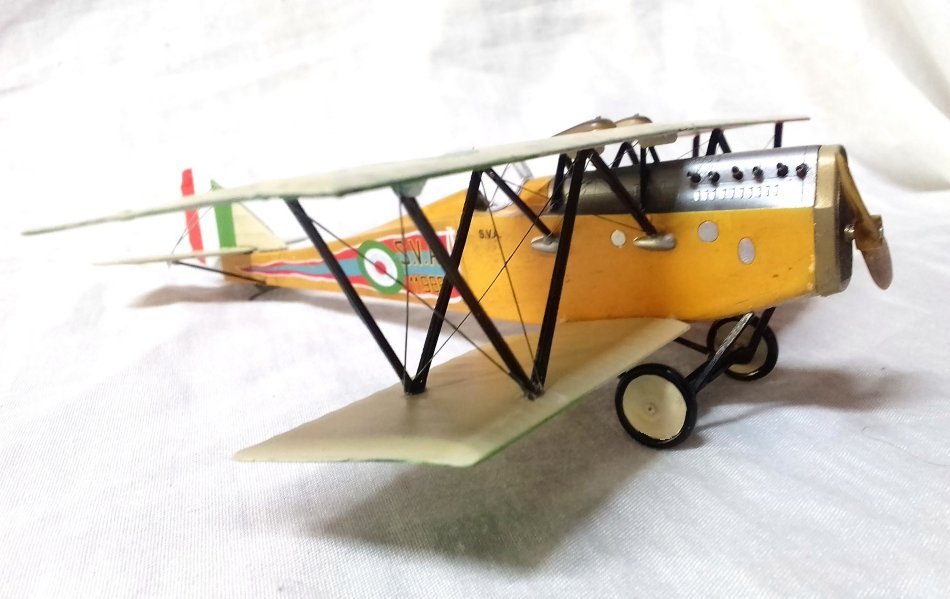
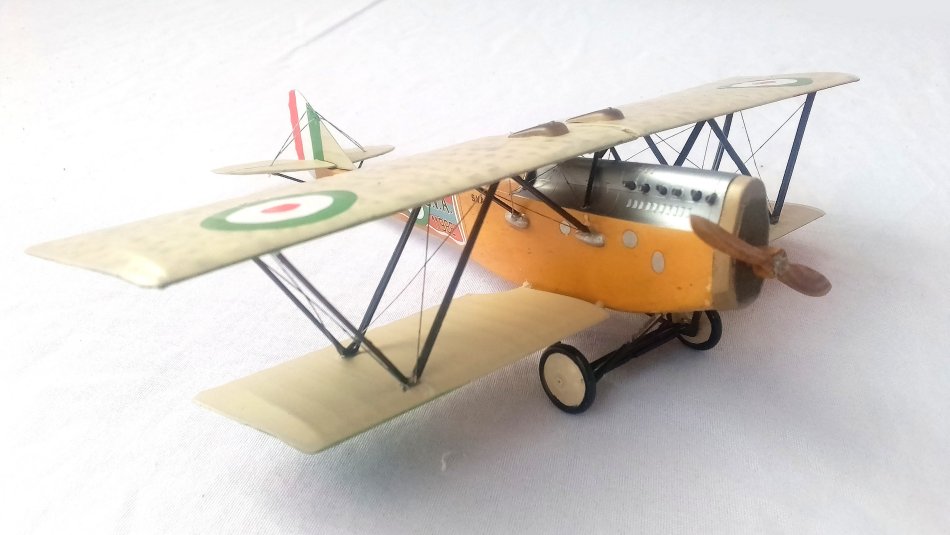
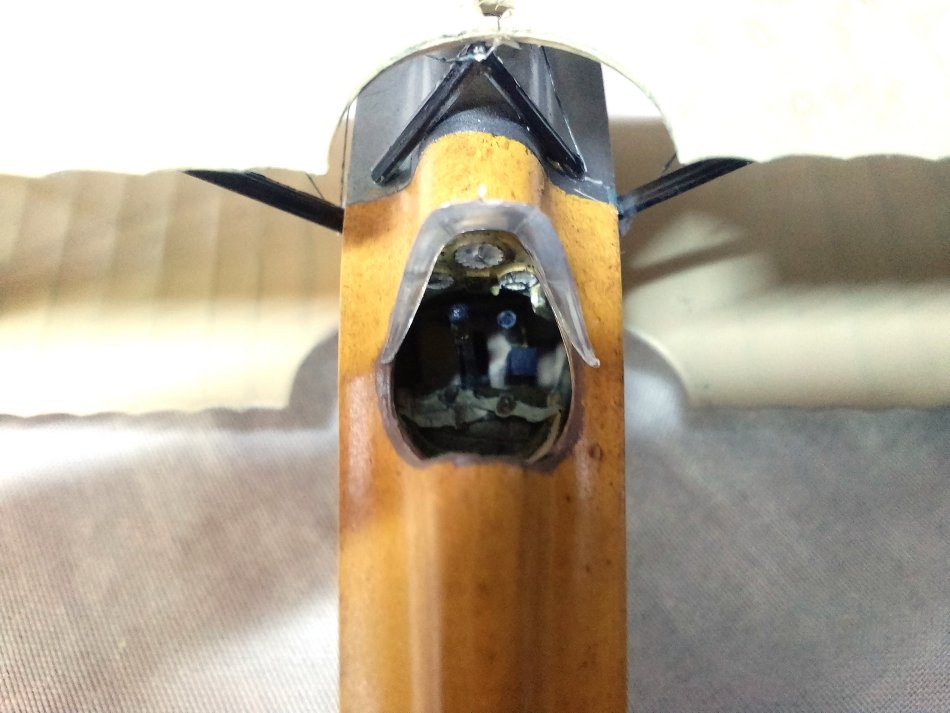
This is the Fly Models Ansaldo S.V.A.5 Late - 1/48 - FLY48007. First, let me say this is not a fun build. The fit is really good and true to scale but because of this, the top wing is held together by two very thin little pieces of plastic which were both broken. This forced me to glue the wing together with two clear pieces of clear sprue. Next, the lower wings have two tiny plastic extensions that fit into tiny holes into the fuselage. This makes for a very frail attachment. However, when the struts are glued this makes for a strong wing to the body to wing bond. I started with the carpet assembly. Painted the inner fuselage, inserted the carpet and glued the body together. I had never tried to simulate wood grain panels before so I decided to try on this kit. I used Mister paint as my base color Giallo Mimetico. Next, I placed a dab of oil Van Dyck brown on a piece of cardboard to get some of the oil to leach out. I sectioned out a panel and then applied with a fan art brush tiny specks of oil paint. Next, I removed as much of the paint from the brush and proceeded to brush in one direction. To my great surprise and pleasure, I was very pleased with the results. I then proceeded to do the rest of the fuselage. I now proceeded to the wings. I masked between the wing ribs. Applied black to the rib removed type and proceeded to apply a light coat of Mister Hobby sail color. Next painted the red and green bottom of wings color. Here I used Misterkit acrylic paints. I painted the struts Mister hobby black. Now the fun begins thought. However much to my surprise, everything went very well. I used thick superglue to glue the struts. I should have applied the rigging before I affixed the top wing, but in my haste, I skipped this step, much to my regret. I used stretched sprue for the rigging. When it dried I painted the rigging dark gray because in my opinion black is too harsh. Now the hard part. The wheels are held onto the axle by a very thin tiny piece of plastic. Needless to say, I broke one of the pieces. I had to add a reinforced axle and this created a big problem. The decals went on easily with the exception of one of the long banners, which broke into three pieces. Mr. Hobby's softener and setter were used on the decals. Happy Modeling, Vincenzo
|
Aircraft: Ansaldo S.V.A.5 Manufacturer: Societa Giovanni Ansaldo Type: Reconnaissance Year: 1918 Engine: S.P.A. 6A 6-cylinder liquid-cooled inline, 220 hp Wingspan: 29 ft 10.25 in (9.1 m) Length: 26 ft 7 in (8.1 m) Height: 10 ft 6 in (3.2 m) Weight: 2,315 lbs (1,050 kg) Maximum Speed: 143 mph (230 kph) Ceiling: 21,980 ft (6,700 m) Endurance: 6 hrs Armament:2 machine-guns Crew: 1 |
|


|



|



|
|
|
|
|
|
|

|

|
|
|
|
|
|
|
|
March, 2023 STORMO! © 2023 |