|
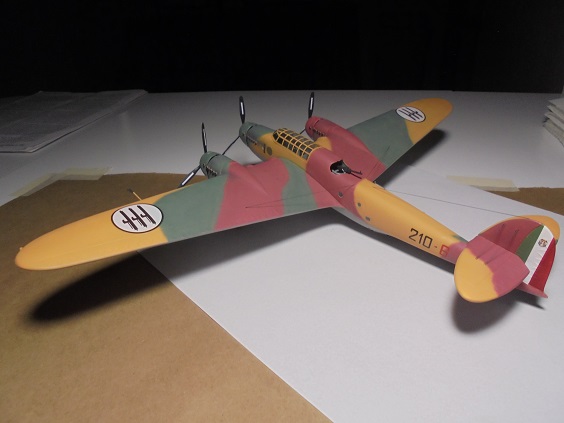
Broplan 1/72 CANT Z.1007 I.F. Asso Alcione (Kingfisher) by Richard Mendes |
|

Click the STORMO! Eagle to return to the Gallery |
|
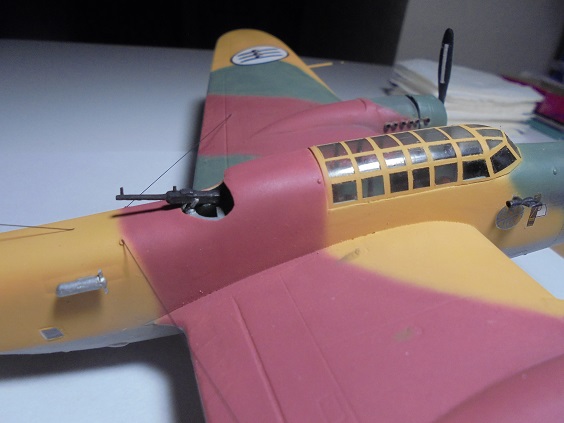
The Cantieri Aeronautici e Navali Triestini (CANT) Z.1007 Alcione (Kingfisher) medium bomber based on the Z.506 Airone (Heron) seaplane were amongst the largest wooden aircraft to see combat during the 20th Century, both planes designed by Filippo Zappata (1894-1994). A further development of the plane, the CANT Z.1007bis had "excellent flying characteristics and good stability" [1] and is regarded by some as "the best Italian bomber of World War II." In 1935 Zappata designed the three-engine monoderiva (single-tail) Z.1007 and the twin-engine bideriva (twin-tail) Z.1011. Both planes were powered by Isotta-Fraschini Asso XI inlines. The Z.1007 first flew on March 1937 (MM.337) one year after the Z.1011 and twenty-nine months after the Z.506 Airliner (MM.291). The Z.1007 "Asso" design and performance was superior to the Z.1011 which resulted in the Regia Aeronautica ordering 18 aircraft on January 9, 1936 and a further 16 on February 23, 1937, deliveries taking place between February-October 1939. The Z.1007's handling and manoeuvrability were praised but its performance was lower than predicted and Zappata therefore started a major redesign of the Z.1007, production of the initial version being limited to the existing orders placed before the prototype flew. The mid-wing Z.1007 Asso was aerodynamically cleaner than its contemporary, the mixed steel tube and sheet, wood and fabric Savoia-Marchetti S.79 though its wooden construction entailed having to employ specialized wood working labor. Asso aircraft could carry 2,000 lbs of ordnance in a long, shallow horizontal bomb bay, defensive armament being one 12.7mm machine gun in an open dorsal position (on a rearward facing fuselage dorsal Scarff Ring) and a 7.7 mm machine gun in a ventral tunnel (on flexible mounts), crew armor protection also being provided. In May 1939 the first Z.1007 Asso aircraft equipped the 210° Sq. and 211° Sq. of 50° Gruppo and then in August 212° Sq. and 213° Sq. of 51° Gruppo, both Gruppi of 16° Stormo. References [1] De Marchi and Tonizzo 1994, p. 31. |

|
|
|
|
|
|

|

|
|
|
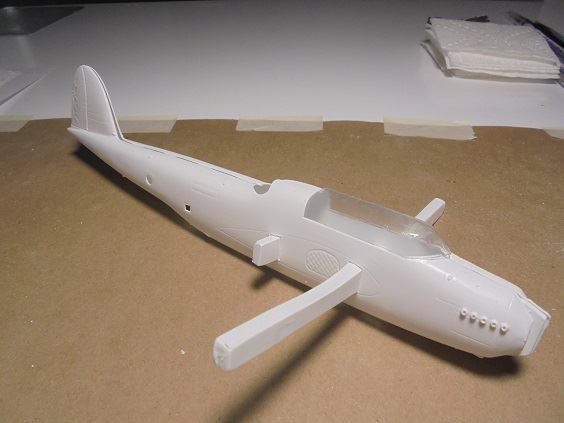
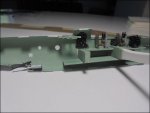
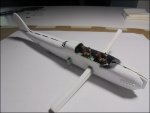
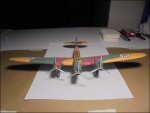
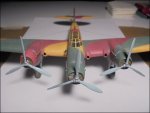
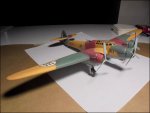
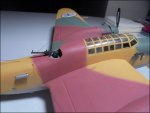
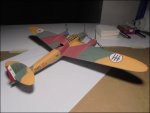
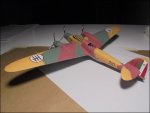
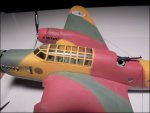
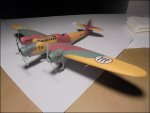
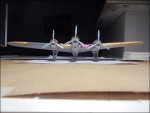
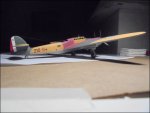
The early 2000s-vintage 1/72nd scale Polish BroPlan MS-97 CANT Z.1007 with vacuform styrene plastic and injected-plastic parts is the only model kit of the Asso variant in any scale. Adequately molded with more fuselage crew cabin detailing than 1973-vintage 1/72nd SUPERMODEL CANT Z.1007bis all injected-plastic models the Broplan kit lacked a Pitot tube, mainwing navigation lights et. al. parts that had to be scratch-fabricated well as (mostly) unusable inkjet-printed water decals though atypical of vacuform and resin model kit makers provided useable well as helpful assembly instructions.
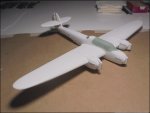
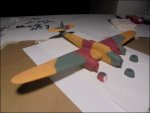
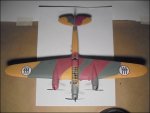
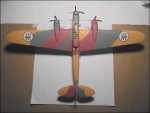
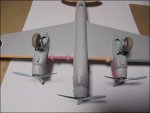
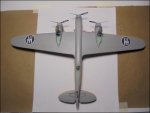
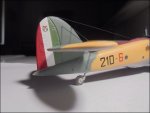
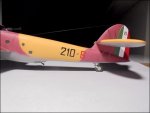
To my eternal relief the model build went well though punctuated by tense moments whilst assembling the fuselage and mainwing halves with cut styrene plastic positioning and retaining tabs similar to those for the resin Cunardmodel Piaggio P.108T fuselage in 2019, mainwing engine/landing gear nacelles, engine radiator/cowling, landing gear et. al. assemblies. Gluing on the long “greenhouse” canopy over the fuselage crew cockpit was fully expected to be a disaster though came off near perfect thanks to extra-careful knife-trimming and sand-shaping work, strategic placement of cut plastic alignment tabs inside fuselage cockpit sides keeping it in place, same couldn’t be said gluing the fuselage dorsal gun station transparency on the starboard side cracking off whilst cutting it of the vacuform molding sheet leaving a glue scar whilst putting it back together. Gluing engine radiator/cowling assemblies on mainwing engine nacelle and fuselage nose mounts entailed lots of trimming work to fit squarely on, lots of work as well gluing on eight closely-spaced EZ Line stretch threads on rudder sail and tailplanes replicating bracing wires. Paint Painting the Z.1007 Asso mainwing, fuselage and engine/landing gear nacelle interiors was straightforward; Humbrol, Testors and Model Master enamels replicating Verde Anticorrosione along with Brass, Rust, White, Yellow, Dark Gray et. al. detailing colors. Painting the model exteriors entailed good deal of Internet research concerning mimetico colors and schemes, period photographs suggesting CMPR-GAVS Schema A5 tri-color bands similar to those on early production Savoia-Marchetti S.79s well as on the BroPlan kit instructions, i.e. CMPR-GAVS specifying Giallo Mimetico 3 (GM3), Verde Mimetico 53192, Marrone Mimetico 53193, Broplan GM3, Verde Mimetico 2, Marrone Mimetico 2, chose BroPlan’s on assumption “they did their homework” with regards to coloration research. Just as important was verifying topside mimetico and Grigio Mimetico underside color separations were soft-edged per period photographs; little overpainting necessary spraying on bands and underside Grigio Mimetico, fate smiles! Decals Water decal markings for the BroPlan Z.1007 Asso model included spare SUPERMODEL Z.1007bis kit 210° Squadriglia codes and stylized fuselage fasci, large Tauro 72-554 mainwing tri-fasci and House of Savoy rudder markings approximating those seen on Alciones the BroPlan kit decals unusable other than the manufacturer’s stylized logos successfully transferred onto the model’s forward fuselage sides underneath the cockpit windscreen after several heart-stopping tries the entire model subsequently spray-sealed with Testors Clear Semi-Gloss lacquer on September 12, 2020.
|

Aircraft: CANT Z.1007 Asso Manufacturer: Cantieri Riuniti dell'Adriatico Type: Bomber Year: 1937 Engine: Three Isotta-Fraschini Asso XI RC.40, supercharged V12, water-cooled, 730 hp each Wingspan: 78 ft 7 in (23.95 m) Length: 51 ft 10 in (15.80 m) Height: 16 ft 6 13/16 in (5.05 m) Weight: 27,000 lb (12,300 kg) (Loaded) Maximum Speed: 267 mph (429.69 km/h) at 16,404 ft (5,000 m) Ceiling: 21,800 ft (6,650 m) Range: 1,740 miles (2,000 km) Armament: 7.7mm MG (ventral) + 12.7 MG (dorsal); 1,760 lb (800 kg) of bombs Crew: 5
|
|
|





|
|
|
|


|


|
|
|
|
|
|
September, 2021 STORMO! © 2021 |