|
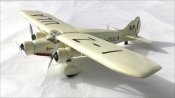
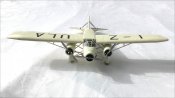
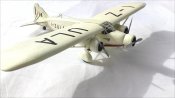
Broplan 1/72 Caproni Ca.133 (Passeggeri) Civil Transport by Vincent Fiore |

|

Click the STORMO! Eagle to return to the Gallery |
|
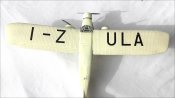
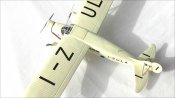
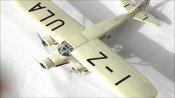
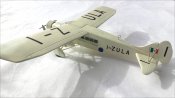
The Caproni Ca 133 underwent many years of service as a civil transport plane, especially on African routes, before seeing war service in East Africa and Russia. Of about 275 Ca 133s manufactured, most were earmarked for military service as transport, logistical support and paratroop planes. But more than a dozen were delivered to Ala Littoria, which kept them in service until just before World War II. The Caproni Ca 133 was a direct development of the 1930 Caproni Ca 101, an all-metal fabric-covered high-wing monoplane. There were several models of the Ca 101, differing in number (one or two) and power of engines installed, e.g. the 200 hp Alfa Romeo, the 370 hp Piaggio Stella, and the 240 hp Walter Castor. Most of the Ca 101s were also military aircraft, but a few were used by the Societa Nord-Africa Aviazione, Ala Littoria, and SAM, which flew eight passengers at a time on East African flights. The military version, powered by three 270 hp Alfa Romeo engines, were assigned to some night bombing units of the Italian air force. This aircraft had two or three machine guns, mounted on the back and sides, and could carry a payload of one-half ton of bombs. The Ca 101 saw combat first in the Ethiopian campaign and, despite its obsolescence, was in service during the first years of World War II. In 1935 an improved version of the Ca 101 was developed, the Ca 133. The two aircraft were conceptually identical, including the same structure and configuration, and even the same wing. But the Ca 133 was a significantly superior plane, both in aerodynamic form and in power. The Ca 133 was powered by three 460 hp Piaggio P.VII C.16 engines, smoothly housed in pods suspended from the fuselage. It was a high-performance plane and could carry a larger payload than its predecessor. The passenger version of this aircraft, which was used on routes connecting Rome with Italian colonies in Africa, could carry eighteen passengers plus a two-man crew. The military version carried eighteen fully equipped servicemen. The Ca 133 saw service throughout World War II on all fronts: in Africa, Albania, Greece, and Russia. Twelve Ca 133s took part in the Italian campaign over the English Channel, the Italian air corps' Belgian operations in October 1940. Ca 133s also provided logistical support for a short time for the fighter squadrons that flew alongside the German Luftwaffe. |

|
|
|
|
|

|
|
|
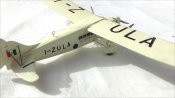
Upon completion of the construction I discovered there was a descrepency in the height of the gas tank. One side it was too low. I cut a thin sheet of plastic to the proper dimensions and glued it to the top of the gas tank and that solved the problem. After priming and painting I removed the masks from the clear parts, much to my horror I discovered I had forgot to remove the masking tape from the inside clear parts. I put the kit aside for a month or so. I pondered the situation for a while, and deceided to cut an opening in the bottom of the fuselage. I then removed the masking tape and closed up the opening. A very big problem was the framing of the cockpit which is very light. There are no aftermarket masks so I had to come up with a solution. After some trial and error I deceided to paint some stripes of scotch tape, cut it to the proper thickness and apply it. To my delight it worked very well as compared to my first attempt of trying to use clear painted decal stripes. Future wax was applied before decaling. I used aftermarket decals for the registration code letters. Things to do better: if I build another Ca.133 I would do a better job on the two bladed propellers by shortening them. |

Aircraft: Caproni Ca 133 Manufacturer: Societa Italiana Caproni Type: Civil transport Year: 1935 Engine: Three Piaggio P.VII C.16, 7-cylinder radial, air-cooled, 460 hp each Wingspan: 69 ft 8 in (21.23m) Length: 50 ft 4 in (15.34m) Height: 13 ft 2 in (4.00m) Weight: 14,800 lb (6,700kg) Cruising speed: 143 mph (230 km/h) Ceiling: 18,000ft (5,500 m) Range: 840 miles (1,350 km) Crew: 2 Passengers: 16
|
|
|
|
|
|
|


|


|
|
|
|
|
|
September, 2022 STORMO! © 2022 |