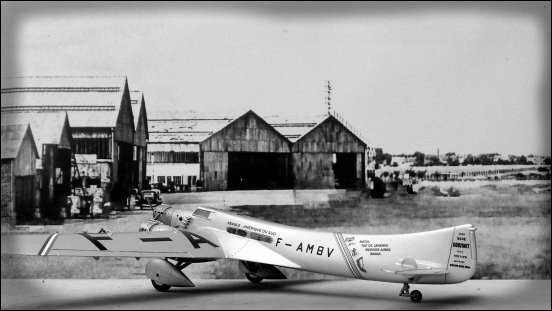
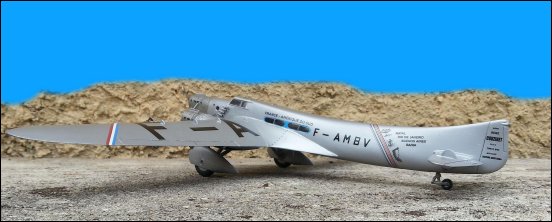
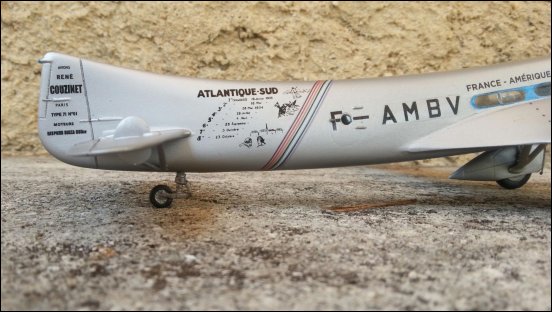
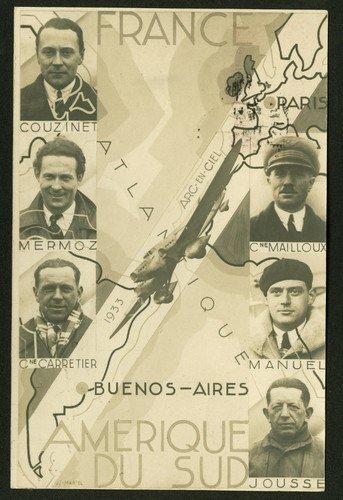
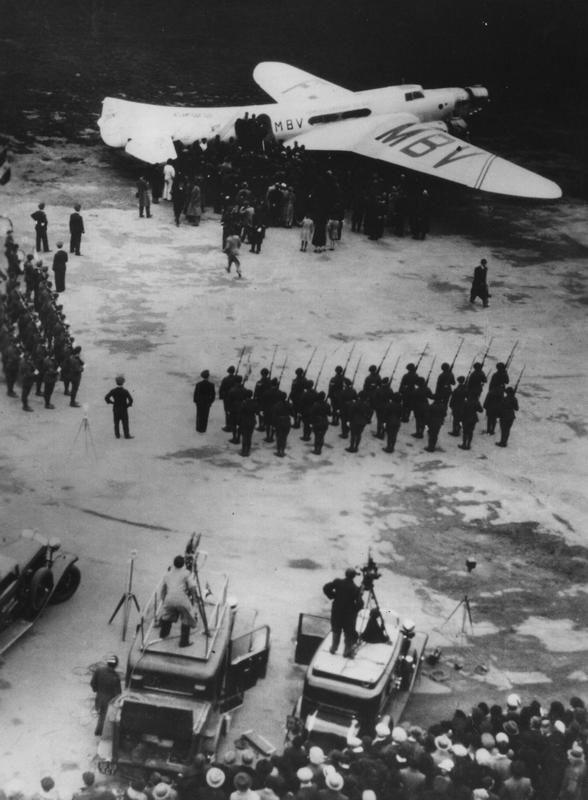
Designed for transatlantic postal service, the Couzinet Arc-en-Ciel (Rainbow) went into service with
Aeropostale, alongside the Latecoere 300 Croix du Sud (Southern Cross) hydroplane, on the long route between
St. Louis, Senegal, and Natal, Brazil. Only one Arc-en-Ciel was ever built, and it was modified several times. In
the last five months of 1934, it completed eight Atlantic crossings. But the most noteworthy flight took place on
January 16, 1933, when the pilot Jean Mermoz and three crew members inaugurated the South American route
by covering the distance between St. Louis and Natal in 14 hours and 27 minutes.
The Couzinet 70 was the result of a design that the twenty-three-year-old Rene Couzinet developed in 1928 in
collaboration with Marcel Maurice Drouhin. Their plan was to construct an aeroplane that could make the
Atlantic crossing from east to west. Drouhin and Couzinet were so enthusiastic that they launched a public
collection throughout France to get the necessary funds to construct the plane. Two million francs were collected,
and the first Arc-en-Ciel was built. In August 1928, the plane crashed during a test flight, and Marcel
Maurice Drouhin was killed. A second model was destroyed by fire.
Couzinet could not be stopped. Though mourning the death of his friend, he continued to design planes
modelled after his original project. The 70 type, also called Arc-en-Ciel, was built expressly for the
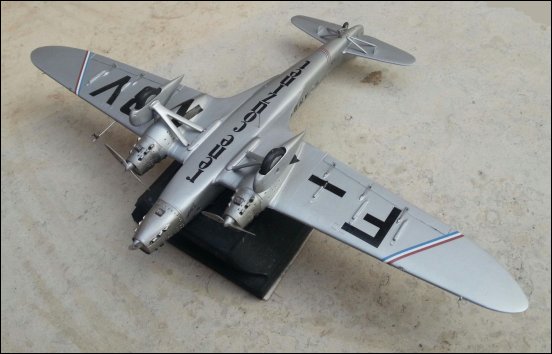
trans-Atlantic service of Aeropostale. Just like its prototype, this plane was a low-wing monoplane powered by
three 650 hp Hispano-Suiza engines. The hull was broad and the under-carriage was fixed. But the lines of the
plane were rather unusual. In particular, the fuselage was altogether original in shape. Its continuous vertical
tapering, including the rudder, acted as a drift board. The wings were very thick and they were made heavier by
the large engine housing, and the undercarriage was almost as long as the wing was broad. The whole plane
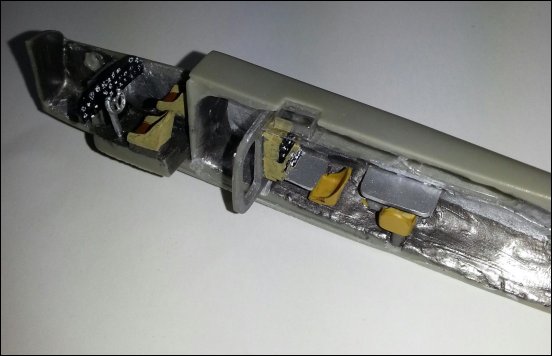
was covered in wood. There was accommodation for four crew members and a cabin for cargo, with three
windows on each side.
After Mermoz's inaugural flight, the Couzinet 70 was extensively modified and renamed Couzinet 71. The
fuselage was lengthened, the tail structure was altered, and the three-blade propellers were replaced by two-blade
propellers. Both the 70 and 71 had metal propellers. Thus remodelled, the Arc-en-Ciel began its regular postal
run to South America on May 28, 1934. Beginning in June of that year, there was a monthly Atlantic crossing.
Early in 1935, the plane was overhauled once again. The under-carriage fairings were removed, and
trimmer engine housings were introduced, while the radiators were moved.
|