|
Hasegawa 1/48 Macchi C.202 Serie III Folgore (Thunderbolt) by Marco Bossi |

|

Click the STORMO! Eagle to return to the Gallery |
|
One of the best fighters of World War II, this classic fighter possessed a great rate of climb, high speed and maneuvreability and was a first-rate aircraft on all counts. The Macchi C.202 was the contemporary of the Bf.109F and the Spitfire Mk.V and in certain aspects the aircraft was superior to both, such as in the rate of climb, dive speed and agility. Both the Macchi and the Sptifire shared a common lineage in the Schneider Trophy racers. In fact the Supermarine (Spitfire) designs were largely influenced by the Macchi M.39. The C.202 was used extensively in North Africa, the Soviet Union and in defense of the homeland and was Italy’s best fighter of WWII, although more powerful fighters had been produced later in the war. Over 1,150 C.202s were built in little over two years. Although often overlooked, the two Breda 0.50in caliber SAFATs provided adequate firepower and had double the range of contemporary English fighter 0.303 MGs as well as greater hitting power. In fact no formal request for heavier armament was made until the appearance of the American four-engine heavy bombers. The Folgore was well liked by its pilots and its only shortcoming was that too few were built. In Africa The three C.202-equipped Gruppi in North Africa at the end of 1941 found themselves compelled to withdraw across Libya in front of the advancing Commonwelath forces. 9° Gruppo engaged RAF Tomahawks the day after arriving at Martuba, 26 November. There followed a tough month of combat and retreat before it finally turned its surviving C.202s over to 1° Stormo and returned to Italy to join its mate at Gorizia. When the front stabilized at EI Agheila on 8 January 1942, the two remaining Gruppi could only muster a total of 25 C.202s. In late January 1942, when Rommel took the offensive again, 1 °Stormo had its 6° Gruppo at Ara Phileborum and 17° at Tamet. They started 'freelance' hunting missions in concert with JG27 Bf109s, leaving the remaining Italian aircraft in Africa, CR.42s and C.200s, to ground attack duties. With Rommel's advance 1° Stormo moved forward, occupying Benghazi K3 field. Through the rest of the spring of 1942 the front remained quiet, allowing both sides to rest and build strength.
On 26 May Rommel again struck. 4° Stormo had meanwhile returned, now with both Gruppi C.202-equipped. The two Stormi were joined in a 'Brigade' led by Lt. Col. Alfredo Reglieri, 1° Stormo commander. Based at Martuba, they had a strength of over 60 aircraft. Their task was to clear the air of the RAF, allowing Stukas and the older Italian fighters to attack without interference. At dawn on the 26th, 59 C.202s strafed No.250 Squadron Tomahawks at Gambut, to start the offensive. They were then directed to gain air superiority over Tobruk and Bir Hacheim, which they were able to do. Both fortresses fell before the end of June. Over 1000 sorties were flown by C.202s during this period, only 17 of their number being lost. During June, 1° Stormo returned to Italy, being replaced by 3° Stormo, whose 18° Gruppo was still in C.200s but whose 23° Gruppo had received C.202s in May. The new Stormo went to Abu Haggag, 4° moving to Sidi el Barrani and then Fuka. Abu Haggag and Fuka were on the Mediterranean coast between Marsa Mattruh and El Alamein, where the British retreat had finally stopped. The total number of C.202s in Africa peaked at 93 on 15 July 1942. In all, the RA had 25 bombers, 90 ground attack aircraft and the 93 C.202s, 46 C.200s and 43 G.50s, a total of 297 aircraft ready for the decisive battle at EI Alamein. By autumn 1942, RAF Liberators and Spitfires had reached the Western Desert, new and formidable opponents for the C.202s. Having held off Rommel's July and August attacks at El Alamein, Montgomery prepared his counterstroke for late October. In preparation for that offensive, the RAF attacked Axis airbases, striking Fuka and Abu Haggag on 20 October. A number of 3° and 4° Stormo Folgores were destroyed on the ground. Montgomery finally attacked on 23 October 1942. In the last days of October, between aerial combat and RAF strafing, the two C.202-equipped Stormi lost 15 in the air and four on the ground with a further 46 damaged. They were soon forced to retreat along with the general Axis withdrawl. 4° Stormo passed its remaining serviceable Folgores over to 3° Stormo which now had both its Gruppi in C.202s. 3° Stormo then continued the fighting retreat across Libya. Its continual harrassment of the British advance was instrumental in allowing the Axis to hold the British advance at Mareth on 16 February 1943. In late November 1942, 4° Stormo returned to the fray with new C.202s, supplementing 3° Stormo which was gradually being depleted of aircraft. 4° Stormo kept on with the fight into the second half of December when its 10° Gruppo gave its remaining fighters to 9° Gruppo and again returned to Italy. Until New Year's, 9° Gruppo flew sorties from Misurata and Castelbenito in the defense of Tripoli but was again forced to withdraw in January. At that time 9° Gruppo once more turned its remaining Folgores over to 3° Stormo, once more leaving that unit as the last C.202 unit in Africa. 3° Stormo was at Medenine, Tunisia at the end of January 1943 where it finally was able to hold, and where it encountered USAAF fighters, P-38s, for the first time. Source: [1] Gentilli, R. and L. Gorena, Macchi C.202 in Action, Aircraft No.41, Squadron/Signal Publications, Texas, 1980 |

|
|
|
|
|
|
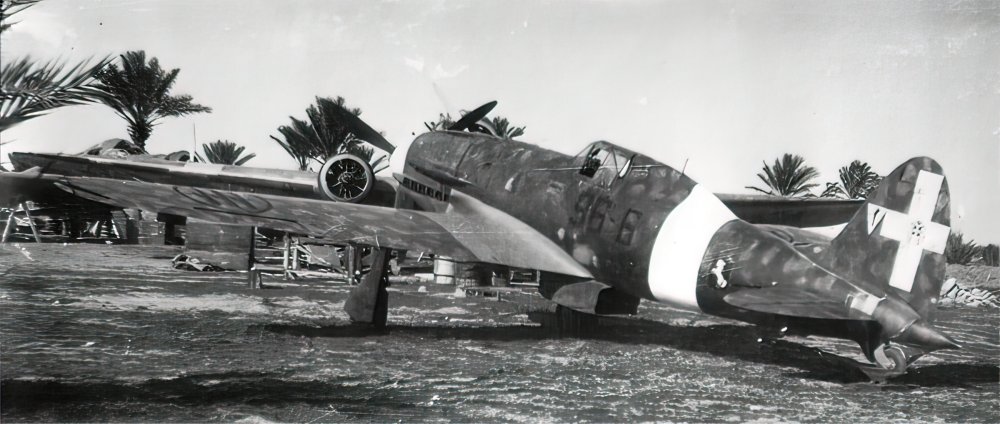
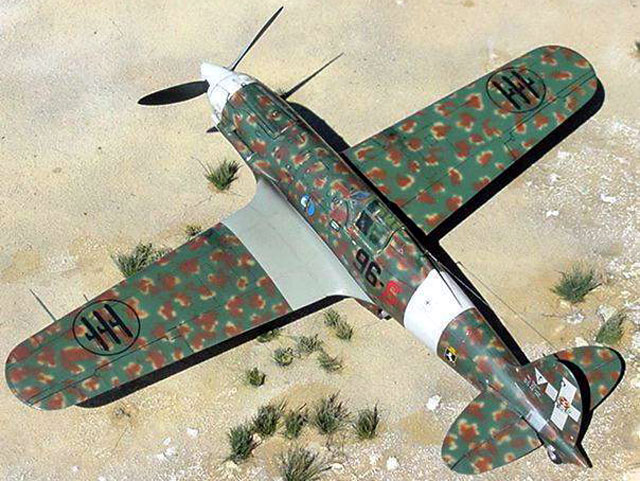
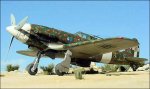
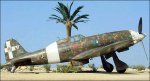
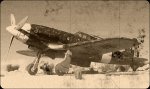
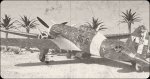
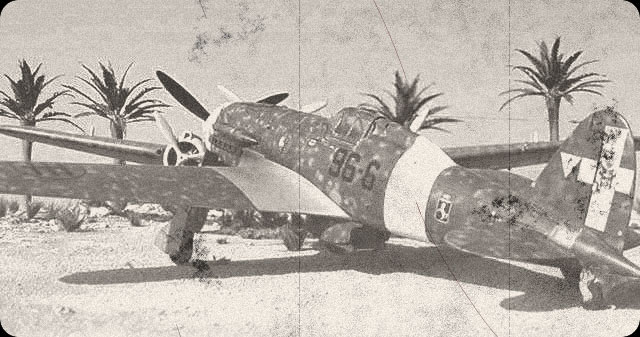
Here is Hasegawa's 1/48 scale Aermacchi C.202 "Folgore". This is C.202 MM.7726, 96^ Squadriglia, 9° Gruppo Caccia Terrestri, 4° Stormo, Libia 1941/42. OOB with the camouflage as in Ali e Colori n.4, Aer.Macchi C.202, Profile 11 La Bancarella Aeronautica and also seen in the front cover of the old Squadron Signal No.1041.
The camouflage consists of standard network scheme CMPR C8 nicknamed "poached egg". This comprises a base of giallo mimetico 4, bruno mimetico, verde mimetico 2 and grigio azzurro chiaro 1 undersides. The colors used are "humbrol". The shaded stains are made using a brush diluting the color with kerosene and applying it in small drops, patiently waiting for it to dry. The plane in the background of the diorama is a 1/72 Supermodel Cant. Z.1007, although in reality it was likely a SM 79. The palm tree is scracth-built in 1/72. References: 1) Macchi C.202 – 205 in action - AIRCRAFT No.1041, Squadron/Signal publications 2) Aer.Macchi C.202 – Ali e Colori 04, La Bancarella Aeronautica 3) Aer.Macchi C.202 – Ali d'Italia 02, La Bancarella Aeronautica 4) Storia Militare No. 111, Albertelli Edizioni Speciali SrL 5) allot of photos |
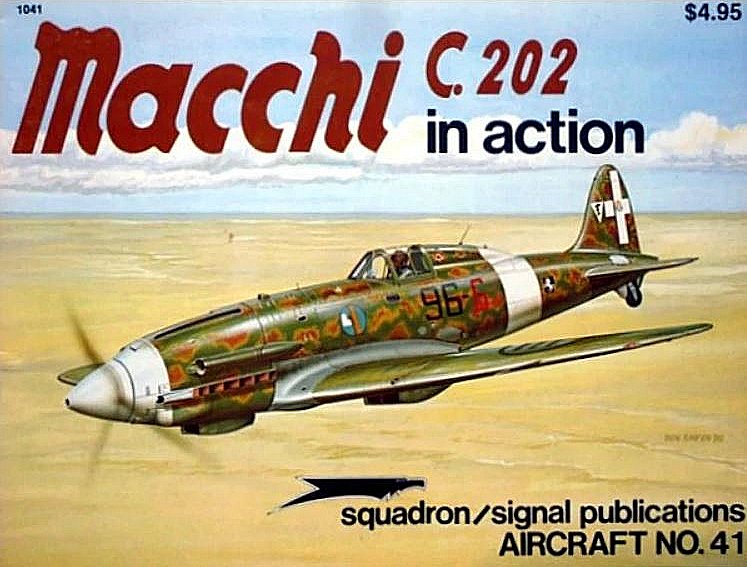
Aircraft: Macchi MC.202 Manufacturer: Aeronautica Macchi S.p.A. Type: Fighter Year: 1941 Engine: Daimler Benz DB 601A-1, 12-cylinder V, liquid-cooled, 1,175hp Wingspan: 34 ft 8 1/2 in (10.57m) Length: 29 ft 1 in (8.85 m) Height: 9 ft 11 1/2 in (3.02 m) Weight: 6,480 lb (2,937 kg) (Loaded) Maximum Speed: 372 mph (600 km/h) at 18,050 ft (5,500 m) Ceiling: 37,700 ft (11,500 m) Range: 475 miles (765 km) Armament: 2 x 12.7 mm SAFATs (0.5 in) Crew: 1 |
|



|
|
|
|
|


|


|
|
|
|
|
|
|
|
November, 2023 STORMO! © 2023 |