|
Special Hobby 1/72 Piaggio P.108B Serie I Bombardiere (Bomber) by Guy Shepherd |
|

Click the STORMO! Eagle to return to the Gallery |
|
The Piaggio P.108 B was the only heavy, four engined bomber to see service with the Italian air force (Regia Aeronautica) during World War Two. Due to the lack of production capacity of the Italian aviation industry, too few were built to play a significant role in this conflict. In total Piaggio built only 163 P.108 Bs, but this fact does not make the design less remarkable. The Piaggio P.108 B (Bombardiere) was an all metal cantilever low-wing monoplane with an retractable undercarriage, driven by four Piaggio P.XII RC 35 18 cylinder radial engines, each producing 1350 hp. The first prototype was finished in October 1939 and had a very advanced defensive armament for its day. Not only had the Piaggio two 7,7 mm machine waist guns, a 12,7 mm machine gun in the lower turret and a similar weapon in the nose turret, it also had two remotely-controlled twin gun turrets on the outer nacelle of each wing. The first allied bomber with a similar armament was the Boeing B 29, which was developed four years later. The bomb load of the Piaggio comprised of 3,500 kg, all carried internally in the bomb bay. In comparison, the Boeing B-17 'Flying Fortress' had a maximum internal bomb load of 2,200-kg. The only unit of the Regia Aeronautica to fly the Piaggio P.108 B was the 274a Squadrilia Bombardamento a Grande Raggio (B.G.R.), the 274th Long-Range Bomber Group. This unit was formed in May 1941, around the first machines that came off the assembly lines. After initial training and some familiarization with the plane the group became operational on June 1942. The most spectacular raids with the Piaggio P. 108 B were flown during October 1942, when the Regia Aeronautica launched several night attacks on Gibraltar, from the airfield of Decimomannu on Sardinia. Several versions were derived from the Piaggio P. 108 B, such as the P.108 A (Artigliere), which had a 102 mm anti shipping gun in it’s nose, the P.108 C (Civile) airliner and the P.108 T (Trasporto). The last two versions had a newly designed fuselage of larger diameter, for the transportation of passengers or freight. These planes were hardly used by the Regia Aeronautica, the main user being the German Luftwaffe. In September 1943, after the Italian armistice, the Luftwaffe had captured all fifteen built P.108 Cs and P.108 Ts. They were deployed to the Russian front, as part of Luftflotte 2, where they performed sterling duty, among others during the evacuation of the Crimea in 1944. In 1940 a seaplane version of the P.108 was designed, the P.108 B.I. (Bombardiere Idrovolanti), but this was never developed beyond the stage of a wooden mock-up. |

|
|
|

|
|
|
At first I intended to build the box version which was the P.108B Serie II:
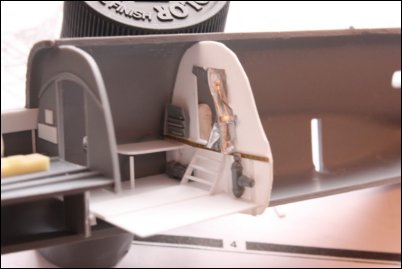
The build went together very easilly with the minimum of filler needed anywhere. I fabricated the room behind the cockpit as i was convinced (albeit stupidly LOL) that it would be visible,
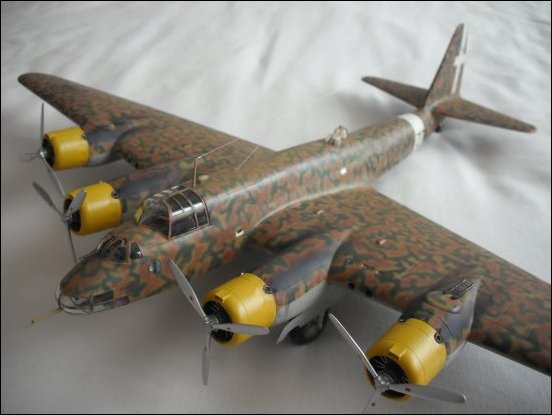
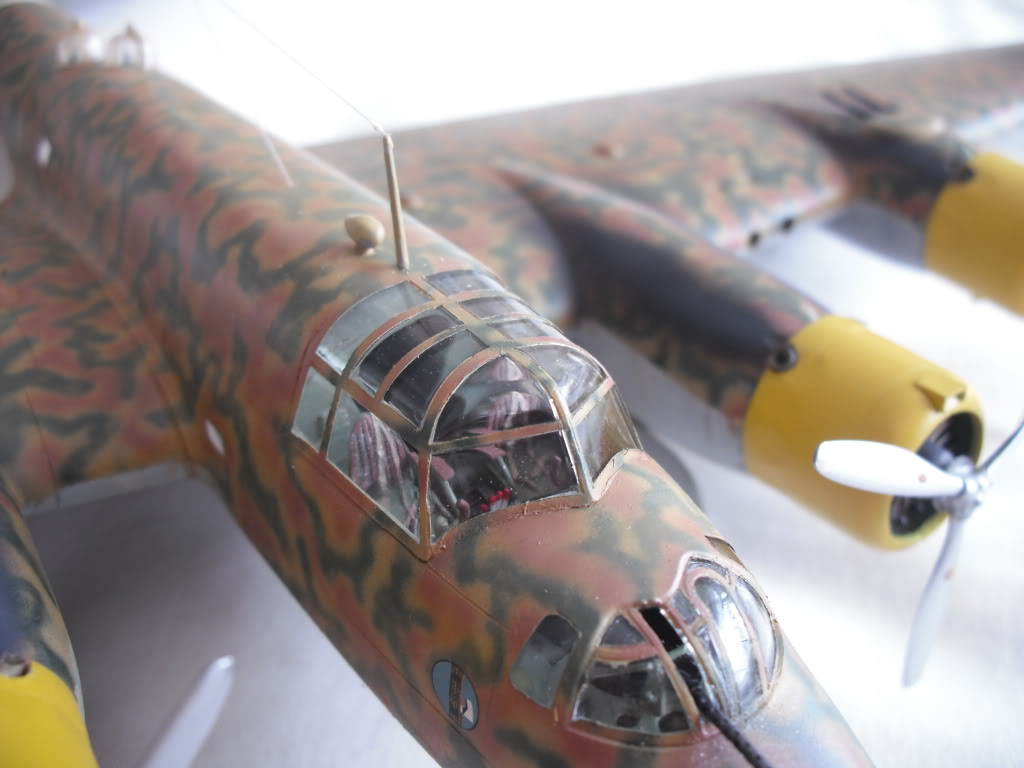
After what seemed like no time at all the plane was ready for paint. The picture of the model that really caught my eye was a profile on Wings Palette https://wp.scn.ru/. This plane was the plane in which Benito Mussolini's son died in a crash landing. For the paint i used Lifecolurs fantastic Italian paints. and Sky models decal sheet 72-019 (Bomardieri Italiani). The camo, the C10A scheme, was fairly complicated but do-able with a litlle forethought and a steady hand. 1st up the undersides were painted Grigio Mimetico, and then masked. Next up I painted the entire top surface Giallo Mimetico 3. Then came the 1st of the tricky bits. I remember reading Jean Barby saying that good references were the key. If Jean says it, its true. Luckilly I had a decent pic from the Ali D'Italia book on the subject. So I attacked the 1st part of the 'Blobbles' the Verde Mimetico 3. Correct pressure and paint mix is the key to this stage also after aboiut 5minutes of painting ensure you wipe the tip of your airbrush to prevent paint build up. After this stage was finished I started on the last 'Blobble', Marrone mimetico. With the painting finished i glossed the whole plane with Future floor polish and decalled the plane. I then gave the panel lines a light panel wash with oils mixed with odourless thinners and then finished off with a flat coat. This was a great build and i highly recommend it to all. |

Aircraft: Piaggio P.108B Manufacturer: S.A. Piaggio & Co. Type: Bomber Year: 1942 Engine: Four Piaggio P.XII RC 35, 18-cylinder radial, air-cooled, 1,350 hp each Wingspan: 105 ft (32 m) Length: 75 ft 2in (22.92 m) Height: 17 ft (5.18 m) Weight: 65,970 lb (29,855 kg) (Loaded) Maximum Speed: 261 mph (420 km/h) at 12.800 ft (3,900 m) Ceiling: 26,400 ft (8,050 m) Range: 2,190 miles (3,520 km) Armament: 8 x 12.7mm BREDA SAFAT machine guns; 7,700 lb (3,500 kg) of bombs Crew: 6 |
|

|


|


|
|
|
|
|
|
|


|


|
|
|
|
|
|
April, 2011 STORMO! © 2011 |