|
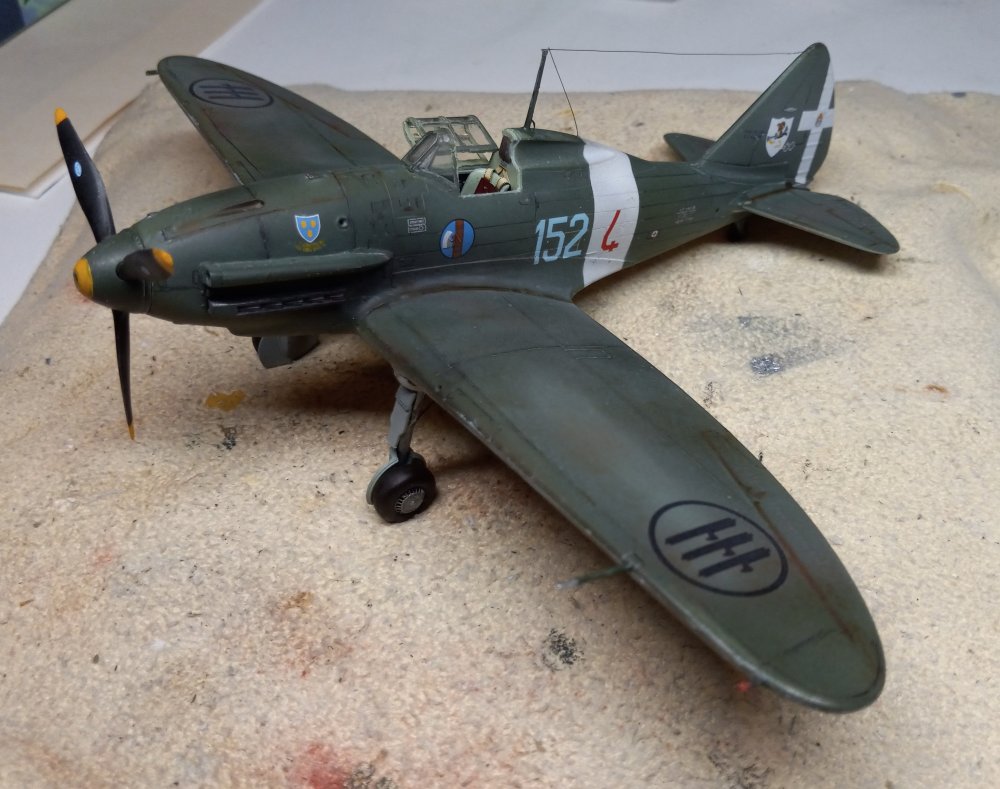
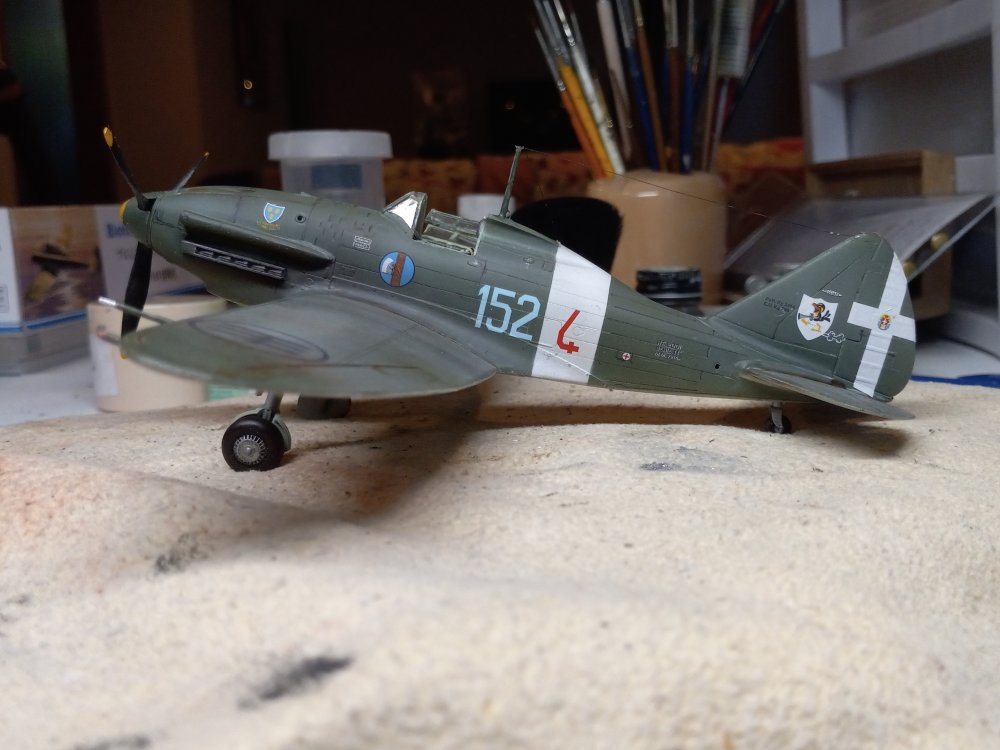
Sword 1/48 Reggiane Re.2001 Falco II Italian Ace Salvatore Teja by Richard Davenport |
|

Click the STORMO! Eagle to return to the Gallery |
|
Caproni-Reggiane's lack of success with the Re 2000 and the availability of Daimler Benz engines led the Italian company to develop a new version of its fighter. The new aeroplane was a marked improvement, and its over-all performance put it in a class with the excellent Macchi MC.202. However, its operational career was limited. There were delays in putting the finishing touches on the aircraft, production was slow, and engines were scarce (priority was given to the Macchi fighter). Although the Re 2001 was designed as an interceptor, it was gradually reassigned to fighter bomber and night fighter missions, and in less than two years a total of 237 planes were built in different versions. The Re 2001 prototype first took to the air in July 1940. The designers, Roberto Longhi and Antonio Alessio, adapted the structure of the earlier Re 2000 to the new in-line engine. They remodelled the fuselage but kept the old wings and tail-plane. An initial delay in finishing the aircraft was caused by the authorities' rejection of the built-in fuel tanks. They had raised the same objecction to the Re 2000. Several months went by before the designers came up with a new solution, and built another prototype. Tests were carried out for some time, and it was June 1941 before the first aeroplanes were delivered. Meanwhile the designers had developed a new version in which the radiators were inside the wings. This seemed to be an extremely promising innovation. The first prototype was altered and called the Re 2001bis. Test flights began in 1941, with Francesco Agello, who had established the world speed record for seaplanes, at the conntrols. This aircraft flew some 40 mph (64 kmh) faster than the standard model, but it never got beyond the prototype stage. Another variant model developed in 1942 also remained in the prototype stage. Because of the delay in receiving the DB engines, the designers found a temporary alternative power plant in the Isotta Fraschini Delta, an air-cooled engine. The Re 2001 Delta, as this variant was called, made a series of test flights late in 1942. It crashed in January 1943, and the production order for 100 aircraft was cancelled. Production of the standard Re 2001 proceeded slowly, always limited by the availability of strategic raw materials. About 40 were built in 1941, a little over 100 in 1942, and the rest in the first half of 1943. Alongside the original fighter version there appeared the CB model, a fighter bomber, and the CN model, a night fighter. The CB had a belly bomb-rack that could carry a 220 pound (99 kg) bomb or a 550 pound (249 kg) bomb. On occasion the aeroplane carried a 1,400 pound (635 kg) bomb. The CN carried two 20 mm cannons in place of the 7.7 mm machine guns of the standard model. A naval version was also considered, and was to have been carried on board the aircraft carriers Aquila and Sparviero. The Re 2001's operational career began in December 1941, when it was assigned to three squadrons. The aircraft were used chiefly in the Mediterranean and over metropolitan territory as night fighters. After the 1943 armistice there were more Re 2001s with the Allies than with the ANR. Five aircraft survived the war and remained in servce for a few years. |
|

|
|
|
|
|
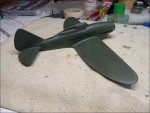
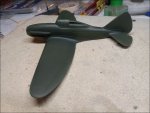
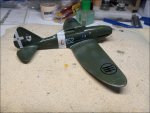
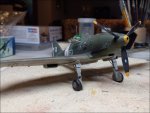
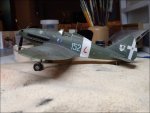
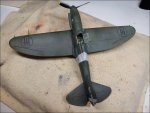
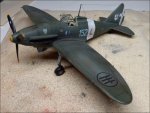
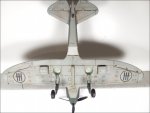
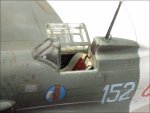
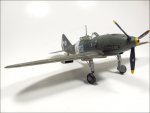
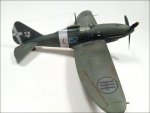
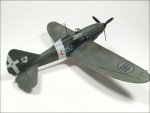
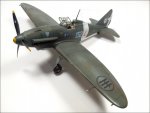
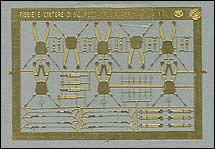
This is the Sword 1/48 kit (SW 4812), using Stormo decals (Stormo! Italian WWII Aces - Part II - 48002) to add this to my Battle of Malta display. I added some "plumbing" to the cockpit, a lens to the gunsight, as well as Eduard seat harness (49105). I deviated a bit from instructions by gluing the upper fuselage from the inside, and then adding the instrument panel and seat from the underside; I think this helped in precise positioning. Being a “short run” kit, it lacks things like locator pins, so precise alignment of the fuselage and wings requires careful attention and patience. I installed the underside of the wings first, insuring the correct position, then added the upper wings. To strengthen the horizontal stabilizer join, I inserted a brass rod through the fuselage to connect both parts. The radiators have prominent ejector pin marks which have to be removed to attach the radiator cores. I opened the gun ports and other vents, etc. in the fuselage. After priming with AlClad II Grey Primer & Microfiller (ALC 302), I painted the underside with LifeColor Regia Aeronautica Grigio Azzuro charo 1 (AU 525) and the topside with LifeColor Regia Aeronautica Verde Oliva Scuro 2 (AU 527). I lightened some of the shading, added the white stripe, and sprayed a light coat of Testors Glosscote to prepare for decals. For this project, I first bought the Stormo decals because they included 152-4, flown by Capitano Salvatore Teja to carry out missions over Malta in 1942. Then I bought the Sword kit, only to discover the kit included decals for the same aircraft! Ah, well. I decided to go with the Stormo decals, which, I believe, are sharper, more detailed and probably have better color register. After I finished the decals, I discovered I had the white stripe in the wrong position! The decals are quite thin; still, it took Micro-Sol and a hairdryer in tandem to get them to settle into contours and panel lines. Another light spray of Testors Glosscote and it’s ready for weathering and detailing. After applying pastels and tempra, I sealed everything with Model Master Acryl Flat Clear. I added bits of brass rod to the landing gear to strengthen the join. Some of the kit bracing rods for the gear were bent, so I replaced these with brass rod. Then came the small details, like navigation lights, pitot, antenna mast, venturi. It’s finished! And, despite the misplaced stripe, I’m pleased with the results. On the whole, the kit was enjoyable. And this will be a good addition to my Battle of Malta display. |

|
Aircraft: Caproni-Reggaine Re.2001 (Falco II) Manufacturer: Officine Meccaniche 'Reggaine' S.p.A. (Caproni) Type: Fighter Year: 1941 Engine: Alfa Romeo RA 1000, RC41-I 12-cyclinder V, liquid-cooled, 1,175hp Wingspan: 36 ft 1 in (11.0 m) Length: 27 ft 5 in (8.36 m) Height: 10 ft 4 in ft (3.15 m) Weight: 6,700 lb (3,040 kg) (Loaded) Maximum Speed: 349 mph (563 km/h) at 17,700 ft (5,400 m) Ceiling: 36,000 ft (11,000 m) Range: 684 miles (1,100 km) Armament: 2 x 12.7 mm (0.5 in) BREDA-SAFAT machine guns; 2 x 7.7mm (0.303) BREDA-SAFAT machine guns Crew: 1 |
|
|
|









|
|
|
|


|



|
|
|
|
|
|
August, 2022 STORMO! © 2022 |