|
Sem Model 1/72 SIAI-Marchetti S.74 Military Transport by Richard Mendes |

|

Click the STORMO! Eagle to return to the Gallery |
|
The Savoia-Marchetti S.74 "Millepiedi" (Millipede) four-engine, 20-27 seat airliner designed by Alessandro Marchetti (1884-1966) first flew on November 16, 1934 powered by 700hp Piaggio P.X nine-cylinder radials. Developed from the 1932-vintage mixed wood and duralumin-constructed S.72 tri-motor heavy bomber/transport, three civil aircraft: I-URBE, I-ALPE, I-ROMA co-assigned military serials MM.424, 425, 423, were constructed for Ala Littoria airlines on Rome-Marseille-Paris and Italy-Libya flights, re-engined in 1937 with 780hp Alfa Romeo 126 radials the Regia Aeronautica (RAI) Comando Servizi Aerei Speciali (Special Air Services Command) commandeered and reserialized them MM.60364, MM.60366, MM.60365 on June 16, 1940, fitted with bench seats for passenger and cargo flights the 616a Squadriglia Transpordo (ST) flew them between Italy, Tunisia and Libya subsequently transferring them to the 604o ST on July 7th as machines 604-8, 604-11 and 604-9. S.74s though unarmed and vulnerable to air attack nevertheless could carry twice the payload of newer, smaller in fuselage length S.75 tri-motors all three seeing extensive round-the-clock flying service throughout the 1940 Italian army advance into Egypt well as withdraw back into western Libya during the British Operation Compass counterattacks December 8 - February 9, 1941. None were lost whilst flying fuel, food et.al. supplies and personnel in, refugees and wounded out of the North African front lines up till August 1941 when a Royal Air Force Bristol Blenheim unsuccessfully attacked 604-8 north of Pantelleria island during daylight the RAI immediately switching to flying them at night over the Mediterranean. None of the three planes constructed survived the war: • October 23, 1941; 604-11 departed Castel Benito Tripoli, Libya for Gerbini Paternò, Sicily with 27 military and civilian passengers on board crashing into a mountain whilst flying in bad weather near Licodia Eubea, Sicily killing all on board.In addition to its notable RAI wartime service I-ROMA on December 22, 1937 set the world’s closed circuit speed record of 1,000 km with a 10-ton load averaging 322.089km/h, purposely lightened to make the record attempt on January 26, 1938 it was returned to the Savoia-Marchetti for restoration back to civil service with Ala Littoria. |

|

|
|
|

|

|
|
|

|

|
|
|
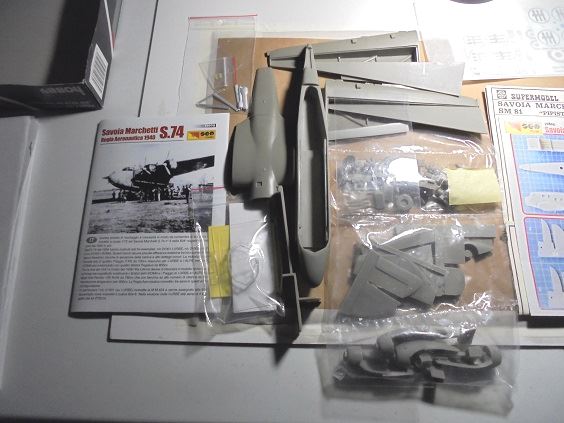
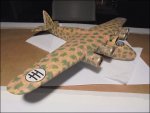
The 2015-vintage SEM Model Savoia-Marchetti S.74 military (72009 RAI “604-8”) and civil (72010 Ala Littoria I-URBE) model kits with resin, white metal and vacuform plastic parts are the only ones currently available in 1/72 scale, the more difficult to build though arguably better appearing 1/72 scale BROPLAN vacuform et.al. component parts well as the 1/144 scale Air Craft Models (presumably vacuform) kits being the only others though unobtainable. The military kit was chosen to include in my collection of RA aircraft subjects, with several large and heavy cast resin parts building it indeed was going to be challenging!
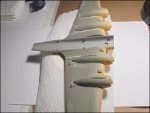
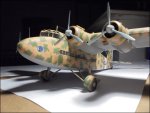
The mainwing assembly - the largest and heaviest single-unit one I've done in resin to date - was built up from a large and heavy one-piece cast resin center section part outwards; two large and heavy two-piece outer cast resin wing parts glued together as sections each then glued onto the center section followed by gluing on four cast resin engine nacelles each conveniently numbered for correct placement; considerable putty filling, filing and standing was necessary. The model kit lacked aileron and flap actuators, wing tie-down rings and underwing navigation lights, fabricated them from styrene sheet plastic. The four cast resin Piaggio X 9-cylinder radial engines were adequately detailed though had to be gingerly handled as they hold the engine cowlings themselves being just as delicate to handle!
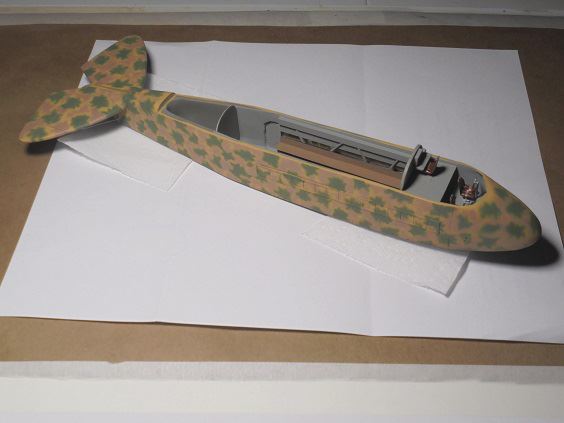
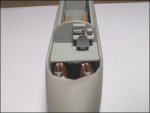
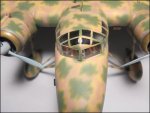
The fuselage interior was easier to build though not entirely without difficulty; much cutting, filing and sanding necessary getting cockpit flight deck and navigator/radio operation station parts to properly fit, no ladder to the navigator/radio operation station nor passenger/cargo cabin bench seats, fabricated them from styrene sheet plastic, no flight crew seat straps as well, fabricated them from sprayed-over and cut to size Scotch Magic Mending Tap strips, etc. The model kit included a magnificently detailed third-party cockpit instrument panel part of it going out of view after the center floor flight instruments stand was glued on – oh well!
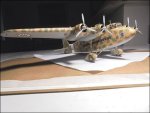
The fuselage exterior likewise was easier to build; etched bronze cabin window strips backed with clear plastic were glued over cut to size model kit provided pliant clear plastic strips glued on the sides of a large and heavy one-piece resin fuselage part, kit provided cut to size paint masking strips subsequently placed over the former. Mainwing and fuselage assemblies had to be painted separately then joined together, tricky given their weightiness, trickier still puttying, filing and sanding join seams followed by painting over all of them without a single disaster along the way - fate smiles! Gluing tailplane and rudder assemblies on the fuselage went off OK as well though some seam puttying was necessary - fate smiles again! Landing gear assembly work also went off OK, all parts first painted then glued on mainwings and fuselage though not without difficulty, i.e. uneven “V” strut fits between wheel spats and fuselage.
Painting the model in RAI “604-8” livery entailed extraordinary coloration research; kit provided camouflage scheme documentation inconclusive as to base coloring uppersides, i.e. Giallo Mimetico 3 or Verde Mimetico 3, aware of orthochromasia issues associated with period photography chose former based on Internet photos suggesting a light color Humbrol 63 Matt Sand + 10% Testors Flat Yellow + 36% by volume Flat White for scale shading enamels replicating Giallo Mimetico 3 thus was employed. Large Schema C1A “semi-star” mottles were sprayed over it with Humbrol 117 U.S. Matt Light Green replicating Verde Mimetico 3, 50/50 113 U S Rust + 119 Light Earth replicating Marrone Mimetico 53193 + 36% each Testors Flat White enamels approximating those photographed on “604-8” fuselage sides during WWII. All undersides were sprayed Humbrol 140 Matt Gull Grey + Testors Flat White shading enamels replicating Grigio Mimetico.
All throughout their operational lives each of the S.74s were subjected to modification of one kind another most notably removal of all their Ala Littoria airline passenger cabin accommodations and associated equipment when militarized in 1940. With regards to "604-8" this included refitting it with different radio equipment including removal of the D/F loop behind the cockpit, in building my model of this airplane left it off per period photos.
|




Aircraft: SIAI-Marchetti SM.74 Manufacturer: SIAI-Marchetti Type: Civil Transport Year: 1935 Engine: Four Piaggio Stella X.RC. 9-cylinder radial, air-cooled, 700 hp each Wingspan: 97 ft 4 in (29.68 m) Length: 70 ft 1 in (21.36 m) Height: 18ft 1 in (5.50m) Weight: 30,8001b (14,000kg) Cruising speed:186 mph (300km/h) Ceiling: 23,000 ft (7,000 m) Range: 620 mile (1,000 km) Crew: 4 Passengers: 27 |
|













|
|
|
|
|
|
|
|

|

|
|
|
|
|
|
February, 2020 STORMO! © 2020 |