|
SMER 1/48 SIAI-Marchetti SM.79CS Corsa (Racer) by Vincent Fiore |

|

Click the STORMO! Eagle to return to the Gallery 
|
|
In 1934, Savoia-Marchetti commenced work upon what would become the SM.79. The design team was headed by Ing. Alessandro Marchetti. The plane had originally been conceived as a fast monoplane transport aircraft, capable of accommodating eight passengers and to be used in air races. The design, which was initially designated as the SM.79P (P for passenger), was originally intended to be a civil derivative of the Savoia-Marchetti SM.81, a militarised transport/bomber aircraft that was itself based upon the Savoia-Marchetti S.73 airliner. The company set about the construction of a single prototype with the intention of entering the London-Melbourne race. A three-engine configuration was adotpted primarily for commercial safety concerns rather than for speed. The prototype c/n 19001 (later MM.260) was to adopt the liquid-cooled 801 hp Isotta-Fraschini Asso XI Ri powerplant, however, it was deceided to use the more reliable, although less powerful 590 hp Piaggio Stella P.IX R.C.40, a derivative of the license-produced French Gnome & Rhone K.9. On 28 September 1934, the prototype SM.79 conducted its maiden flight, piloted by Adriano Bacula. Despite the company's aim to participate in the London-Melbourne race the plane's prepartions were not completed in time. The prototype's registration was I-MAGO which rather allusively meant "Wizard". The plane featured sleek contours and continuous panoramic windows, true to its original intended role as a passenger aircraft. The prototype was able to quickly demonstrate its speed, conducting a flight from Milan to Rome in just one hour and 10 minutes, flying at an average speed of 250 mph (410 km/h). On 20 July 1935, it was awarded its Certificate of Airworthiness. Soon after on 2 August 1935, the prototype established a new speed record flying from Rome to Massawa in Italian Eritrea, in 12 flying hours with a refuelling stop at Cairo, Egypt. Various other world records were established during multiple test flights performed by the prototype. It was determined early on that it was the engines rather than the airframe itself that proved to be its limiting factor and accordingly the prototype was re-engined. During 1935, the P.IX engines that had been originally installed were replaced by Alfa Romeo 125 RC.35s and in 1936, these were replaced by the new and more powerful Alfa Romeo 126 RC.34s. The prototype being used by Generale Valle, the Chief of Staff of the Regia Aeronautica for various trips to East Africa as a fast liaison. The high performance demonstrated by the prototype attracted the attention of the Italian military, who approached Savoia-Marchetti with a request to investigate the prospects of producing a bomber-conversion of the type.
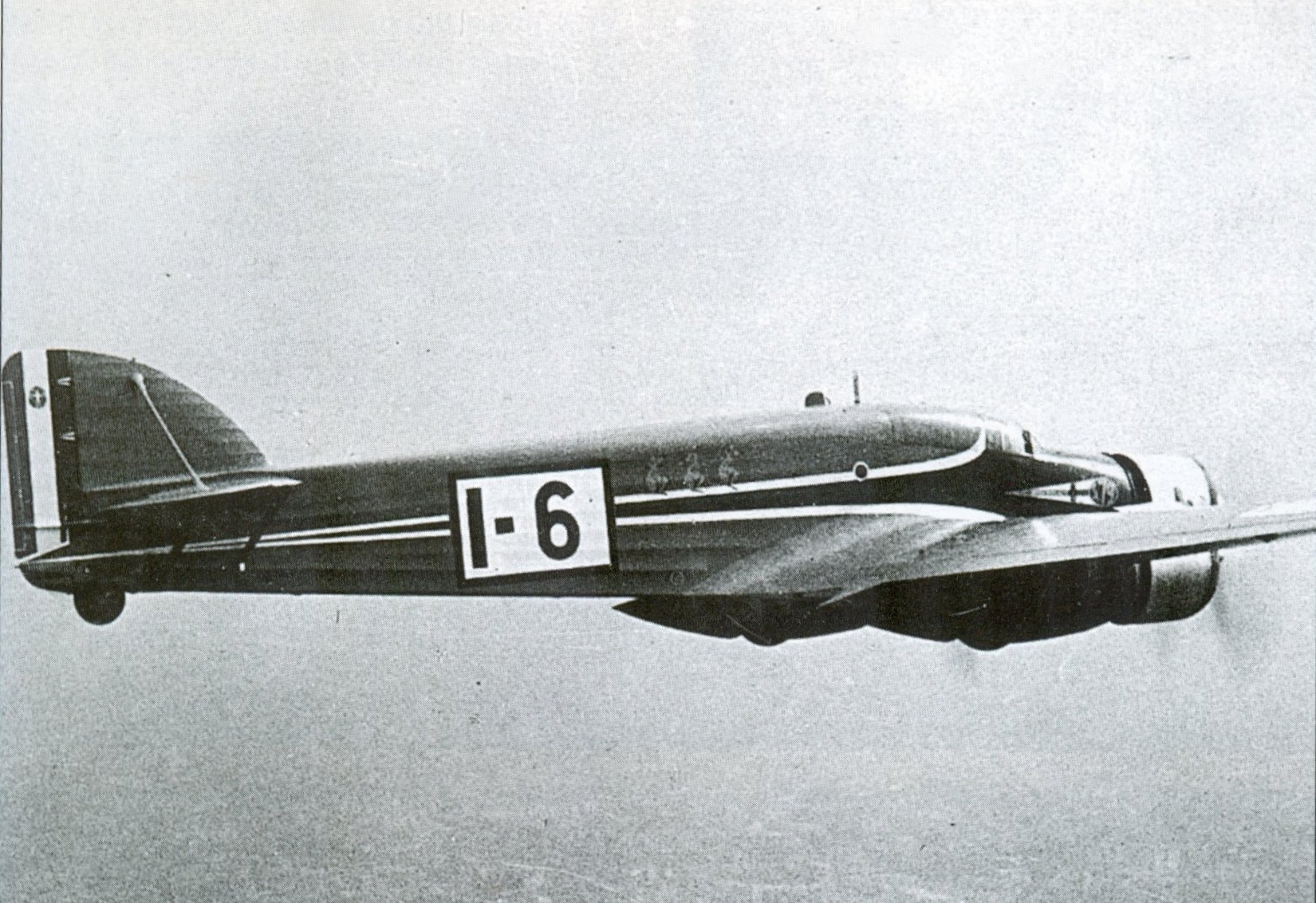
While S.79s battled over Spanish skies, other remarkable exploits were being carried out by more "peaceful" variants. On 20 August 1937, in the place of a previously intended speed race from New York to Paris, to be held in celebration of the tenth anniversary of Charles Lindbergh's first Atlantic crossing, six Italian crews (in addition to two more in other aircraft types) were entered with their specially-modified S.79s in the Istres-Damascus-Paris race, encountering strong competition from foreign competitors. Six machines taken from a bomber production batch were modified with the removal of defensive armament and bomb-carrying installations, the upper fuselage "hump", the bomb aimer's belly gondola, increased fuel tankage to an overall 7,000 litre capacity, improved and augmented instrumentation, radio and pilot aids, engines adapted for use of 100 O.N. fuel and fitted with new variable-pitch Ratier airscrews, oversized oil radiators and new landing gear tires to withstand the increase in all-up weight. Designated S.79C (C for "CORSA", i.e. Racer), the first example so modified took to the air on 4 March 1937 flown by Passaleva and Maffezzoni, closely followed by other examples. All machines sported a vivid fire-red finish and were given civil registrations: I-BIMU, -CUPA, -FILU, -LICA, -ROTR and -TOMO. The race saw the brilliant victory of Italian crews who placed 1st, 2nd, 3rd, 6th and 8th, respectively. Only I-LICA did not finish its race, following a take-off accident at Damascus, luckily without consequences for its crew. The first to arrive at Paris was the I-CUPA piloted by Tenente Colonnello Cupini and Capitano Paradisi, that covered the 6,190 km of the whole circuit in 17 hours, 32 minutes and 43 seconds at an average speed of well over 352 km/h (423 km/h having being attained on the 2,921 km-long Istres-Damascus leg). I-FILU piloted by Maggiore Fiori and Capitano Lucchini placed second at an average speed of over 344 km/h, and I-BIMU piloted by Tenente Colonnello Biseo and Tenente Bruno Mussolini (the son of Benito Mussolini), placed third with an average speed of almost 343 km/h.
The planes chosen for this raid were redesignated S.79 T (T for "Transatlaniico") and were registered I-BISE (ex I-BIMU), I-MONI (ex I-CUPA) and I-BRUN (ex I-FlLU), respectively. Some modifications were introduced, such as the return to SIAI-built airscrews, thoroughly overhauled engines, enlarged fuel fillers, improved radio and navigational aids and automatic pilot. The flight was intended as an experimental check of the possibility of carrying passengers and mail between Italy and South America by means of landplanes rather than by seaplanes, as was the current practice at the time. Preparation day and night flights, engine endurance tests and various checks were intensively carried out in December 1937 and the first two weeks in January 1938, with the machine overloaded up to 13/14 tons, half of which made up of fuel! The crews included Biseo and Paradisi for the first machine, Moscatelli and Castellani in the second one, and Mancinelli and Bruno Mussolini in the third pLane. The three S.79 T started their long flight early in the morning of 24 January 1938 and the flight proceeded smoothly along the Rome-Dakar route, although disturbed by a strong wind that, by lifting thick sand clouds made visibility intermittently poor. The distance was covered in 10 hours 50 minutes at the exceptional average speed of 415 km/h, all three machines landing at the same time in the late afternoon. The flight was resumed early in the morning of the following day. At first the flight was carried out with the three planes in formation and in sight of each other, then the weather worsened and made the navigation very tedious on account of violent squalls and strong winds that forced the pilots to resort to their instruments for flight. Early in the afternoon, trouble developed with I-MONI that, following an airscrew failure forcing an engine to be stopped and its airscrew feathered, had to continue its flight on two engines only at a reduced speed. The I-MONI was forced to an intermediate landing at Porto Natal, whiLe the other two planes flew on towards Rio de Janeiro, at which airport they successfully landed late in the evening. The 9,650 km between Rome and Rio de Janeiro had been covered in 24 hours and 22 minutes of actual flying time at the phenomenal average speed of 406 km/h. On 27 January the I-MONI, after its failure had been remedied, rejoined its companions from Porto Natal with a final flight carried out on the edge of 450 km/h. The success of this flight, which had sensational repercussions all over the world, paved the way for routine air service between Italy and Brazil through the newly-established L.A.T.I. company (Linee Aeree Transcontinentali ltaliane), which was to make use of S.83s - civil versions of the military S.79s, S.75s, S.76s and S.82s - all subsequent developments of the now world-renowned trimotor. Source: Cesare Gori, Ali D'Italia #9 SIAI S.79 1a Parte, La Bancarella Aeronautica, Torino, 1998. |


|

|
|
|
|
|

|
|
|
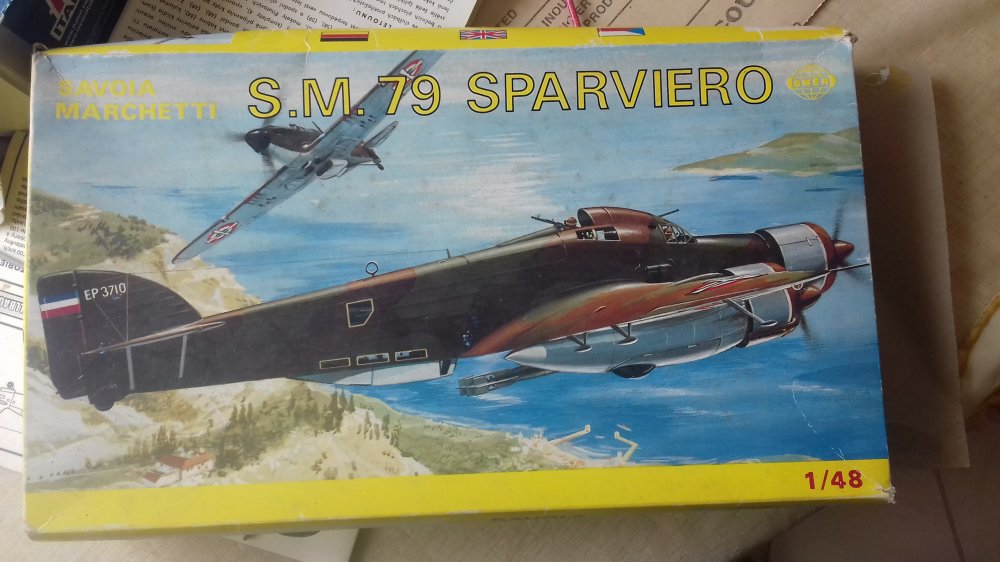
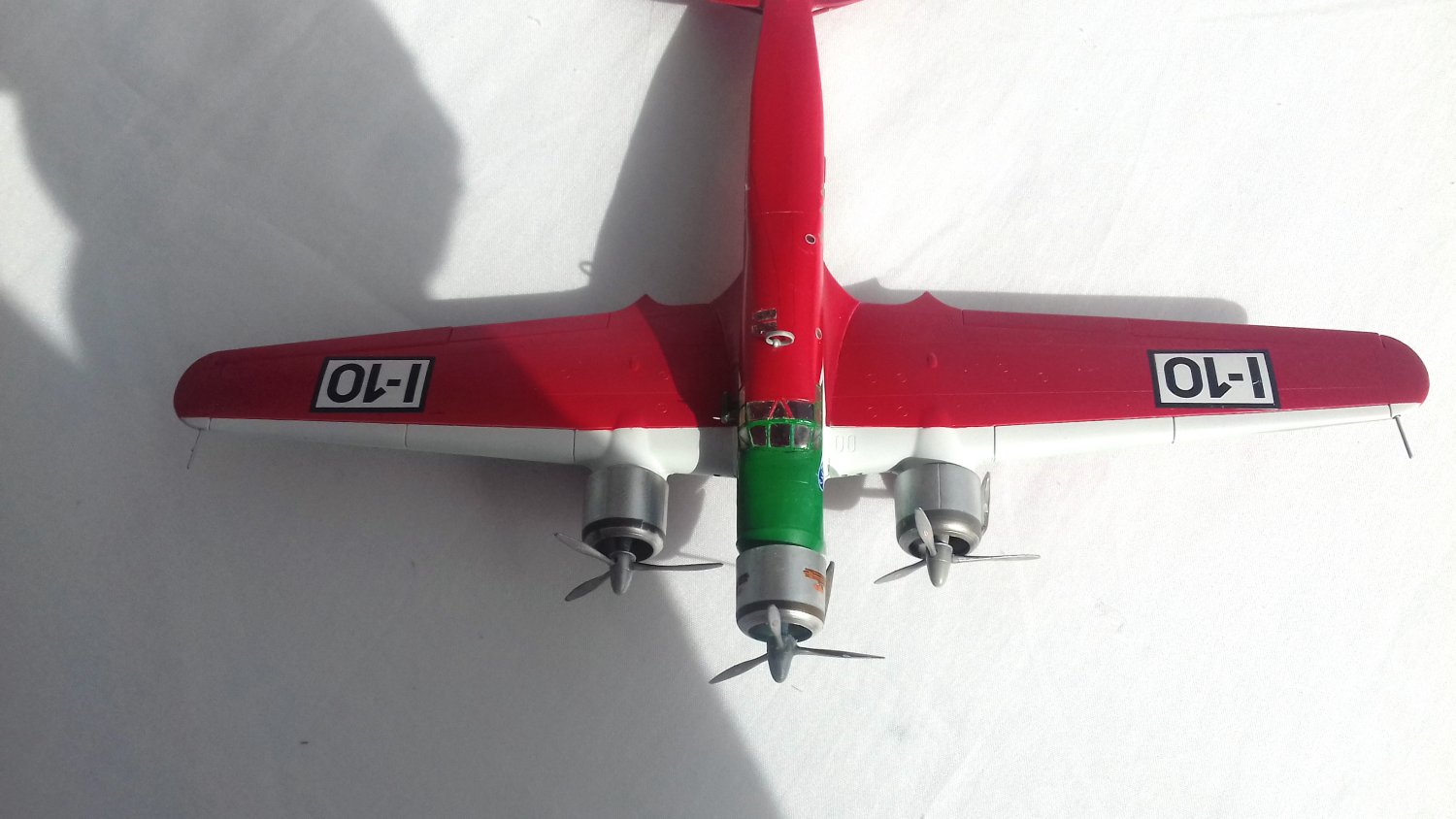
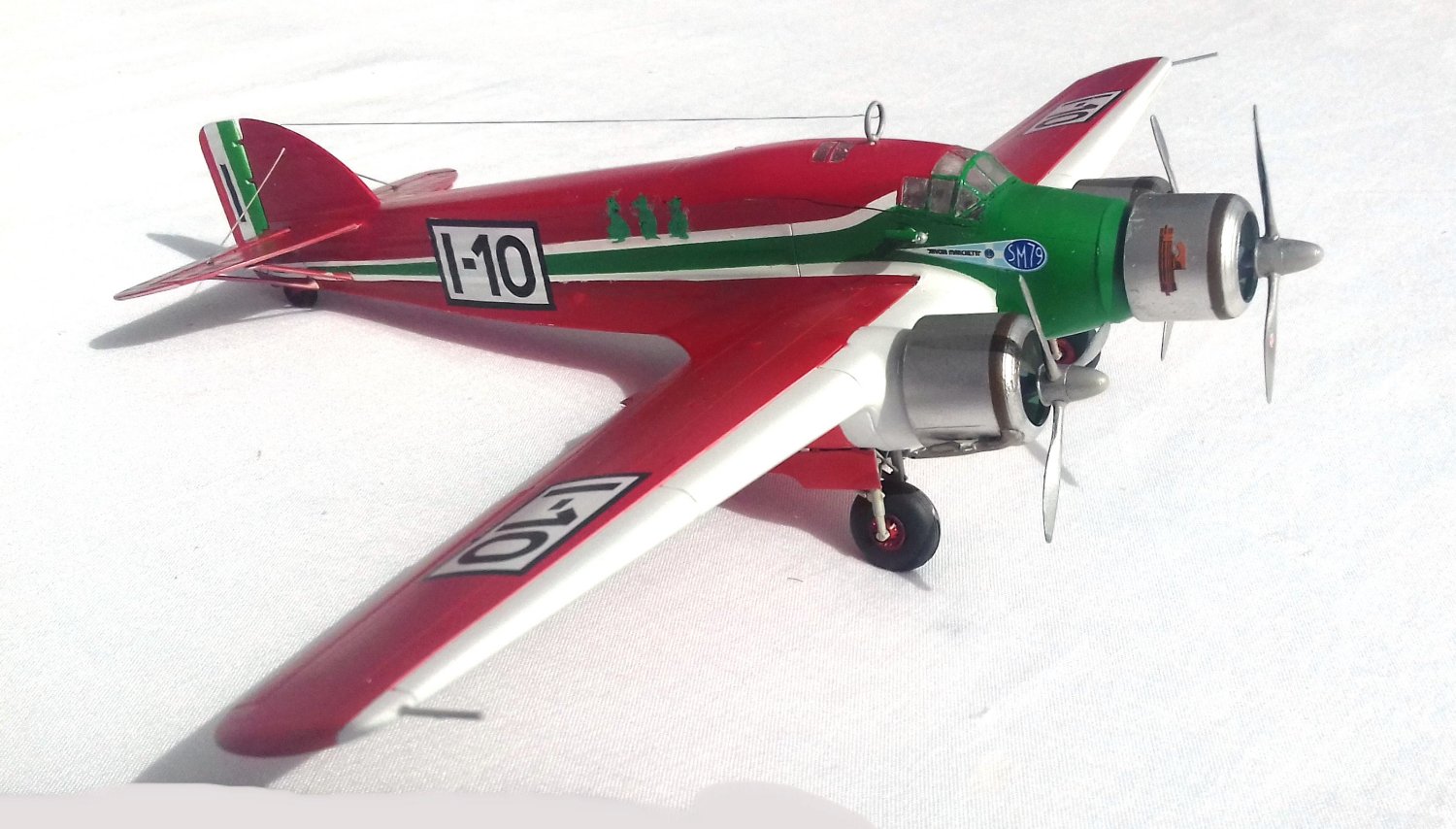
This is the vintage SMER 1/48 SM 79. After removing the dorsal hump I proceeded to build this kit in a regular manner. Because of the complexity of the color scheme, I decided to paint the fuselage before attaching the wings and tail plane. I first painted the fuselage sides white. I then applied masking tape to create the white outlining the green. When this dried I applied a liquid mask to the green. When the mask dried I proceeded to paint the rest of the kit: wings, tail etc. When I removed the mask, some paint did lift - I corrected this until I was happy with the finish. The decals came from my spare parts box because the decals that came with the kit had been used on an unsuccessful to build of the same racer. |
Aircraft: SIAI-Marchetti SM.79 Prototype (I-MAGO) Manufacturer: SIAI-Marchetti Type: Civil Transport Year: 1934 Engine: Three Piaggio Stella P.IX R.C.40, 9-cylinder radial, air-cooled, 590 hp each Wingspan: 69 ft 7 in (21.20 m) Length: 53 ft 2 in (16.20 m) Height: 13 ft 5t in (4.10 m) Weight: 23,180 lb (10,500 kg) (Loaded) Maximum Speed: 248 mph (400 km/h) Ceiling: 23,294 ft (7,100 m) Range: 1,180 miles (1,900 km) Crew: 4 Passengers: 8
|

|
|


|
|
|
|
|

|





|


|
|
|
|
|
|
October, 2021 STORMO! © 2021 |