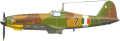
Rick, I wondered the same thing when I saw this extraordinary photo a few days ago.
Jean is right in his thought, but I think that aircraft has the paint too uniform to be worn by sun, sand or rain. It has been soiled and scratched only by personnel clothes and shoes, respectively below the cockpit and at wingroot. Apart this, the relic has quite no trace of dirt, nor along the seams!
The photo colours aren’t much faded (a little just for the red). The man flesh hue is credible, and the “Nocciola Chiaro” appears no darker than it. The yellow component is well represented in the withered weed on the background.
That aircraft was a Breda-built, serie VI, VIII or X. The port wing had been replaced with a Macchi-built one, wearing the typical “smoke rings”. Hues of respective VOS2 and “NC4” appear almost identical between those parts, so standard paints had been used by both factories. The interior is the same grey for undersides, which confirms that Breda used it in place of (or over) Verde Anticorrosione. The camo green matches well with Verde Oliva Scuro 2, as for Verde Mim 2. The tone difference between the sand and the grey is faint, and if you modify that shot into b/w, it almost disappear, as in the following photo of Macchi serie III MM 7806 (later 90-1 of ace Cap. Ranieri Piccolomini):
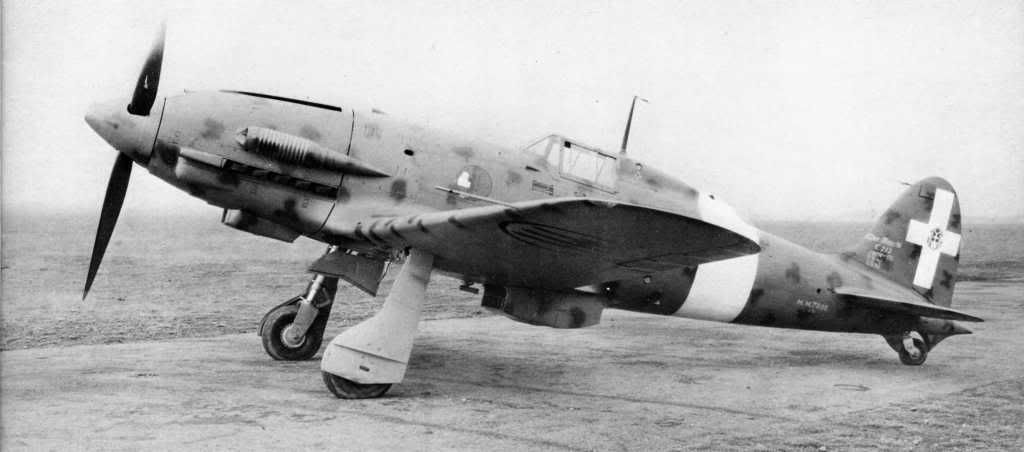
This was an official factory image of a brand-new aircraft. There is no shadow-effect, as the weather is foggy. Note that the fuselage fascio appears darker than “NC4”.
This is enough for the tone. The question remains open for the paint hue. The colour you mean seems to be a pale (and pinky?) brown. I think that the Vitocharts’ “Colore 4 variante sabbia” (FS33303), that’s a grey with a hint of brown, can be an option. As can be Giallo Mim 4, which had been used by Macchi, but
not by Breda, according to CMPR.
About one year ago I met modeller and researcher Stefano Zaghetto. He kindly allowed me to examinate some colour chips took as sample during WWII and before; some were original paints. One of these chips corresponded to FS30475, and had the following handwritten note on its background: “Colore 4 chiaro, MC 202 Comiso”. This colour seemed strange to me, at time, but now I think it fits pretty good with that photo, and this could be a confirmation of its use.
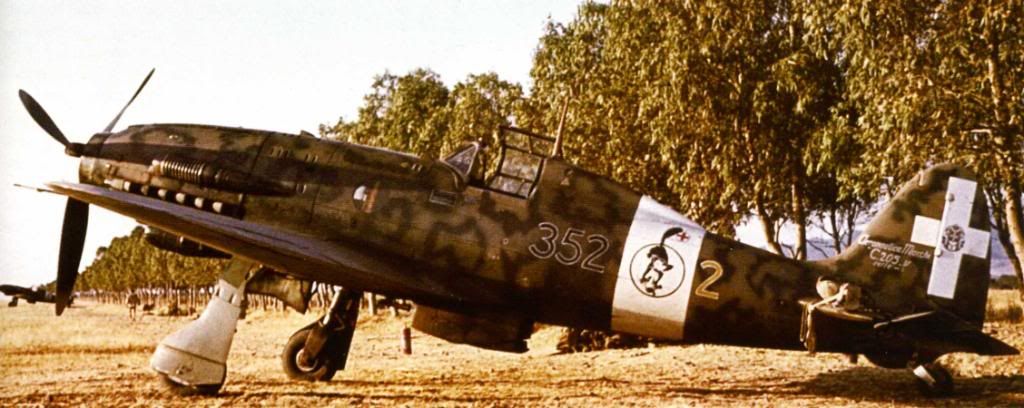
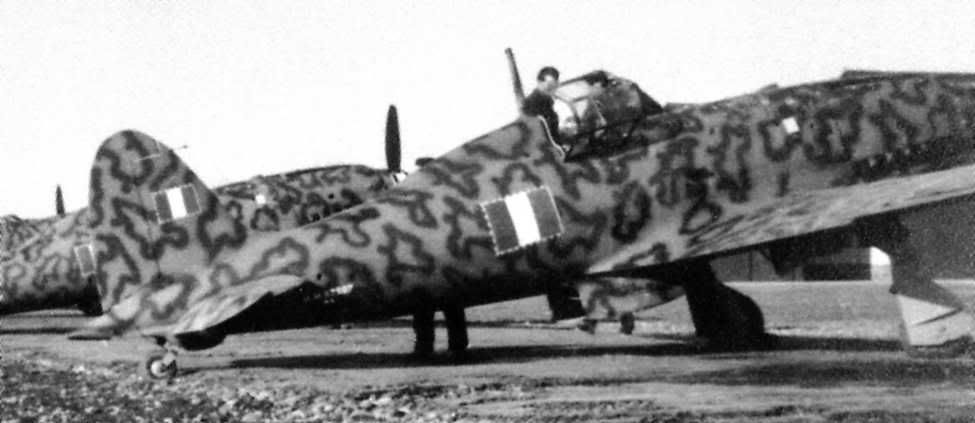
After all this, is the classic FS30219 to be thrown away? No, of course. But we must keep in mind that the famous Tavola 10, announced in 1941, had been distributed later at an unknown date, and the example recovered has a postwar rubber stamp on its frontside. However, later in the war, the camo background became darker, as shown by the following images from D’Amico-Valentini’s Camouflage and Markings of ANR, Classic Colours, 2005 (in the colour shot the fascio is lighter than Nocciola Chiaro, this time):
In the meeting as above, I had also the opportunity to examinate an original paint chip by an ANR MC.205 shot down some 20 kilometers from my home, and recovered a few years ago. It is the only original specimen of NC4 actually applied on an aircraft, as far I know. The chip was identical to Nocciola Chiaro 4 as in CMPR’s chip table attached to its 1st edition book, in 1977. Zaghetto took a snapshot of this comparison, but I don’t own it.
I know, by personal correspondence, that Rick agrees with me that all of us trusted for more than thirty years in a book that’s not wrong, but surely is incomplete. I think that the discovering, in all this time, of colour photos, relics (see the post on Swedish Re.2000 in this forum…) and documents can reveal us many surprises.
Well, the discussion is opened!
Stefano