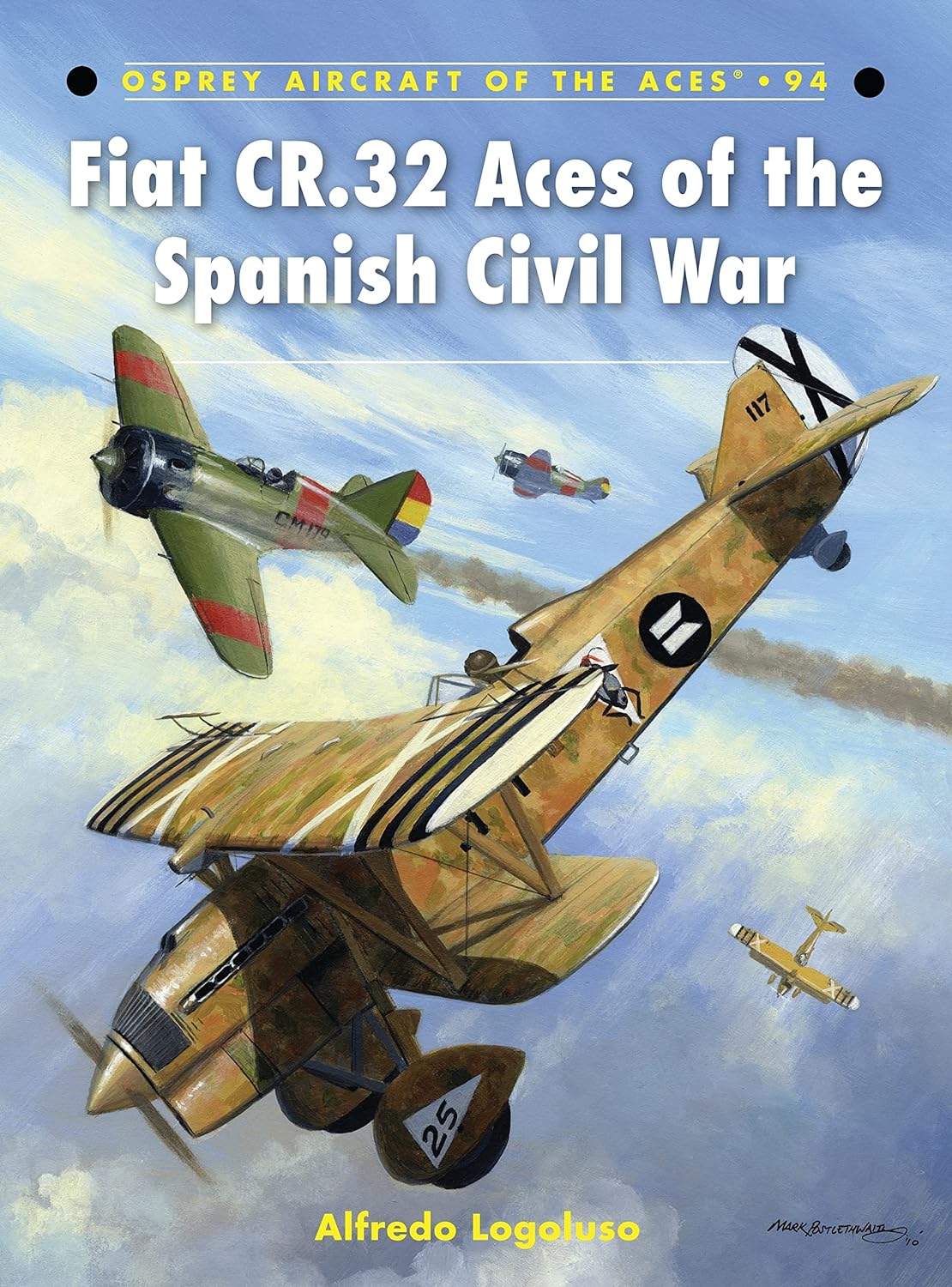
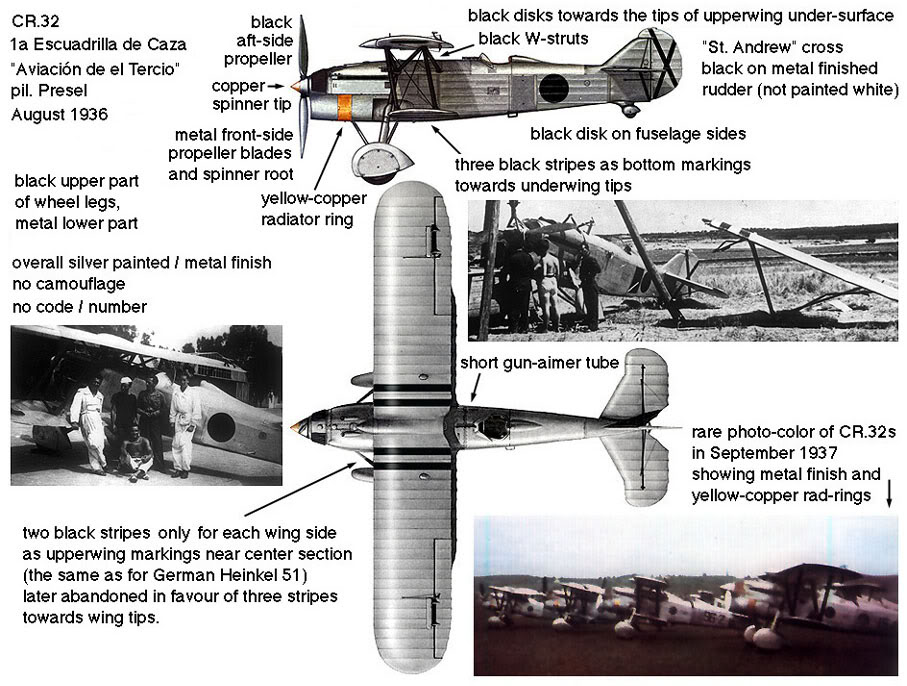
When at the beginning of August 1936 the first 24 CR.32s were sent to Spain, no camouflage was applied to these fighters in service with
the Regia Aeronautica, the aircraft finished in silver (aluminium) overall, with a bright copper-yellow radiator ring (rad-ring) and
mat-black painted wing struts as well as on the aft-side of the propeller blades; the same silver paint covered Italian national CR.32s
directly taken from the Regia Aeronautica service units and depots before being shipped to Spain, similarly as with the first S.81 bombers
sent in advance to the Nationalists by air at the end July 1936. Communist workers in Italy confirmed this, reporting to operatives in
France that 36 ground crew from the Breda firm worked on 26 and 27 July in two military airports to remove Italian markings on 12
three-engined S.81 bombers, later flown to an unknown destination.
This uniform silver (light) finish of the first CR.32s sent to Spain is confirmed by photographic evidence of aircraft shipped to Spain,
unloaded, assembled and beginning operations in August-September 1936.
A rare colour photo taken in September 1937 shows the contrast between silver overall finish and the copper-yellow radiator ring on a
line-up of uncamouflaged CR.32s (reference for Profile 1 in colour plates of Osprey 94): this was the case for the first CR.32s operating
in Spain by 1936 and also later, when the radiator-rings remained partially or totally uncamouflaged, sometimes after replacement of that
part (Image 1; profiles 1, 2, 3, 4, 6, 8, 15, 28, 30).
|
|
Image 1 - 1a Escuadrilla de Caza "Aviacion de el Tercio" pil. Presel - August 1936
|
|
In continental Spain only, the first camouflage scheme applied to CR.32s, in September 1936, were characterized by irregular and
more-or-less linear or narrow and shaded reddish-brown patches/mottles, on more-or-less uniformly painted sand-yellow upper-surfaces: in
fact, during September-October 1936, green was not yet applied. This was because the first major operations of the CR.32 in central Spain
began in Caceres base, a terrain (with no trees or grass) where abundant red dust covered aircraft in hot and dry climate conditions, the
prevalent colors of the local summer landscapes were also being mainly reddish and yellowish tones.
References regrading early camouflage come especially from fighter pilots, such as Generali Adriano Mantelli and Giuseppe Ruzzin, who
independently confirmed the two-colour camo scheme applied to the first CR.32s in continental Spain during September-October 1936: Mantelli
recalling the camouflage origins precisely from Caceres' reddish dust and Ruzzin reporting (letter to author: 20 March 2001) about
camouflage for CR.32s: "When the third expedition arrived at Cadiz on 12 October 1936, our CR.32s were painted silver as in Italy, the
same aircraft being soon repainted with yellow and maroon patches, according to pilot preferences: unfortunately, paint was granular,
thus reducing speed by at least 5 Km/h; later paint varnish was changed to a gloss". This sugegsts that "yellow" or "sand-yellow" and
"reddish-brown" or "maroon" paints initially used for CR.32 camouflage in Spain were probably non-standard aviation paints, not
corresponding to later standardized colors for military aircraft finish, being instead paints of uncertain production and origins,
possibly manufactured in Spain (for general purpose), or other possible Italian origins. Examples of the so-called "red-and-yellow"
CR.32 early camouflage in Spain (1936) are given in Osprey 94 in the color-profiles 3, 4, 5, and photos on pages 13, 14, 15, 16, 17, 18, 19, 20, 21, 26, 27, 30.
Green patches or mottles, with more-or-less shaded/soft edges, began to be added or applied later to CR.32 camouflage operating in
continental Spain (during the winter 1936-37, from bases near Torrijos where olive-trees and vegetation were present), this also being
remembered by Generale Mantelli and confirmed by b/w photos, showing four different "grey-tones" on camouflaged CR.32 surfaces,
corresponding respectively to silver (clearest, uncovered areas), yellow, red, green (the latter appearing generally the darkest tone
on b/w photos; an example is in Image 2 - reference for color profile 6).

|
|
Image 2 - 3a Sq. Aviazione Legionaria - pil. Montegnacco - December 1936
|
|
Early examples of green mottled or patched camouflage applied along with (or upon) silver and yellow painted upper- and side-surfaces
are given in Osprey 94 profiles 7 and 8, or photos on pages 32, 33, 34 and 37. An example of camouflage applied in January 1937 is
given in Image 3 - reference for colour profile 7.

|
|
Image 3 - CR.32 bis "quadriarmo" - 5a Sq. Aviazione Legionaria pil. Francois - February 1937
|
|
As remembered also by Generale Mantelli (letter to the author, 8 February 1976): "Our CR.32s, initially aluminium-finished, were
camouflaged according to the colors of the operational area in so far as upper surfaces are concerned, while under-surfaces were
painted bluish-grey".
CR.32s based in the Balearic Islands instead remained silver overall until Summer 1937, where about half of these fighters keeping this
so-called "aluminium-finish" (even till toward the end of Civil War), some others however bearing the typical Italian "banded-camouflage"
scheme of 1936-'37, very rarely seen on CR.32s operating on continental Spain.
According to other sources also, from the end of 1936 to the beginning of 1937 at least two basic green paints were in use in Spain:
a greyish-green and a darker olive-green (the latter more frequently applied). These could be both general purpose paints (also used for
vehicles, railway wagons, etc.) or among early paints imported from Italy and for use as military aircraft camouflage. In fact, by the
winter of 1936-'37 paints used in Italy for the so-called "banded-camouflage" were quite widely available and applied also by the FIAT
factory at Turin where CR.32s were produced, this set including at least five colours: light-yellow or sand-yellow, maroon or reddish-brown,
brown or dark-earth, greyish-green or sage-green, dark-green or olive-green. There was also a sixth colour used for upper- and side-surface
camouflage - a light-earth or ochre-yellow (apparently more often used by the other Italian aircraft manufacturers other than FIAT) - and
a pale-bluish-grey generally applied to aircraft under-surfaces.
Bluish-grey and ochre-yellow were also introduced in Spain by late 1936 and the beginning of 1937 respectively, so by spring 1937 there
were at least six basic colours available for upper and side-surfaces (aluminium-silver, reddish-brown, sand-yellow, ochre-yellow,
greyish-green, olive-green) and two colors for under-surfaces (aluminium-silver and bluish-grey), independently from considering
different origins or purposes (and different tones eventually) of applied paints.
This anyway cannot yet explain the extreme variety of camouflage colors (and schemes) applied to CR.32s in continental Spain during
1936-'39, as the same can only be known by examining hundreds of historical photos, films, relics, etc. In fact, it must be mentioned
that apart from the physical or optical variations introduced by different kinds of photographic films and processing (since orthochromatic
or panchromatic negatives, show different "grey-tones" mainly for yellows and reds in b/w photos), a large variety of camouflage colors
and schemes was also due to three general causes other than the availability of the several basic paints, so that it's possible to observe
b/w historical photos and film-frames of CR.32 flying formations or line-ups on the ground, taken in Spain (and shortly later in Italy too),
presenting - in the same light conditions - each aircraft out of three or four or more machines camouflaged in a different way when compared
to the others: perhaps no other aircraft in aviation history displayed such a wide variety of color and camouflage schemes as the CR.32s in
Spain. As a direct and contrasting comparison, almost all the first-line fighters used by the Spanish Republican forces - those being
hundreds of I-15 biplanes and I-16 monoplanes, both being the primary adversaries of the CR.32 - had unvaryingly and uniformly green
painted upper and side-surfaces, according to the Soviet VVS standard 1936-'39 and memories of both Republican and Nationalist airmen,
with very few known or hypothetical exceptions.
The further three general causes of such a great variety of camouflage schemes were: the non-uniformity in paint preparation,
application techniques and through wear and tear.


|
In preparation, both dilution with solvents and mixtures of basic paints, while application was executed both by brush and air-spray-devices
(the latter more frequently used and an evident reason of changeable finish), all factors influencing the final appearance of painted
surfaces: colours intensity, dullness, shaded effects, etc.
In so far as service wear or attrition is concerned, it is sufficient to imagine two aircraft with similar camouflage colors beginning
operations: the first one seen after three weeks flying during the battle of Brunete on advanced airfields in central Spain in July 1937,
with up to 40°C in the shade and turbulent dust acting as a sand-paper; the second machine flying for three weeks, six months later,
during battle of Teruel in Aragon – locally the coldest winter since 1900, reaching 40°C below zero or much less at flight altitude,
often the aircraft being covered by ice-snow both in the air and on the ground. At the end, the colors appear quite different compared
to each other, and each one different with respect to its initial status.
Moreover, often even parts of the same aircraft (wing and fuselage, port and starboard wing-planes, tail-fin and stabilizer, ailerons or
wheel-fairings, etc.) appeared painted by colours and camouflage schemes different to each other, this mainly depending on repair and
frequent part substitutions operated by ground crews, but also because of existing paint variety.
Re-painting of the CR.32s in Spain was also quite frequent, this not only, or was not mainly, because geographical- and winter- or
summer-camouflage were more-or-less prescribed or applied (both within Italian or Spanish units), but evidently owing more to paint
wear or attrition, more than any other reason. And this also should explain much of the aircraft painting that was applied in the field
and within air-units, instead of at the factories and depots. By the latter, CR.32s were also re-painted after repair, overhaul,
reconstruction, etc., surely giving the aircraft some better degree of camouflage uniformity or standardness, more complying with
seasonal or geographical prescriptions about camouflage. For instance, CR.32 NC 262 (initially coded 3-17 and later 3-51), often
photographed during the Civil War because it was most used by leading ace García Morato, received at least six different two- and
three-color camouflage (and possibly eight) during a period of about 30 months, this meaning an average of one re-painting after
four-five months service, which could be about the same for other CR.32s in Spain, within both Spanish and Italian units.
CONTINUED IN PART II - December 2010
Alfredo is an Aeronautical Engineer and a former Officer with the missile defence section of the Aeronautica Militare Italiana.
He has worked in both military and civil aerospace industries. For many years he has researched the aviation history of the
Spanish Civil War, writing numerous articles for Italy's specialist press on the subject. One of his primary contacts is Angelo
Emiliani, who was the first Italian researcher to document the air war in Spain. Alfredo is the author of Osprey Aircraft of the
Aces No. 94 - Fiat CR.32 Aces of the Spanish Civil War.
|
|