|
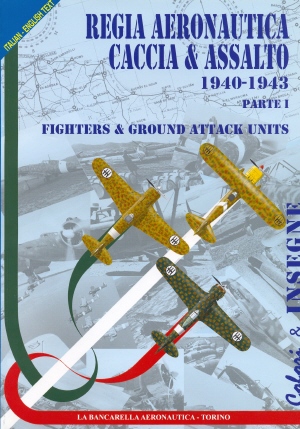
A Re-evaluation of Regia Aeronautica Camouflage 1940 Colori & Insegne - Regia Aeronautica Caccia & Assalto by Steven “Modeldad” Eisenman |
|
|
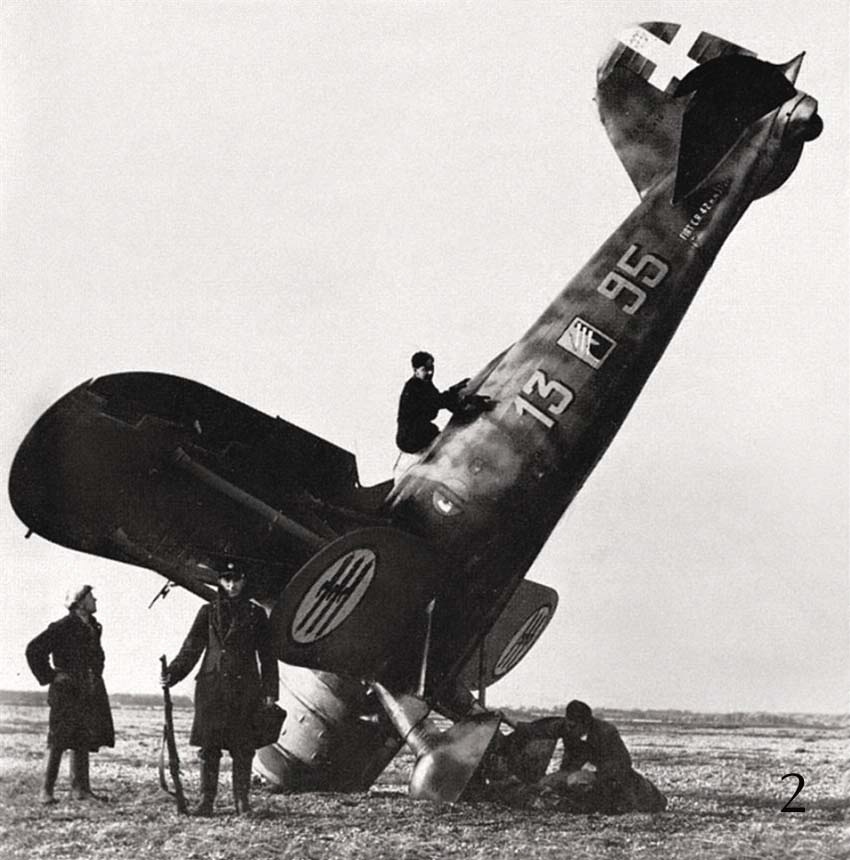
One of the great problems in modeling historic aircraft and in the study of aircraft camouflage is that often fact becomes myth and myth becomes fact. For example, the old fact that (some) Luftwaffe aircraft were painted in a single color green. This then became myth, and the fact was that no Luftwaffe aircraft would be a single green. Now the fact has become myth and the myth becomes fact. It has been documented that some Luftwaffe aircraft were painted a single green, the Bf 109D for example. Then there was the underside of P-40s destined for the RAF. The fact once was that the underside was a "Sky" color, or perhaps Sky Blue. The fact now is that it was "Sky Grey". In trying to separate fact from myth, serendipity can often be a great research tool. Not long after I posted on HyperScale a response to a question regarding the camouflage on the CR 42 in the RAF Museum at Hendon, I was looking through Vol.2 Section 4 of the Classic Publications' Jagdwaffe series, Battle of Britain Phase Four, on an unrelated research issue. I came upon the few pages in that volume on the Regia Aeronautica's involvement in the Battle of Britain. On page 314 is a picture of a CR 42 (Img 1) with its nose in the ground. According to the caption, this is MM.6976 (NOTE: this is a typographical error, it should be MM.5701), coded 95-13 (or 13-95, Squadron number was carried in the back; the individual aircraft number facing forward) flown by Sergente Pietro Salvadori. On 11 November 1940, Sergente Salvadori's aircraft overheated due to an oil line failure and he was forced to land in England at Orford Ness, Suffolk. This is the CR 42 that is at Hendon.
Looking at the picture, I was of the opinion that a single colored (dark green?), jagged camouflage mottle was applied to the base color on the upper surfaces of the upper and lower wings. Based on another picture I found of 13-95 (Img 2), the pattern on the fuselage appears to be a softer and denser style of mottle (Editor's note: this was quiet common, fusalge sides and top surface of wings were often painted differently on RA planes ie., shapes and patterns, however colors remained the same), clearly not as "jagged" as the pattern on the wings. As to the color, it also could be a single color green (Verde) or two colors, green (Verde) and reddish-brown (Marrone).
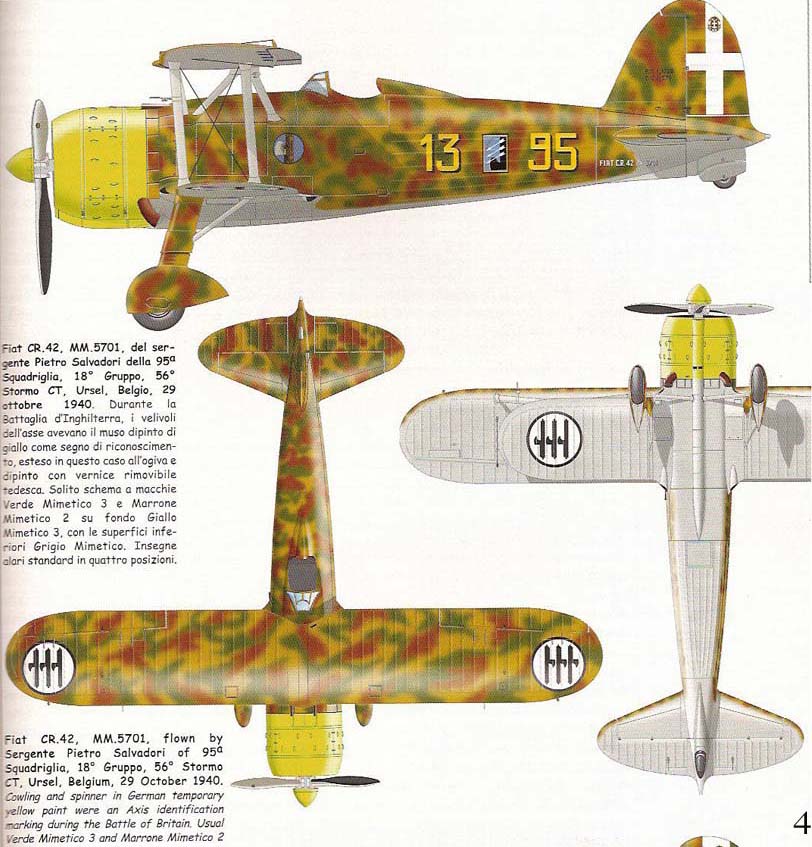
The camouflage pattern on the CR 42 in the Jagdwaffe volume is nothing like the pattern that is currently applied to the CR 42 in Hendon (Editors Note: The CR.42 that is on display at Hendon had undergone restoration in 1964 and further restoration in 1973-74). The dark jagged pattern is much larger and there is more space among the pattern pieces. The camouflage on the fuselage is quite different also. I then took out Part I of Regia Aeronautica Caccia & Assalto by Waldis and De Bortoli. This is the first part in a two part series that is a very comprehensive monograph on RA camouflage and marking from 1940 to 1943. On page 23 is a profile of a CR 42 with the serial MM.5701 (Img 3) and coded 13-95, the same one as in the Jagdwaffe monograph. The aircraft is pictured as it was on 29 October 1940. It is shown in the "typical" pattern of Giallo 3 base color, with Verde 3 and Marrone 2 mottle densely applied over the entire airframe. The pattern on the wing-tops differs only in that the two mottle colors appear to be more elongated, rather than being oval in shape, as on the fuselage. The underside is said to be Grigio (Grey). While I could not be sure about the colors, it was quite clear that the wing-top pattern was not the same as on the aircraft in the photograph.
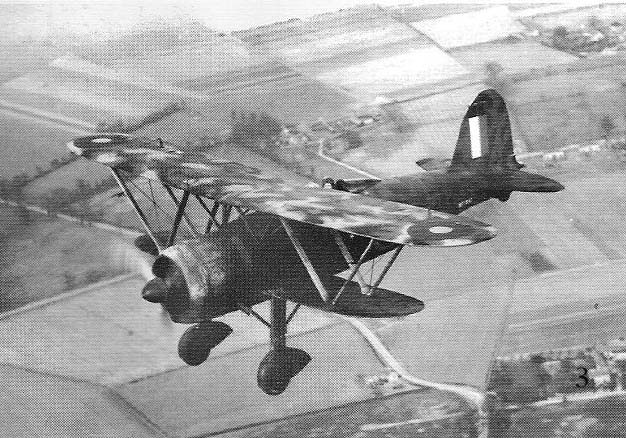
According to Waldis and De Bortoli, this aircraft belonged to Sergente Pietro Salvadori, who, on 11 November 1940 became disoriented in fog, ran out of fuel and landed at Orford Ness. Could poor Sergente Salvadori have crashed twice on the same day, for different reasons, in two differently camouflaged aircraft with identical markings? I strongly doubt it. It is also extremely unlikely that Sergente Salvadori had differently camouflaged aircraft with the same serial number on 29 October and 11 November. At this point, who or what was I to believe. I contacted one of the authors of the Jagdwaffe volume and he had in his possession copies of the RAF’s Crashed Enemy Aircraft Reports. Serendipity comes into play yet again. He had a copy of document A.I.1.(g), Crashed Enemy Aircraft Report Serial No. 25, dated 14 November 1940, No. 3/154. This report is about a CR 42, serial number MM.5701, coded 13-95 - the aircraft of Sergente Pietro Salvadori. The aircraft, as described in the report, was said to have greenish-yellow blotches. The underside was said to be silver. The face of the prop blade was pale blue and black on the back. The Gruppo badge on the fuselage was described as having a blue background. A separate interrogation report regarding Sergente Salvadori reveals that his oil line did break, causing him to land. But was the camouflage that was described a one-off event? Another CR 42 was brought down in England and a report was made on this aircraft. This report was Report Serial No.24, Date 13.11.40, No.3 Report 3/149. This CR 42 had the serial number MM.6976 and was coded 16-85. While this aircraft was from a different Squadriglia, it belonged to the same Gruppo as 13-95. Both 85 and 95 Squadriglia were part of 18 Gruppo CT. The report describes this CR 42 as being muddy brown with green blotches. The underside was reported as being silver, and again a pale blue propeller face with black on the back. The Gruppo badge was described as having a blue background. As was the case with 13-95, no mention was made of a third topside color. For purposes of this discussion I will assume that the base color on 13-95 was the same “muddy brown” as reported on 16-85. I believe this is a valid assumption. So how could two aircraft that are documented as being in green blotches on a muddy brown base color, have a third topside color ascribed to it? Part of the blame rests with the RAF. The report on 16-85 has an interesting aside. The RAF seemed to believe that the CR 42s were hastily thrown into combat. The RAF report mistakenly assumes the Regia Aeronautica did not have the time to repaint the aircraft from their inappropriate dessert camouflage! The RAF misinterpreted the scheme applied as a desert scheme. The RAF restored 13-95 to flying condition (Img 4). But, along with roundels and a fin flash, the RAF applied what they believed to be a more effective camouflage. A picture of 13-95 in RAF roundels clearly shows that a third color was applied to the upper surfaces that merged with the original green. My guess is that the RAF applied Dark Earth. Now we do have a CR 42 with Verde 3 and Marrone 2 blotches, but the Marrone may actually have been Dark Earth.
Let me digress here and discuss the Finnish G.50 issue. In going through the Finnish Air Force History volume on the Fiat G.50 by Keskinen and Stenman, I noticed that a number of G.50s that had not been repainted appeared to have a dark base coat. Darker than what is usually portrayed as Italian Giallo 3. While it is difficult to tell from a black and white photo, the blotches applied seemed to be a single color. The profile also shows a brown base camouflage with green blotches. Trying to reconcile what I saw in the Finish Fiat G.50 book with what I thought I knew, I contacted one of the authors. He informed me that based on his research, and observation of the un-restored original paint, the camouflage on the Fiats that arrived in Finland was brown with green blotches. He went on to say that only two G.50, FA-17 and FA-32, might have had two color blotches applied. I wish to point out that the G.50s arrived in Finland in Italian camouflage with the Italian serial numbers. They received only Finnish national markings and serial numbers after arrival. Also, they were not all from the same Fiat production block. Finally, the G.50s arrived over a period of nearly seven months, beginning at the end of December 1939 and ending mid-June 1940. One other reference added to my doubts. In the Ali D’Italia monograph on the CR 42, there is a brief section on the CR.42s sold to Belgium. These aircraft arrived in Belgium in April 1940 in Italian camouflage and Italian serial numbers. The pictures of a Belgian CR.42, still with Italian serial numbers on it, show it in a camouflage pattern that appears to be “stringy” and in what appears to be a single color. The profile shows the CR.42 in brown and green camouflage scheme. Returning to my opening premises of the myth-fact dialectic, I believe it is apparent that I now feel that Waldis and De Bortoli have created a possible myth, particularly about the camouflage applied to the Fiat CR.42 and G.50. When I first reviewed the Waldis and De Bortoli monograph upon its publication, I was quite impressed by the information they presented, including the references and analysis. It did not seem to be inconsistent with other articles and books, just more definitive. I must now re-examine my initial impression. Let me try to summarize what I believe to be Waldis and De Bortoli’s position is regarding the Fiat camouflage schemes in effect during 1940. In 1938, the Regia Aeronautica established a standardized camouflage scheme specified in Order Sheet No. 8571, issued on 14 March 1938. This scheme was to be a topside scheme using three colors: yellow, green and brown. The underside was to be grey. By June 1940, these three topside colors were fully in effect. It should also be noted that the topside colors were maintained throughout the life of an aircraft. Rarely were they changed to reflect a change in combat location. On 10 June 1940, Italy entered the War by declaring war on France and England. On 13 June, Italy attacked France. In describing the CR 42’s camouflage at the time of the attack on France, Waldis and De Bortoli note that: "All of them [meaning the CR.42s] displayed the standard factory finish of the time, consisting in a three-tone mottled camouflage with Verde Mimetico 3 (Camouflage Green No. 3) and Marrone Mimetico 2 (Camouflage Brown No. 2) blotches over a Giallo Mimetico 3 (Camouflage Yellow No. 3) background. Undersurfaces were invariably painted Grigio Mimetico (Camouflage Grey)" Could the word "All" have been a poor translation? It was not. The Italian, which is in a parallel column of text, for the same section of text begins "Tutti i CR.42 avevano la mimetica standard di quell periodo." It continues with the same description of the color scheme.What about the Fiat G.50 of the same time period? Waldis and De Bortoli go on to say: “All aircraft [G.50] in service at that time came off the CMASA production line (a Fiat subsidiary company) at Marina di Pisa, wearing a three-toned mottled camouflage of the same colours used on the Fiat CR42 …”. Once again the Italian word "Tutti" is used.Now, to carry this forward to the Battle of Britain. In September 1940 the Corpo Aereo Italiano took up position in Belgium in support of the Luftwaffe. Waldis and De Bortoli note that: "Both operational fighter types [CR.42 and G.50] in Belgium carried the same colours as previously used in the French campaign with no modification.” They go on to note that 18 Gruppo received brand new CR 42s. "The colour scheme was not changed however, maintaining the standard three-tone factory scheme with Verde Mimetico 3 and Marrone Mimeitico 2 blotches over a Giallo Mimetico 3 background, and Grigio Mimetico lower surfaces." It was the same situation with the G.50s that arrived also. The fact that the CR 42s were new is confirmed by information that indicates aircraft 13-95 was produced around the end of August 1940, and 16-85 was produced around the end of September 1940. I don't believe it is too much of an exaggeration to say that one is left with the distinct impression that, by the beginning of 1940, all Fiat aircraft were painted in the Fiat factory scheme. This being dark green and reddish-brown blotches on a base which was of a warm and rich shade of sand. The undersides were a light grey. This impression is given further strength by the fact that all of the profiles of Fiat CR.42s and G.50s (in this book) show the aircraft in this Fiat factory scheme. But if that was truly the case, how does one account for the CR.42s described by the RAF or the Finnish G.50s or even the Belgian CR 42s. Certainly Waldis and De Bortoli do not account for these "exceptions", if that is what they were. Personally, I don’t believe they were exceptions. I do not believe that one or two Fiat CR 42s slipped through with aluminum doped (presumably that is what the silver was) undersides, long after the time when that practice should have ceased. For whatever reason, Fiat continued to use aluminum dope on the underside of fabric-covered aircraft, and used only one color for the topside blotches on some, if not many aircraft. It appears that Waldis and De Bortoli did not account for or look into the issue of camouflage variations, even though the information was clearly available. Of course, there is also the issue of the reasons for Sergente Salvadori's landing in England. Even though the Jagdwaffe volume and the Waldis and De Bortoli monograph came out about the same time, it seems quite clear that first hand RAF accounts were not looked into by Waldis and De Bortoli. Also, the issue of the Finnish G.50s appears to have been ignored as a point of reference. This leaves me with the impression that Waldis and De Bortoli may have looked not much further than Regia Aeronautica documents, taking them at face value, and interpreting pictures based on those documents. Where does that leave us with regard to the Waldis and De Bortoli monograph? In my view, the volume is now highly suspect, and could be considered to be unreliable. Many of the pictures of CR.42s and G.50s in allegedly Verde and Marrone blotches, may be merely various densities of Verde, giving the impression of two colors. I am also left with the impression that Giallo 3 Mimetico was much browner than what my previous impressions were (Editor's note: Giallo Mimtico 3 was manufactured by Arson-SISI and is very likely that firm's Giallo Mimetico 53194, listed in SIAI documents-VITO Charts Giallo Mimetico (1938)). Granted, color is very subjective and Italian colors were inconsistent. In all reality, except for the two CR.42s that crashed in England, we may never know the truth. But, I for one still await further research on the color and markings of the Regia Aeronautica during the early war period. Interestingly, this has implication for modelers. With good quality kits of the CR.42 in both 1/48 and 1/72 scale, modelers will have to make a decision, based on whether they accept or reject the conclusion I have reached herein. Of course, one can always do two, one in each of the possible camouflage patterns. One final note on Sergente Pietro Salvadori; the interrogation report was made available to me, and I'd like to share it below. The last line is particularly telling. I have also included the interrogation report of Sergente Antonio Lazzari, who was the pilot of the other CR.42 that crashed in England on 11 November.
SERGENTE PIETRO SALVADORI:
SERGENTE ANTONIO LAZZARI:
REFERENCES:
1) Courage Alone, The Italian Air Force 1940-1943; Chris Dunning; Hikoki; 1998. [Img 4] 2) Fiat CR 42; Ali D’Italia; Bancarella Aeronautica; 1998. 3) Fiat G 50; Piero Vergnano; Ali D’Italia; Bancarella Aeronautica; 1997. 4) Jagdwaffe - Luftwaffe Colors Volume Two Section Four – Battle of Britain Phase Four November 1940 –June 1941; Eric Mombeek with David Wadman & Martin Pegg; Classic Publications; 2002. [Img 1] 5) Regia Aeronatica - Caccia & Assalto 1940-1943, Part 1; Paolo Waldis & Marino De Bortoli; La Bancarella Aeronautica; 2002. [Img 3] 6) Suomen Ilmavoimien Historia, Fiat G. 50; Kalevi Keskined & Kari Stenman; Kari Stenman Publishing; 2004. 7) https://www.finn.it/regia/html/seconda_guerra_mondiale.htm [Img 2] Pictures used either with permission or under the Fair Use guidelines. Any image will be removed at the owner’s request. I would like to thank David Wadman and Kari Stenman for their kind assistance. Of course, all errors of commission and omission are mine alone. Copyright: Steven Eisenman, 2005. |
|
|
|
|
|

|

NEW STORMO PRINTS |
|
|

NEW STORMO MUGS AND T-SHIRTS |


|


|
|
|
|
© Steven Eisenman, 2005 STORMO! © 2005 |