×
Italeri 1/72 FIAT BR.20 (torreta Breda M.1)
I-Shiki (Type I) Model 100
by Harvey Low


Click the STORMO! Eagle to
return to the Gallery


The FIAT BR.20 with the Imperial Japanese Army Air Force (IJAAF)
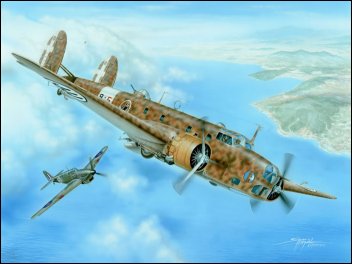
Despite performing limited bombing missions, the good results in terms of speed and sturdiness achieved by the BR.20 in Spain attracted international attention. At the time, in fact, the Japanese Government was looking for a modern bomber to replace its ageing Mitsubishi Ki-1 Type 93 then in service with the Imperial Japanese Army Air Force in the conflict with China. This was a stop-gap measure while Japanese industry could produce in quantity the new Mitsubishi Ki-21 Type 97 medium bomber (Allied Codename 'Sally'). After also evaluating the Caproni Ca.135, the Japanese Government signed a contract with Fiat for the supply of 72 BR.20, complete with engines and spares, for the rather high price - at the time - of around 182 million Liras, plus another 25 million Liras for a second batch of ten aircraft, for a total of 82 aircraft ordered.

On January 1938 the first of 12 Japanese BR.20s shipped from Genoa by sea reaching Talien, Manchuria from where they were further forwarded to Chushuiizu (Korea) by railway, being re-assembled and test-flown under control of an Italian team of military and civil engineers. The long trip continued in-flight to China, where the first aircraft were taken in force by No.3 Independent Chutai at Nangen for the operational conversion on the new type, officially designated 'I-Shiki', or Type I (for Italian) Model 100. As soon as all aircraft arrived they were assigned to No. 15 Chutai, later joining on 1 July 1938, together with No.3 Chutai, the No. 98 Sentai of No. 7 Hikodan, later forming also a third BR.20 equipped Chutai. At a later stage, the Italian bomber eventually equipped also No. 12 Sentai of Kosyurei, Manchuria, forming two Chutai, later increased to three, while the third Sentai (No. 60) within No.7 Hikodan had already received two squadrons of Ki-21.

Operational sorties began on 5 August just before No. 98 Sentai was transferred to Hangzhou at the end of August and then to Anking early in September while No. 12 Sentai was deployed to Handai late in September and then in Manchuria. In December after a dedicated training period, the BR.20 started an intensive cycle of long-range bombing missions over Chungking. Early in May 1939 both Sentais were moved respectively to Kosyurey (No. 12) and Hoten (No. 98) in order to be equipped with the new Ki-21. However, re-equipment to the Ki-21 was delayed, allowing the BR.20 to play a part in the short non-declared conflict with the Soviet Union. In fact, on 27 June 1939 BR.20 units joined a force that bombed Tamstak-Bulak airbase, the most important operational Soviet airbase in the area. Despite active use of the bomber, the BR.20 did not raise positive comments (as far as we know) from its Japanese crews, invariably considering it insufficiently armed and prone to fire (although it should be pointed out that the fuel tanks were replaced by the Japanese for increased range - the BR.20 was not prone to fire in Italian use), criticising also engine reliability (not a complaint in Italian use). Around mid-July 1939, as soon as deliveries of the Mitsubishi Ki-21 permitted, the BR.20 was replaced in front-line units and its use was limited to training units in China and Japan. When the Pacific War broke out, none are known to have been on duty with main operational units although Allied intelligence had reported its use at least until 1942, assigning it the code-name 'Ruth'.

Reference:
Waldis P. and Pedriali F., "Ali D'Italia #23, FIAT BR.20 1a Parte", La Bancarella Aeronautica, Torino, 2006.


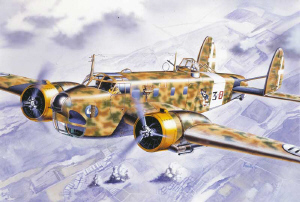
FIAT BR.20 I-Shiki (Type I) Model 100, NC.107 likely part of the second batch of 10 planes delivered to the Japanese in the classic C1 camouflage scheme that superseded the three tone banded scheme in 1938. Note how the underwing surfaces are masked out to accept the Italian underwing fasces, evidently much larger in diameter than the Japanese Hinomaru.

Construction

The Subject
This is the Italeri 1/72 FIAT BR.20. This model is a BR.20 with the 12th and 98th Sentai in June 1938. Seventy-two machines were delivered to Japan and used in northeast China. They flew long-range missions against Chungking, Lanzhou and other targets in the summer of 1938. They were all withdrawn from Japanese service by the time of the Japanese attack on Pearl Harbor, due to newer more effective Japanese bombers like the Ki-21. Markings are from the Kora decal set "Fiat BR.20 Type I over China Part III: (#72.282). The BR.20 was assigned the Allied codename "Ruth" and designated the I-Type (Yi-shiki).

Most of the model is built out-of-box, but I accurized the cockpit, by scratch-building a single cross-bar control column (stretched across and in front of the pilot and co-pilot) replacing the two separate vertical control columns provided in the kit. Some side-wall details were then added from spare parts, including the fuselage frame structures, some control console and a small navigator’s table.

Painting
This Mimetico scheme uses a “sand” base (Giallo Mimetico 4), with patches of olive green (Verde Mimetico) and dark reddish-brown (Marrone Mimetico). The under surfaces were painted in flat aluminum (Minio Opaco) but later transitioned to blue-grey (Grigio Azzuro similar to FS36307).

For the sand base, I mixed AK RC282 with RC064 (2:1) with a few drops of brown, white and yellow. For the green camo, I used the old Gunze Aqueous H303, (AK now makes AK FS34258). For the dark-red-brown I mixed Gunze Aqueous Cocoa Brown H17 with a bit of Red + White (60:30:10).The undersides were a painted silver using Tamiya AS42 right out of the spray-can.

References
1) Arawasi Eagle Eye Series No.3 Mitsubishi Ki-21 Sally & Fiat BR.20 “Cicogna” in Hinomaru.
2) Fiat BR.20. Part 1 (Ali D'Italia #23).

×

** For all Build and Paint related steps and details and additional photos, please refer to the August 2022 issue (Volume 44 / #6) of Scale Aircraft Modelling, from Guideline Publications: **

PLEASE CONSIDER SUPPORTING PRINTED MEDIA


Technical Data

Aircraft: Fiat BR.20
Manufacturer: Fiat S.A.
Type: Bomber
Year: 1937
Engine: Two Fiat A.80 R6 41, 18-cylinder radial, air-cooled, 1,000 hp each
Wingspan: 70 ft 8 in (21.53 m)
Length: 52 ft 10 in (16.10 m)
Height: 14 ft 1 in (4.30 m)
Weight: 21,850 lb (9,900 kg) (Loaded)
Maximum Speed: 286 mph (460 km/h) at 16.400 ft (5,000 m)
Ceiling: 29,500 ft (9,000 m)
Range: 1,860 miles (3,000 km)
Armament: 3 machine guns; 3,527 Ib (1,600 kg) of bombs
Crew: 5

Additional Images


STORMO! Products


August, 2022
STORMO! © 2022