|
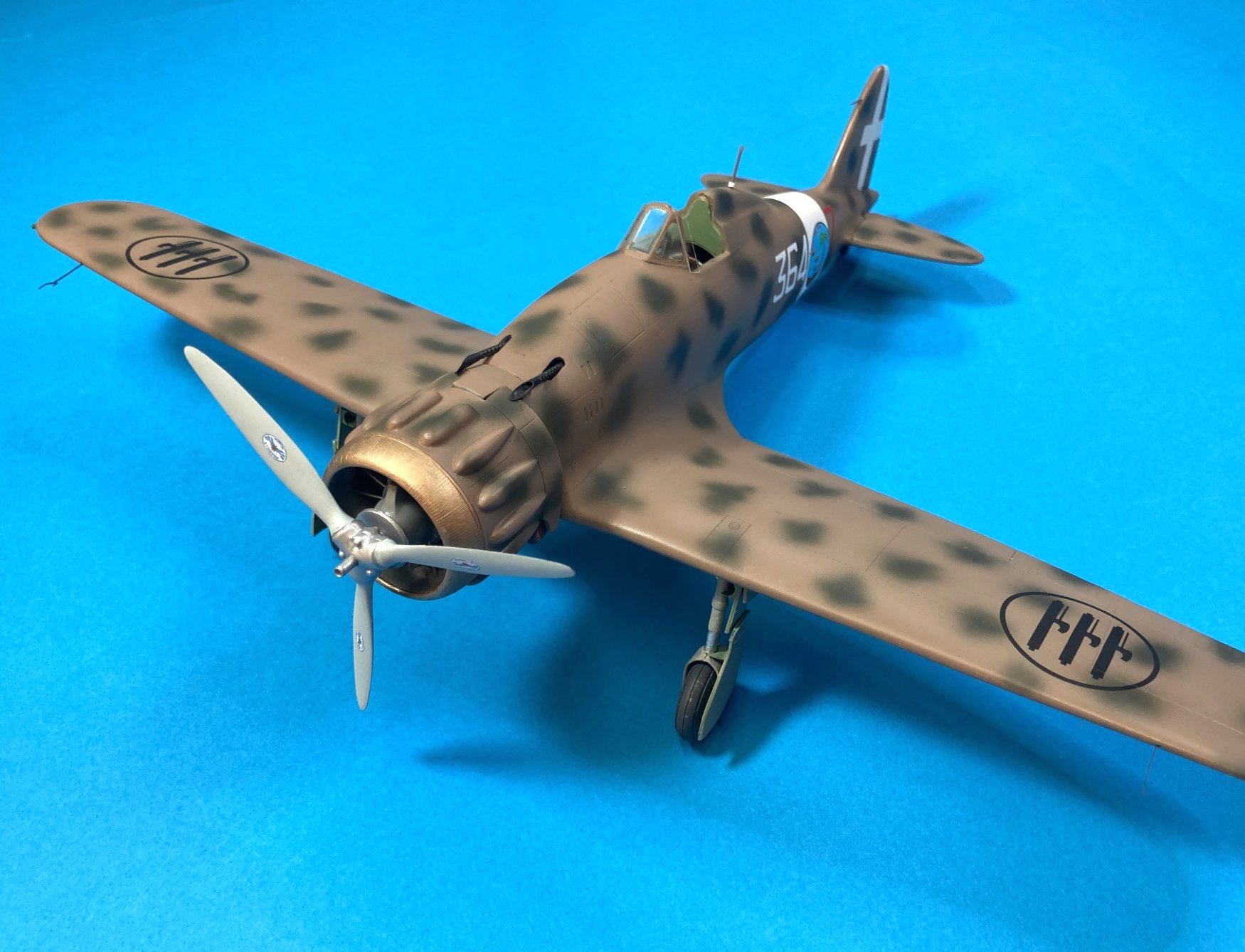
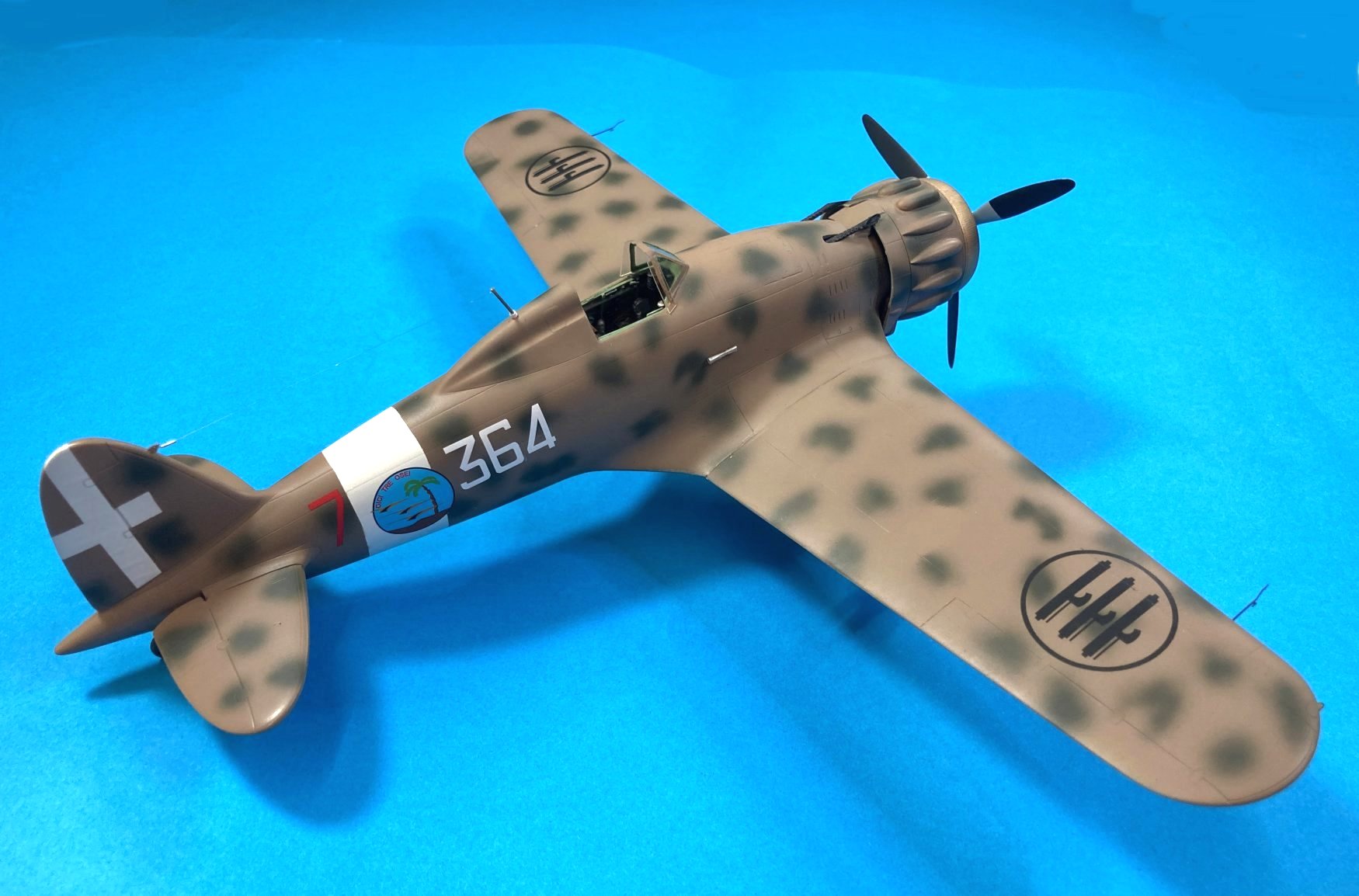
Pacific Coast Models 1/32 MC.200 Saetta (Lightning) by Dennis McCone |
|
|
|

Click the STORMO! Eagle to return to the Gallery |
|
This airplane was undoubtedly the best fighter Italy had ready at the beginning of the war. The Macchi
MC.200 was the first combat airplane designed by Mario Castoldi, who had built a series of important
racing aircraft. Until 1941, when the MC.202 appeared, the MC.200 was the main front-line Italian fighter. It
was used on all fronts and proved to be agile and sturdy, and although it was armed with two
machine guns, the 0.5 caliber guns provided greater hitting power and a longer trajectory than contemproary 0.303 guns
found on British aircraft. Few modifications were carried out during the course of its production, and a total
of 1,151 planes were built between June 1939 and July 1942. Mario Castoldi began the project in 1937, and his experience in building seaplane racers proved invaluable (he designed the Macchi M.39, which won the Schneider Trophy in 1926, and his most recent plane, the MC.72, set a world speed record for its class in 1934 which still holds today). His MC.200 design combined the massive nose of the radial engine with a small slender fuselage, and the result was an airplane that was extremely advanced aerodynamically. The airplane was all-metal, and the under-carriage was retractable. The first models had a closed cockpit, while later ones had an open cockpit with a windshield and rear fairing. Power was provided by an 870 hp Fiat A.74 RC 38 14-cylinder radial engine, which drove a three-blade metal propeller with variable pitch. Standard armament at the time consisted of two 12.7 mm machine guns behind the engine cowling and synchronized to fire through the propeller disc. The prototype took to the air on December 24, 1937, but it took some time to resolve all the problems (including initial stability difficulties). It was accepted by the authorities in 1938 and went into large-scale production. The first airplanes started coming off the assembly line in the summer of 1939, and when Italy entered the war, there were 144 aircraft in service with fighter units. The Macchi MC.200 reached full operational efficiency only late in 1940. The profile of the wing was changed for aerodynamic reasons, and the sliding canopy was removed from the cockpit so that the pilot could bail out more easily. The airplane was first used in large-scale operations on the Greece-Albania front, where the airplane was in direct competition with the British Hurricane, in which it was superior to. The MC.200 later saw duty in Africa and Russia, and in these operations proved to be sturdy and reliable. When the newer MC.202s appeared, the MC.200 was gradually reassigned to other duties. It saw service in attack, escort, and, in Italy, interceptor missions. In September 1943, most of the 52 survivors went south to join the Allies, while a few went north. They were used as trainers and remained in service until 1947. Reference: [1] Angelucci E. and P. Matricardi, "World Aircraft, Commercial Aircraft 1935-1960", Sampson Low Guides, 1979
This unit first received the CR 42 in May 1939, replacing its CR 32s, which it had flown since 1936. Operations began over metropolitan France. A CR 42 from 364 Sq intercepted RAF bombers, based in France, over Torino on 14 June. On 23 October the Gruppo became Autonomo and moved to Albania. From 28 October 1940 the unit was very active over Greece. It was split, with twelve fighters each, between Tirana (363 Sq), Valona (364 Sq), and Argirocastro (365 Sq). During initial operations it began converting to MC 200s. Scutari was sometimes used by 365 Sq. During this period there were many clashes with RAF Gladiators. At the start of the Yugoslav campaign the unit had twenty Macchis operational, mainly at Valona. After the Balkan success one squadriglia was detached to Greece for convoy escort duties. The other two followed from Tirana after a brief period of anti-partisan patrols. At the end of the year the unit left for Africa. There followed an intensive period of escort duties, low-level strafing and fighter sweeps through spring 1942. A scetion of MC.202s was used in July from Benghasi. Besides protecting the port they also escorted convoys between Tripoli and Tobruk. On 20 September the unit had twenty-five MC 200s on charge. On November it left its surviving aircraft to 8 Gruppo and, four days later, flew by SAS from Derna to Lecce. 1943 found the unit re-equipping with Messerschmitt Bf 109 fighters, transferred fron the Luftwaffe’s JG 53. After the initial reaction to its comparative lack of manoeuvrability, the pilots began to appreciate its potent weapon and speed. Conversion did not take long, much to the surprise of the Germans. While working up on these, a section of three MC 202s was detached to Furbara. By April the Gruppo was involved in defensive operations over Sicily. It received forty-nine Bf 109F-4s, G-4s and G-6s. Many of these aircraft were, however, lost to bombing raids. It is thought that only one or two Bf 109Fs were used operationally. In May only three contacts were made with enemy aircraft. A local investigation reported that cover was insufficient because of a slow take-off procedure, poor interception rate, and the late return of airborne aircraft preventing follow-up scrambles (a condition aggravated by German operations in the same area). The unit suggested better warning systems (similar to the Germans), and combining all canon-armed fighters under one command for anti-bomber operations, leaving other aircraft free to take on the escorts. Time was against setting this up, with the appropriate training required. Training was delayed because of continuous scrambles and bombings, and the scarcity of spares and supplies. Altitude performance training was especially limited. The pilots were very enthusiastic but were wearing out due to constant readiness, and many of their aircraft were war-weary. Most of the pilots were experienced and managed to control the skies over Pantelleria in June. On the 10th problems with tyres grounded all the unit's aircraft. Oil and petrol supplies were supplemented by the Germans. While the latter could scramble twice, the Italians frequently had to sit and wait for fuel and oil, often under bombing. Even though the Axis units were at opposite ends of the base, there were problems when the Germans scrambled in all directions, while the Italians lined up for take-off. About twenty-five Bf 109Gs were available for use against the invasion forces in July. On the 3rd of that month, fourteen fighters scrambled to intercept a formation of South African Baltimore light bombers. The escort, from the USAAF, which was on its first operational mission, chased off two squadriglie but the third dived in on the unprotected formation and shot two bombers and damaged several others while braving the South Africans’ return fire and heavy German flak. Two more bombers were downed by the German anti-aircraft fire, along with one of the Bf 109Gs. Seven P-40s were claimed in the covering dogfight. The Gruppo was withdrawn to help defend Rome, then sent north to protect the industrial areas. By 7 September it was still at Torino, having left a detachment at Ciampino with four aircraft, and a Nucleo at Littoria. On the 8th the detachment scrambled before noon against a formation of USAAF bombers nearing Rome. A B-17F from the 97 BG was shot down, becoming what appears to be the last Regia Aeronautica aerial victory of the war. Source: [2] Dunning C., "Courage Alone: The Italian Airforce 1940-1943", Hikoki Publuications, Manchester, United Kingdom, 2009
Courage Alone: The Italian Airforce 1940-1943

|
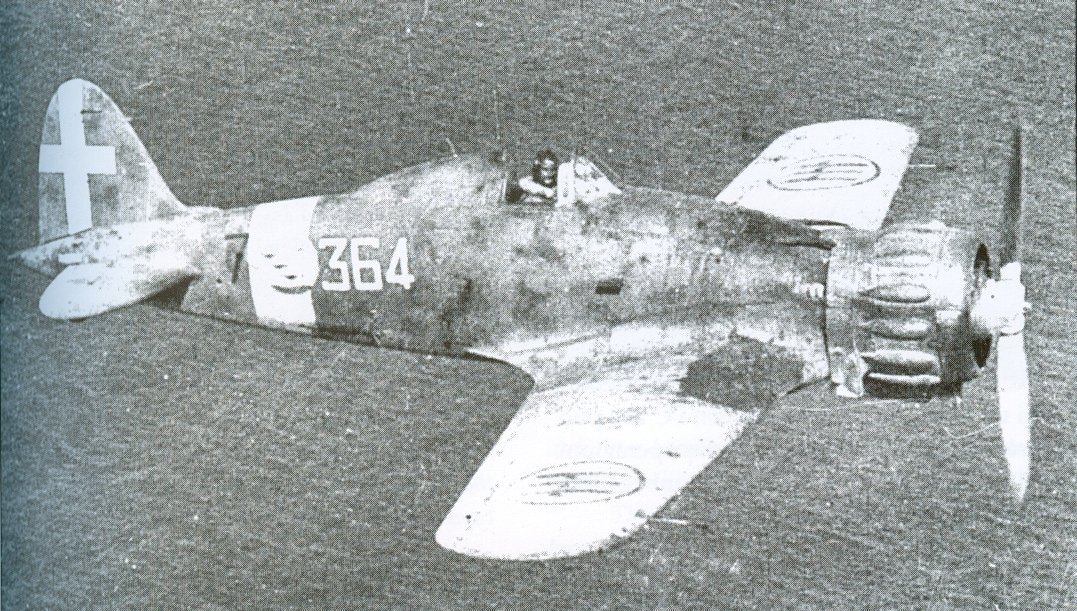
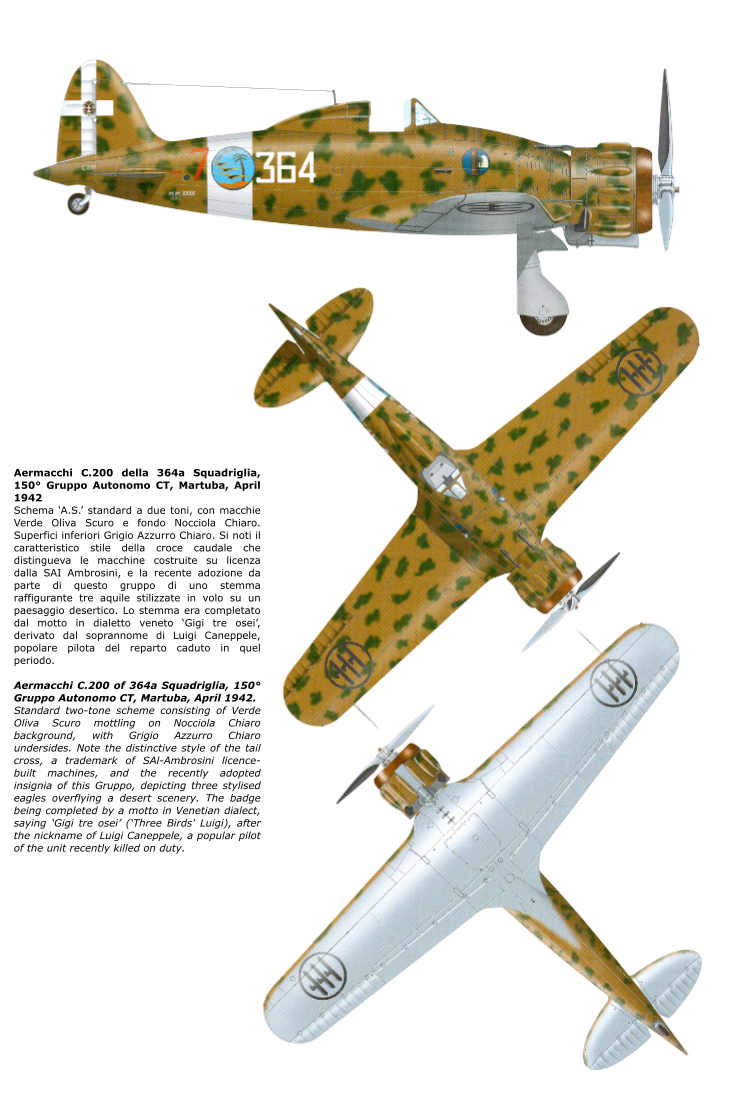
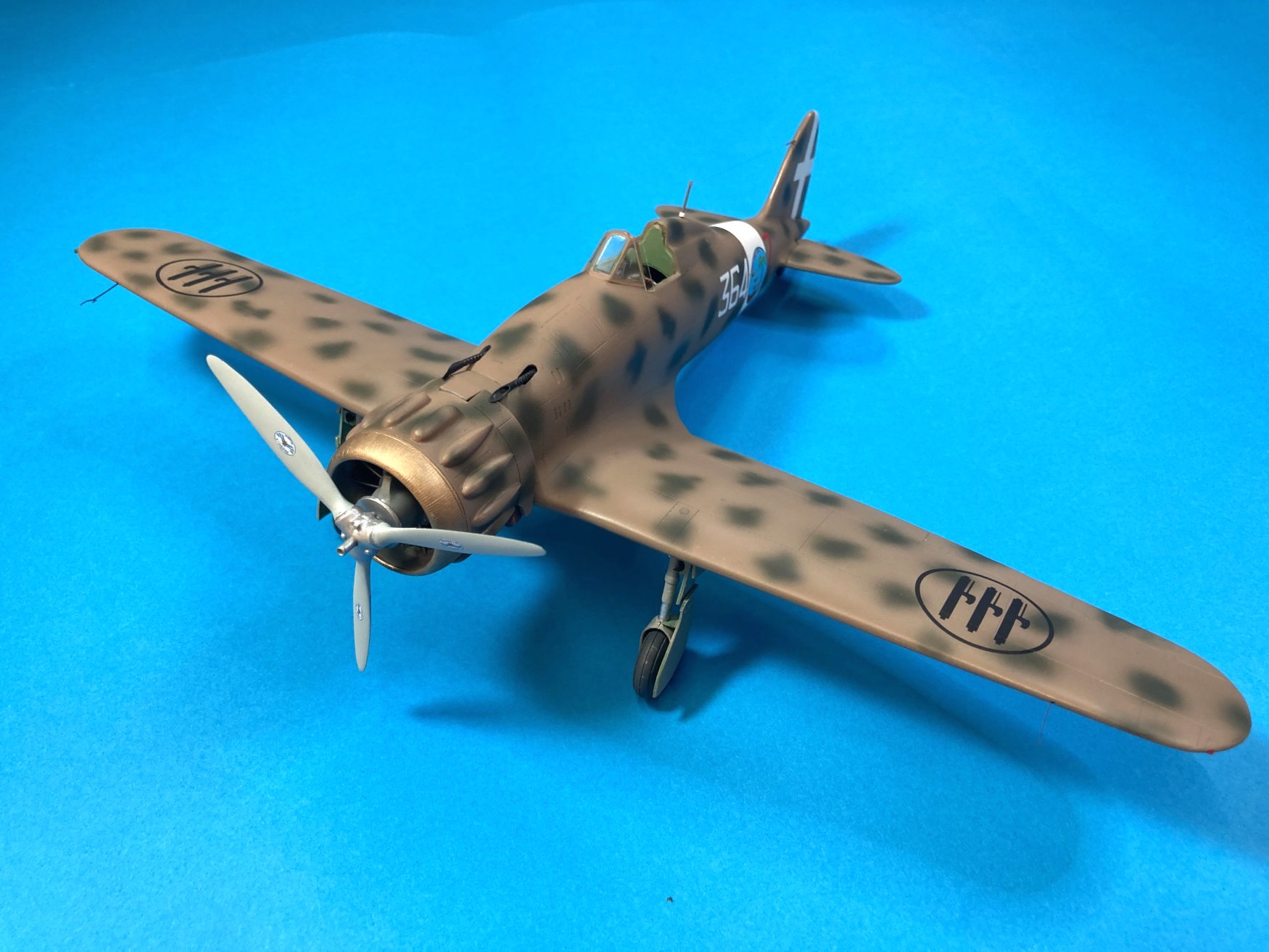
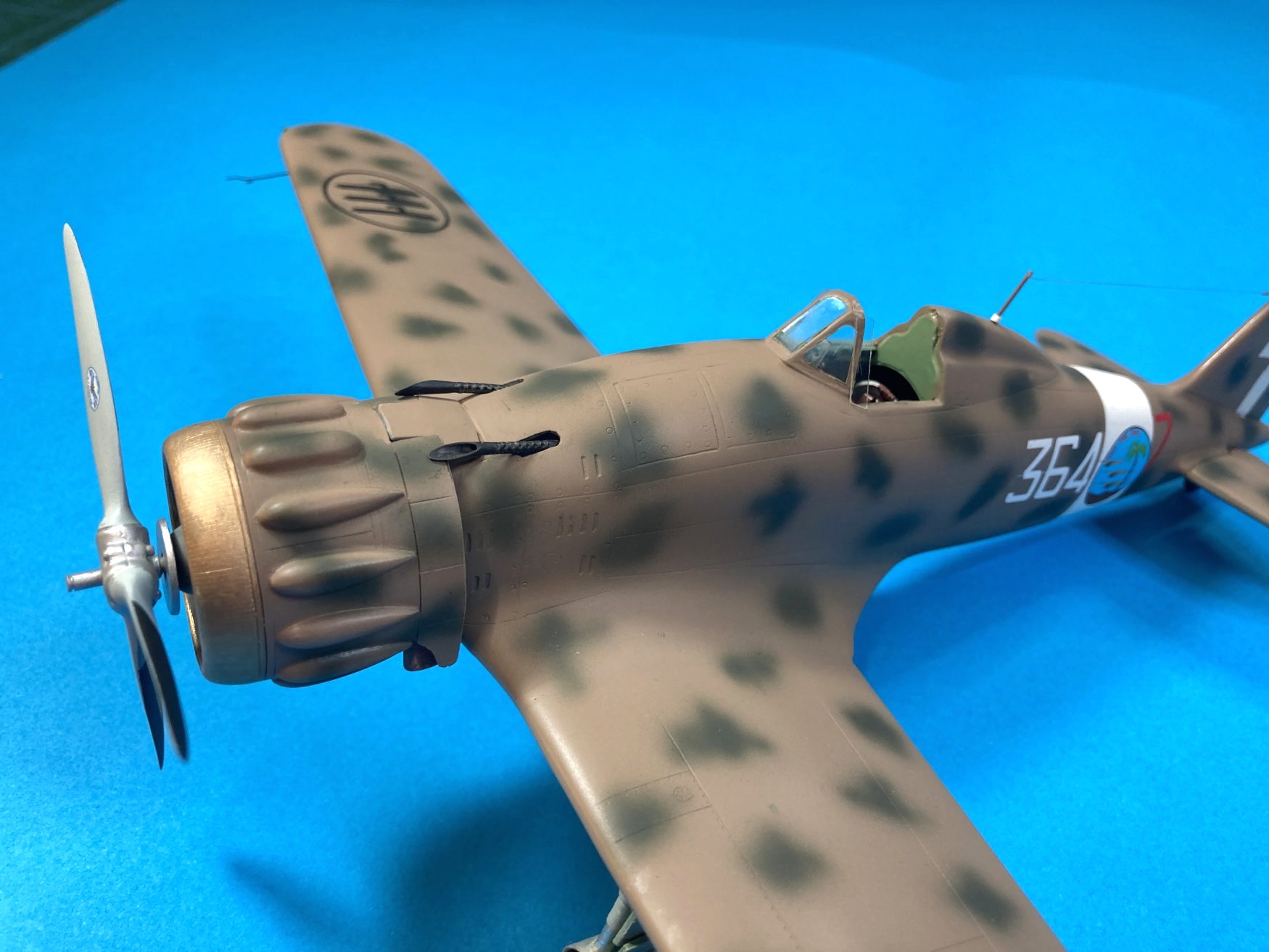
This is the Pacific Coast Models 1/32 Macchi C.200, 364-7, 150o Gruppo, North Africa, Spring 1942 in the late CMPR D2 camouflage pattern. This plane was one of the 223 C.200s manufactured by SAI Ambrosini under license at Passignano s.T. and likely part of the production batch Serie XX that included 30 machines completed between Nov-1941 - April 1942 MM.8437-8466.[8] Macchi Fighters first crossed into my modelling world with a 1/72 scale C202 either Frog or Revell I cannot remember which as I was in short pants at the time so it was a while ago. Intentionally or not the Italian WW2 aircraft come in some very interesting camouflage patterns and colours, and as in all things Italian they look to me to be very stylish. The C200 was used by the Italian air force throughout their involvement in WW2 up to the armistice in several theatres and was the forerunner of a series of aircraft culminating in the formidable C205 one of three Series 5 aircraft, all being powered by a licence-built DB-605 engine the Fiat RC 58 Tifone 1,475hp engine. Some C200’s soldiered on after the armistice on both sides but its heyday was over though some were retained until as late as 1947 as advanced trainers. Pacific Coast Models kits come with lots of resin and PE parts with a nice range of decals with several subjects but are not for the fainthearted as they are very challenging to build. They require a lot of test fitting, sanding, test fitting and more sanding. Their MC.200 Saetta is no exception but does build up to a very nice replica of the real thing. The paint scheme is as follows: Camouflage Pattern: CMPR D2 Undersides Grigio Azzurro Chiarro 1 Uppers Nocciola Chaiaro 4 Upper side patches Verde Oliva Scuro 2 Paints used: Uppers: Nocciola Chaiaro 4, Light Hazel 4, FS30219 Xtracolor X102 FS10219 Tan Vietnam. Upper Blotches Verde Oliva Scuro 2, FS35402 Xtracolor X109 FS14052 Marine Corps Green. Undersides Grigio Azzurro Chiarro 1, FS16307 Xtracolor X134 FS16307 Grey. Other Prop blades. Xtracolor X602 Sukhoi Su-27 Flanker Pale Blue FS35466. Detail painting: Humbrol including the Verde Anticorrosione, using the Humbrol Starmer mix, FS34272 using H78 and H34 (50/50) Description The Saetta was a low wing monoplane of all-metal construction with fabric covered control surfaces. Powerplant - Fiat A.74 R.C.38 14-cylinder air-cooled radial engine 870 hp Maximum Speed - 313 mph (504 km/h) Max Ceiling - 29,200 ft (8,900 m) Range - 350 miles (570 km) Length - 27 ft 1 in (8.25 m) Height - 10 ft (3.05 m) Weight - Empty: 4,330 lb (1,964 kg); Max: 5,280 lb (2,395 kg) Wing Area - 181.0 Sqft (16.82 m2) Wingspan - 34 ft 9 in (10.58 m) Armament: (2) 12.7 mm Breda SAFAT machine guns (400 RPG) under fuselage Some were modified to carry: (8) 15 kg (33 lb), (2) 50 kg (110 lb), (2) 100 kg (220 lb), or (2) 150 kg (330 lb) bombs under the wings References [3] First and foremost, the Stormo! Magazine website, thank you. [4] Macchi C.200 Saetta, Jose Fernandez MMP Books [7] AeroDetail 15, Macchi C.200/202/205, Dai Nippon Kaiga Co. Publications, Tokyo, Japan, 1995
AeroDetail 15, Macchi C.200/202/205 - Dai Nippon Kaiga Co. Publications - UBK012
 [6] Camouflage and Markings Italian Air Forces 1939-1945 Richard J. Caruana [7] Waldis P. and De Bartoli M., Regia Aeronautica Caccia e Assalto 1940-1941, Part II, La Bancarella, Torino, 2003
Regia Aeronautica Caccia e Assalto 1940-1941, Part I
 [8] Di Terlizzi Maurizio, Aviolibri Special 09 - Macchi C.200 Part II, IBN Editore, Roma, 2004
Aviolibri Special 09 - Macchi C.200 Part II by Maurizio Di Terlizzi - AVS009
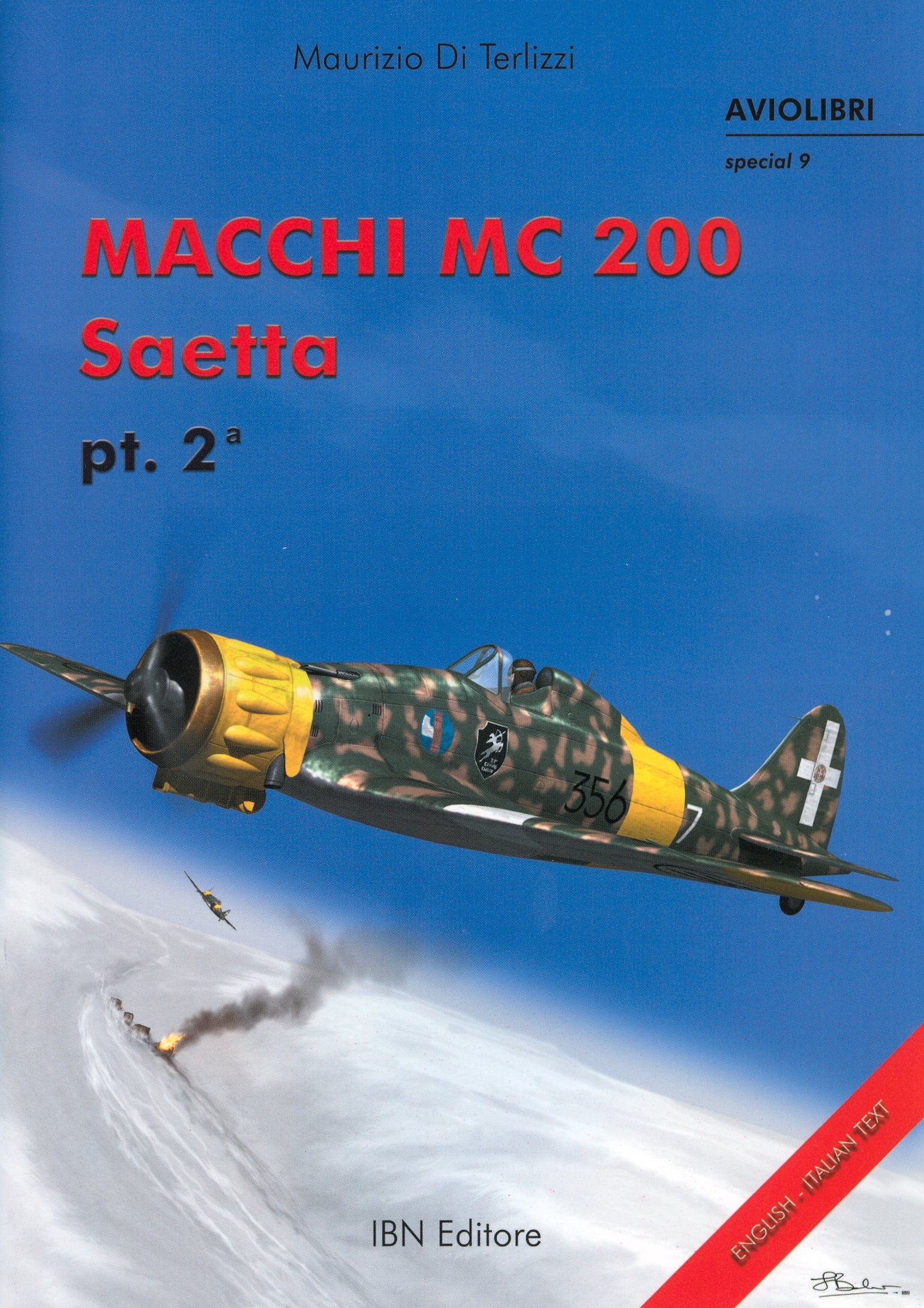

|
Aircraft: Macchi MC.200 Manufacturer: Aeronautica Macchi S.p.A. Type: Fighter Year: 1939 Engine: Fiat A.74 RC 38, 14-cyclinder radial, air-cooled, 870hp Wingspan: 34 ft 8 1/2 in (10.57m) Length: 26 ft 11 in (8.19 m) Height: 11 ft 6 in (3.51 m) Weight: 4,874 lb (2,208 kg) (Loaded) Maximum Speed: 319 mph (512 km/h) at 16,400ft (5,000 m) Ceiling: 28,700 ft (8,750 m) Range: 540 miles (870 km) Armament: 2 x 12.7 mm SAFATs (0.5 in) Crew: 1 |
|
|
|
|
|
|


|
|

|
|

|

|


|


|
|
|
|
March, 2026 STORMO! © 2026 |