|
The SM.55 prototype established fourteen records. Francesco de Pinedo flew it around the world for a
total distance of 27,230 miles (43,820 km). The plane set a series of endurance and distance records. And
it made two Atlantic crossings in formation, in 1930 and 1933, with Italo Balbo at the controls. The SM.55 was
world-famous from the middle 1920s until the middle of the 1930s. Alessandro Marchetti's plane was a remarkable aircraft.
The SM.55 appeared in 1924. The air force was looking for a torpedo-launching seaplane, and the designer
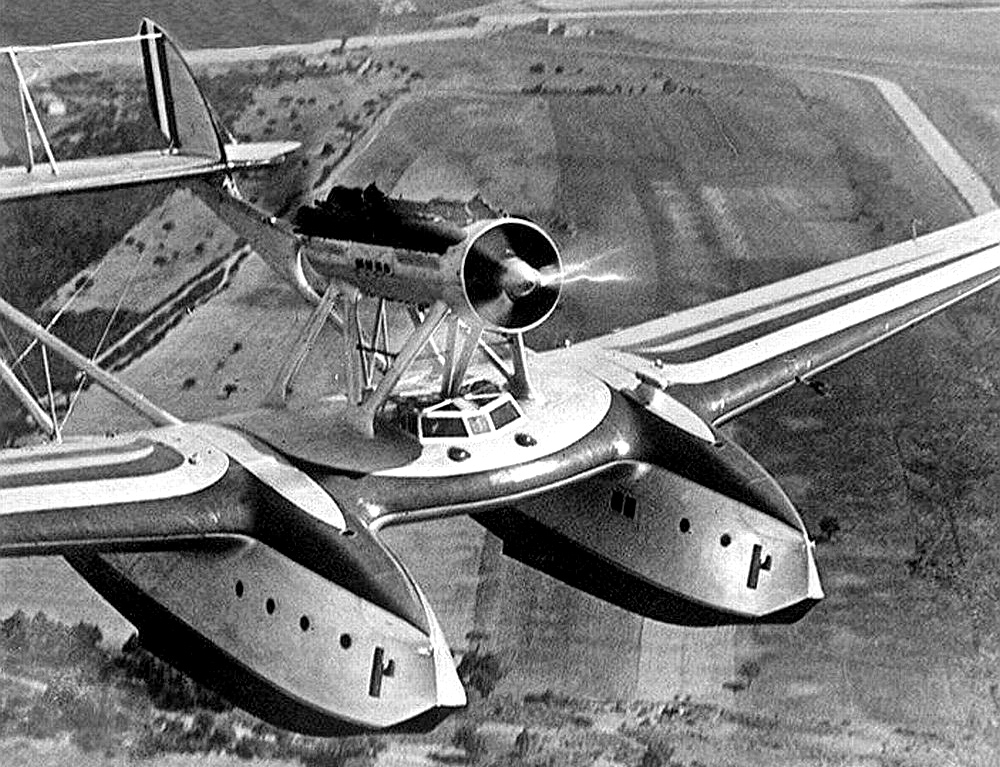
found several original solutions for the technical problems that had to be met. It was a twin-hull flying boat, and
the tail was supported by two booms extending from the hulls. The two engines were installed above the cenral section
of the wing on a trellis-like structure. The cockpit was in the wing between the two hulls, while fuel tanks, radio,
gun and sighting turret were housed in the hulls. Torpedoes or bombs were suspended from the lower side of the wing
between the two hulls. Not only did the plane perform well on water and in the air, but it was designed in such a way that one could
easily reach any part of the craft and, if necessary, replace the installations.
Nevertheless, the air force commission found the plane too unorthodox for its tastes, and two years went by
before the aircraft's merits were fully appreciated. The Italian air force ordered the SM.55 in 1925 and was so
satisfied with its performance that 170 models were manufactured beginning in 1926. There were several variant
models, with different structural details and varying performance, weight, and size. In some cases more powerful
engines were installed. There were three military versions, the A, M, and X models and two civilian versions,
the C and P models. In place of armament and military equipment, the civilian models had room for nine
to twelve passengers. These planes saw service, beginning in 1926, with the Aero Espresso company, the Societa
Area Mediterranea (SAM), and the Ala Littoria. Until 1937 they flew Mediterranean routes.
The first of the SM.55s long-range flights took place in 1927. Francesco de Pinedo and Carlo Del Prete flew
one of the first military SM.55s, the Santa Maria; the armament was removed and structural reinforcements
were applied. At 7.35 on the morning of February 13 they took off from the seaplane port of Elmas,
Sardinia, and flew to Africa, South America, and North America. Because of the negligence of one of the
spectators in New Orleans, the Santa Maria caught fire and burned. The return flight was made aboard another
SM.55, which touched down in Rome on June 16. A total of 28,000 miles (43,820 km) had been flown across
four continents. In 1928 another flight across the South Atlantic was made with the Brazilian fliers Braga and De
Barros aboard. In June of the same year Umberto Maddalena and Stefano Cagna took part in the search for
the wreck of Umberto Nobile's dirigible in the polar region. In May and June Italo Balbo and Francesco De
Pinedo undertook the first mass air cruise in history: sixty-one planes flew more than 1,700 miles (2,800 km)
across the Mediterranean. A second group flight in the eastern Mediterranean was made the following year,
logging 2,900 miles (4,667 km).
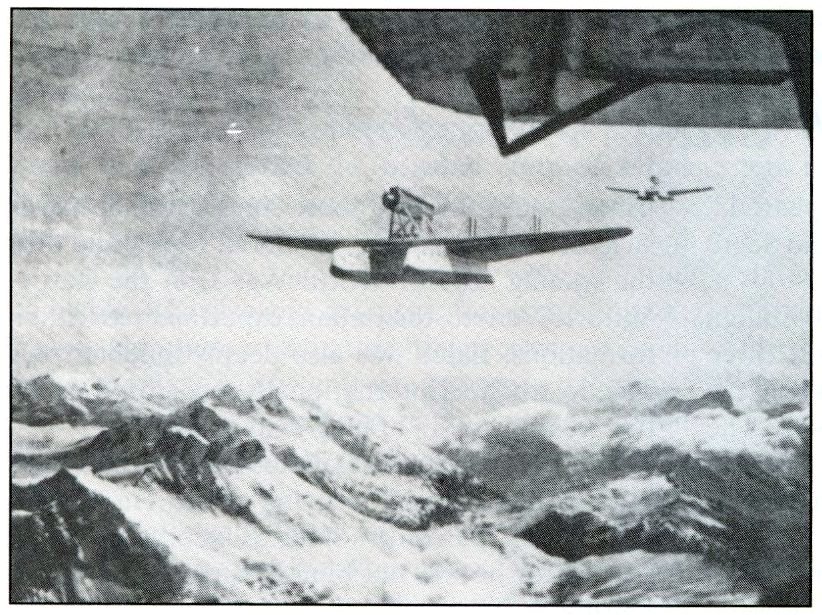
But the SM.55 is probably most famous for the two trans-Atlantic flights of 1930 and 1933. On December 17, 1930, four squadrons of
three aeroplanes - with two in reserve - set off from Orbetello under the command of Italo Balbo. The fourteen planes,
all SM.55As, reached Rio de Janeiro on January 15, 1931, after flying 6,400 miles (10,400 km) at an
average speed of 115 mph (185 km/h). The 1933 flight was in commemoration of the tenth anniversary of the
founding of the Italian air force. Twenty-five SM.55Xs, again under the command of Italo Balbo, flew
from Orbetello to New York and back to Rome. They flew 12,300 miles (19,800 km) in this double crossing of the North Atlantic.
Source:
Angelucci E. and Matricardi P., "World Aircraft 1918-1935", Sampson Low Guides, 1977.
|