CONTINUED FROM PART I - NOVEMBER 2010
The prosecution of the war saw only a limited increase in the uniformity and the standardization of colours and camouflage of CR.32s
in continental Spain, and these were observed more within Spanish units than Italian ones (finish standardization among Italian CR.32
units appeared more within each of the two Squadriglie based in the Balearic Islands: during 1938, 101ª Squadriglia maintained its
aircraft in mainly a silver-finish and 102ª Squadriglia carried the typical Italian 1936-'37 "banded-camouflage" scheme; towards the
wars end, some CR.32s with different schemes of patch-camouflage appeared within both Squadriglie). With the increasing organization
of Nationalist technical services and air-parks, such as the main establishment at Seville in Southern Spain and Logroño in the North,
some camouflage uniformity became more frequent, especially when new CR.32s arrived from Italy to Seville-Tablada where aircraft were
assembled and prepared before being assigned to new units. However, during operational service and maintenance at unit-level, initial
uniformity more-or-less rapidly disappeared. Keeping in mind, since the beginning of air operations and before the end of 1936, the
camouflage of CR.32s in Spain were at least prescribed according to the landscape and the season, but photos and analysis on dated
images and especially field-conditions show that standardization was never completely achieved, apart from some generalized finish
uniformity towards the end of the Civil War in 1938-'39.
Instead, a further kind of disuniformity developed as the war developed, generally along lines of nationality of Italian and Spanish units,
and within the Aviazione Legionaria itself, and along the various tasks performed by the different fighter Gruppi. Different applications
of colors and schemes can also be noted not only between Italian and Spanish units in camouflages: there were obvious differences in finish
even among the Italian Gruppi themselves operating in continental Spain.
This is partially explained in that different combat concepts and "battle formations" were separately developed by the “Cucaracha”,
“Asso di Bastoni” and “Gamba di Ferro” Gruppi in Spain (an interesting article on this matter being published by Italian Rivista
Aeronautica in May 1940, written by an ex-25ª Squadriglia’s CO, Capitano Enrico Meille, who served in Spain during 1938-'39).
However, differences associated with specific Italian and Spanish units are not considered here in detail, a general view on the
subject being considered with some examples in profiles 19 and 20 representing similarly camouflaged aircraft of XXIII Gruppo Caccia,
at the end of 1937 - early 1938, according to a scheme generally different from those of the other Groups. Moreover, particular camouflage
schemes were also tested by Italians on their CR.32s in Spain (unpublished photographic evidence).
The author also had an enlightening interview with a former member of Aviazione Legionaria, Maresciallo Giuseppe Gorini (Lucca, Tuscany,
1985), ground crew charged with camouflaging CR.32s within 25ª Squadriglia of XVI Gruppo Caccia "Cucaracha", who served as a Sergente in
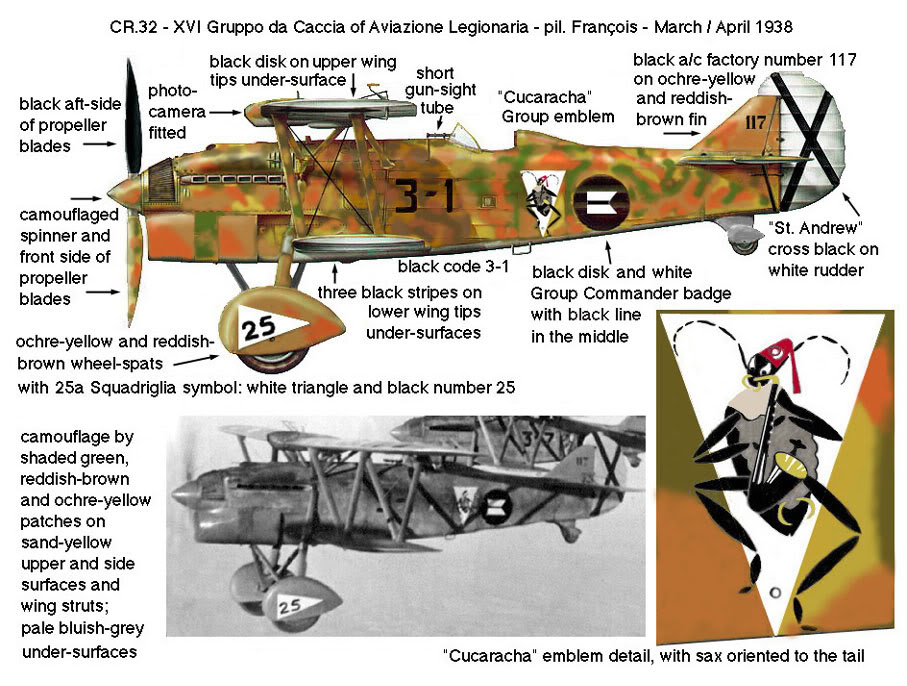
Spain since February 1938 until February 1939 at operational bases of Mas de las Matas, Caspe and Vendrell, in order (Image 4 shows an
example of a four-colour camouflage scheme applied in spring 1938 to a CR.32 from 25ª Squadriglia flown by CO of XVI Gruppo Caccia,
Maggiore Armando François - reference for colour profile 26 in the book).
|
|
Image 4 - XVI Gruppo da Caccia, Aviazione Legionaria - pil. Francois -- March/April 1938
|
|
Although reporting on the last year of the war, when in general ground crews of CR.32 units applied something more of a camouflage
standard with respect to the former period 1936-'37, Gorini too remembered the great colour variety presented by those aircraft he
helped to paint and re-paint, within his first-line unit operating from advanced bases where supplies of secondary maintenance
materials were far from regular: often, basic paints that were available were mixed in changing proportions, the results being
multiple tones and color gradations. Even multiple mixes among intended upper- and lower-surface colors were possible (for instance,
upper- and side-camouflages including sometimes bluish-grey paint during 1938-'39, both within Italian and Spanish units).
Starting from a set of five or more basic colour-paints, applying combinations of two, three or sometimes four different colours
on the same aircraft, adding mixtures of two or more different basic colour-paints in variable proportions and varying camouflage
schemes, all these and other differences in painting techniques, as by brush or spray-devices and paints more-or-less diluted or shaded,
resulted again during 1938-'39 into a great variety of CR.32 finishes, as seen in the earlier period in Spain 1937.
During 1938-'39 an attempt to standardize these schemes appeared, mainly within Spanish CR.32 units and partially among Italian
fighter Gruppi based in continental Spain, in so far as the background camouflage colour is concerned (and may be also more often
in accordance with a warm-season or cold-season paint standards).
The basic difference was application of sand-yellow (paler) or ochre-yellow (darker) as background colour for CR.32 upper- and
side-surfaces (the first colour initially intended for summer and the second one for winter periods). Camouflage was then completed
by more-or-less shaded and extended patches applied on a uniformly painted background: green patches only (two-colour camouflage) or
green and maroon patches (three-colour camouflage).
Again these four basic colours (sand-yellow, ochre-yellow, olive-green, reddish-brown) presented some variability, probably less
accentuated toward the end of the Spanish Civil War.
And again variations should be considered too, for instance: olive-green background with yellow (and maroon) patches/mottles,
greyish-green background or patches/mottles, bluish-grey also used as upper- and side-surfaces colour-paint for background
and/or patches/mottles, etc.
Examing b/w photos, a useful method to check sand-yellow (pale) or ochre-yellow (darker) colour-paints applied to aircraft is a direct
comparison with "grey-tones" corresponding to a person's flesh color (faces, hands, etc.) as seen, near to the painted surfaces, when
taken in the same light conditions. Another useful comparison can be made with "grey-tone" given by standard Italian "Marus" flying-jacket
(pale-brown) widely used by both Italian and Spanish airmen, several examples still existing today.
Sand-yellow "grey-tones" appear comparable with "grey-tones" shown by the pale flesh complexion of caucasians; for example in the book:
photos on pages 13, 17, 19, 20, 27, 30, 34, 37, 38, 40, 41, 43, 47, 48, 49, 51, 64, 65, 70, 73, 74, 75, 81. Colour profiles presenting
quite extensive sand-yellow upper- and side-surfaces are: 8, 9, 10, 12, 13, 14, 17, 19, 20, 24, 25, 28, 30, and 31.
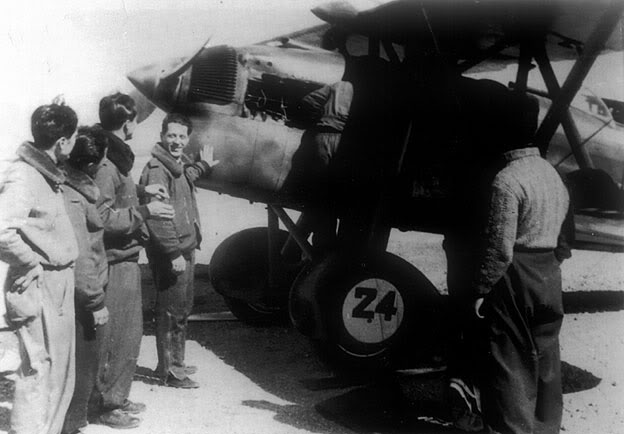
Ochre-yellow "grey-tones" appear darker than flesh "grey-tones" of caucasians; for example: photos on pages 52, 82, 84 (showing personnel from left: with pale, intermediate and dark flesh face complexions) and 85 in the book. Also, examples of CR.32s camouflaged without sand-yellow paint and by ochre-yellow background are in photos on pages 66, 72, 77, 80 - (another example being reported here in Image 5: a CR.32, later in 1938 flown by CO of 24ª Squadriglia, Capitano Giuseppe Majone, with background of upper- and side-surfaces painted ochre-yellow, where the "gray-tone" appears evidently darker than flesh "grey-tone" of the Italian airman with his hand on the forward fuselage, and lighter than the standard "Marus" flying-jacket; instead, olive-green camouflage patches appear darker than flying-jacket). In the book, colour profiles presenting quite extensive ochre-yellow upper- and side-surfaces are: 18, 22, 24, 27, 29, 32, 33, and 34.
|