TABLE OF CONTENTS
The recent release of the
as well as an upcoming publication on the same subject by artists
Alessandro and Camillo Cordasco (with more than a hundred highly detailed profiles), prompted me to update the information I had about the camouflage of this
much appreciated fighter. Since studies of this subject are almost fifty years old, and much has been discovered since, and since there is some
misunderstanding about the camouflage patterns and colors of this plane, I updated and put these thoughts in order with what is known today. I hope fellow modelers
will appreciate this effort.
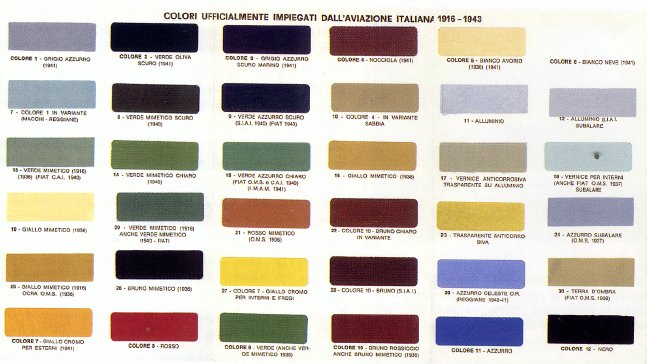
The main source on which I base this research is the well-known study by Umberto Postiglioni and Andrea Degl'Innocenti, Colori e Mimetizzazioni della Regia Aeronautica 1935-1943,
published in 1977 by the Club Modellistico Plastico Ravenna (CMPR), that summarized research by the same authors and others which appeared in the '70s in the CMPR and IPMS Italy bulletins,
and in the Italian air-enthusiast's magazine Aerei. The text was also accompanied by a table of 20 color chips, taken from various factory-original wood models, aircraft parts, wrecks,
and from an official palette called Tavola 10 (see below). This book, which soon became no longer available, was republished in 1995 in a partially revised - but not substantially updated - form
by the CMPR itself together with the Gruppo Modellistico Trentino (GMT) and the Gruppo Amici Velivoli Storici (GAVS). The color samples were this time reproduced in print - with
questionable results - but otherwise this edition had a revised classification of the color schemes, through the attribution of alpha-numeric codes that will be referenced here. In it,
the patterns are also associated with the type of aircraft and the paints used as known, or hypothesized. This book and its patterns are summarized in the
Also, in 1977 the Vitocharts were published, a lesser-known, parallel study by Virginio Tosco, a FIAT designer from the late '30s who, for his work, usually copied with tempera
the colors found on the same airplanes or took paint samples directly from the factory paint lines. It consisted of 39 color chips, which essentially included the CMPR ones,
as well as several others that have almost always been confirmed by evidence. In turn, the text is succinct and essentially unanalytical, not always comparable with the evidence
known today. The analyzed translation of the Vitochart text and a study of its colors are given here:
Another text considered, published before the ones referenced above, is Schemi e Colori Mimetici dell’Aeronautica Militare Italiana (Mucchi, 1975) by Nino Arena and Giorgio Pini, which
despite its title dealt with the paints of the Regia Aeronautica and not those of the current Aeronautica Militare Italiana. This reference mainly listed documents about paint supplies, but
it provided for the first time a reproduction of the above-mentioned Tavola 10, with the addition of a lighter variant of the hazelnut color, which was subsequently ignored by
the CMPR study, but not by Vitocharts.
An article by Giovanni Massimello in issue 76 of the Italian aircraft magazine Aerofan (Jan-Mar 2001) was also used in this work; in it the camouflage schemes of the C.202 Folgore
are carefully examined, as these were also applied to Saettas during the period in which the two aircraft were produced simultaneously.
Original color photos proved useful, not so much for establishing the exact color hue - as they often appear discolored or worn - but mainly for identifying the colors
and understanding the patterns.
As for what should be one of the main resources of any study, i.e. the paintwork remaining on the wrecks, the evidence is practically limited to the relic of the C.200 in the
Caproni Museum at Trento, the only one still with its original colors.
Regarding the paint schemes of the Regia Aeronautica in general, two periods must be considered: the first, which drew on the experience of the Spanish Civil War and included
various top-surface mottle schemes with three — sometimes more — colors with different paints depending on each manufacturer, and the second, which followed a standardization rule for paints and,
indicatively, for schemes as well. The watershed between these periods was marked by two notes from the Direzione delle Costruzioni Aeronautiche (DCA) dated July 21, 1941, and August 25, 1941,
and by communications from the Direzione Generale Costruzione Armamenti (DGCA) nos. 147 and 148 of the Bollettino Tecnico Informativo no. 8 of October 1941, which established the
characteristics of the paints and their application. These referenced to the yet-seen Tavola 10 - COLORI TIPO DELLE VERNICI, published shortly thereafter, a folder containing samples
of twelve colors for camouflage, insignia, and marking of internal systems.
Commonly, these two periods are referred to as the "pre-Tavola 10" and the "Tavola 10" (prior to Tavola 10 and the Tavola 10 periods).
For the first of these periods, as mentioned, the aircraft manufacturers that produced the C.200 were: Macchi, Breda, and SAI Ambrosini — with manufacturer applied camouflage schemes
that differed respectively, and paints it had purchased independently. The camouflage colors were essentially four: green, brown, yellow and gray (or blue-gray), sometimes in multiple shades.
During this period, different schemes could coexist within a single production batch. One possible explanation for this could be due to a pre-war color method, which provided for different
camouflage patterns for the three different seasons: A - spring, B - summer/autumn, C - autumn/winter (DGCA note 8/9/37) 1.
_________________
* Please Note, in addtion to the Tables of Contents this article contains hyperlinks (e.g. Note 1, Photo 2 etc.)
to Notes, Photos, Drawings, Camouflage chips and Supplemental Material denoted by an underscore below the reference number to help navigate this article quickly. Use the Back Arrow
button ← in your browser to return to the last point of reading.

CAMOUFLAGE PATTERNS
Aeronautica Macchi
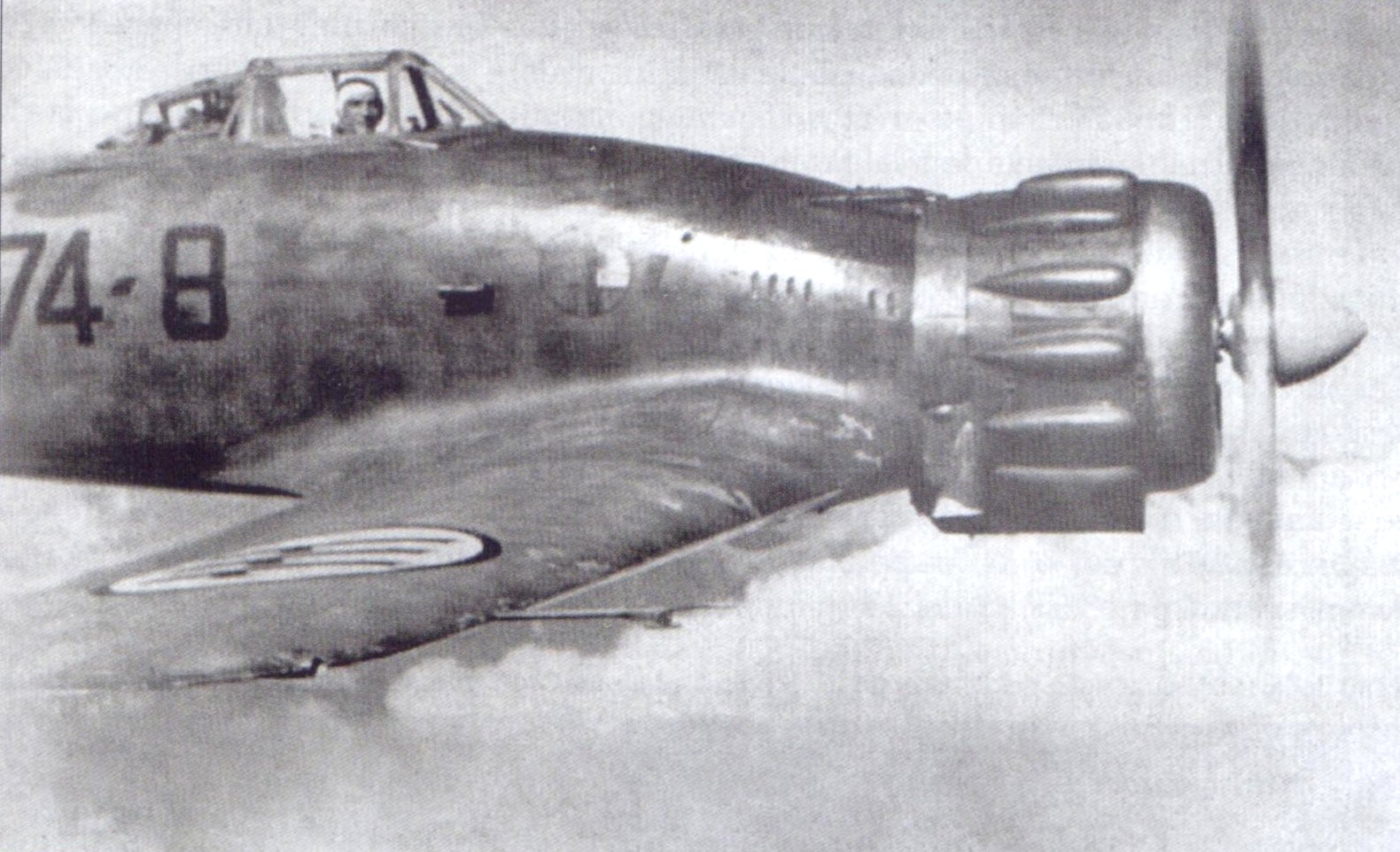
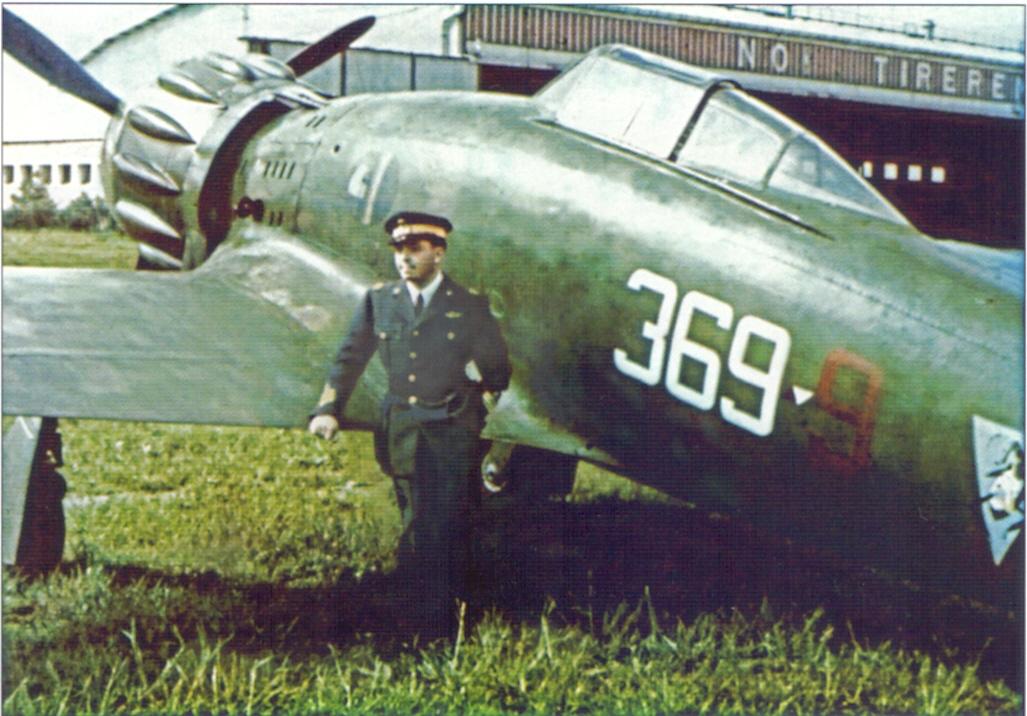
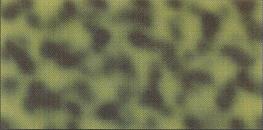 1) The very first C.200s produced by AerMacchi, perhaps a dozen or so, had an apparent camouflage of small, shaded spots of two colors, with the
background of the lighter color and the second applied as a grid (Photos 1-3).
The colors were two greens, as already stated both in the CMPR book and in the Vitocharts.
The referable pattern is the C4 type from the second edition of the CMPR book. Some images suggest a possible transition phase into the subsequent scheme, through
the addition of brown shaded spots, perhaps over the other two colors (see Note 1 (above) and Photo 2).
1) The very first C.200s produced by AerMacchi, perhaps a dozen or so, had an apparent camouflage of small, shaded spots of two colors, with the
background of the lighter color and the second applied as a grid (Photos 1-3).
The colors were two greens, as already stated both in the CMPR book and in the Vitocharts.
The referable pattern is the C4 type from the second edition of the CMPR book. Some images suggest a possible transition phase into the subsequent scheme, through
the addition of brown shaded spots, perhaps over the other two colors (see Note 1 (above) and Photo 2).
|
|
|
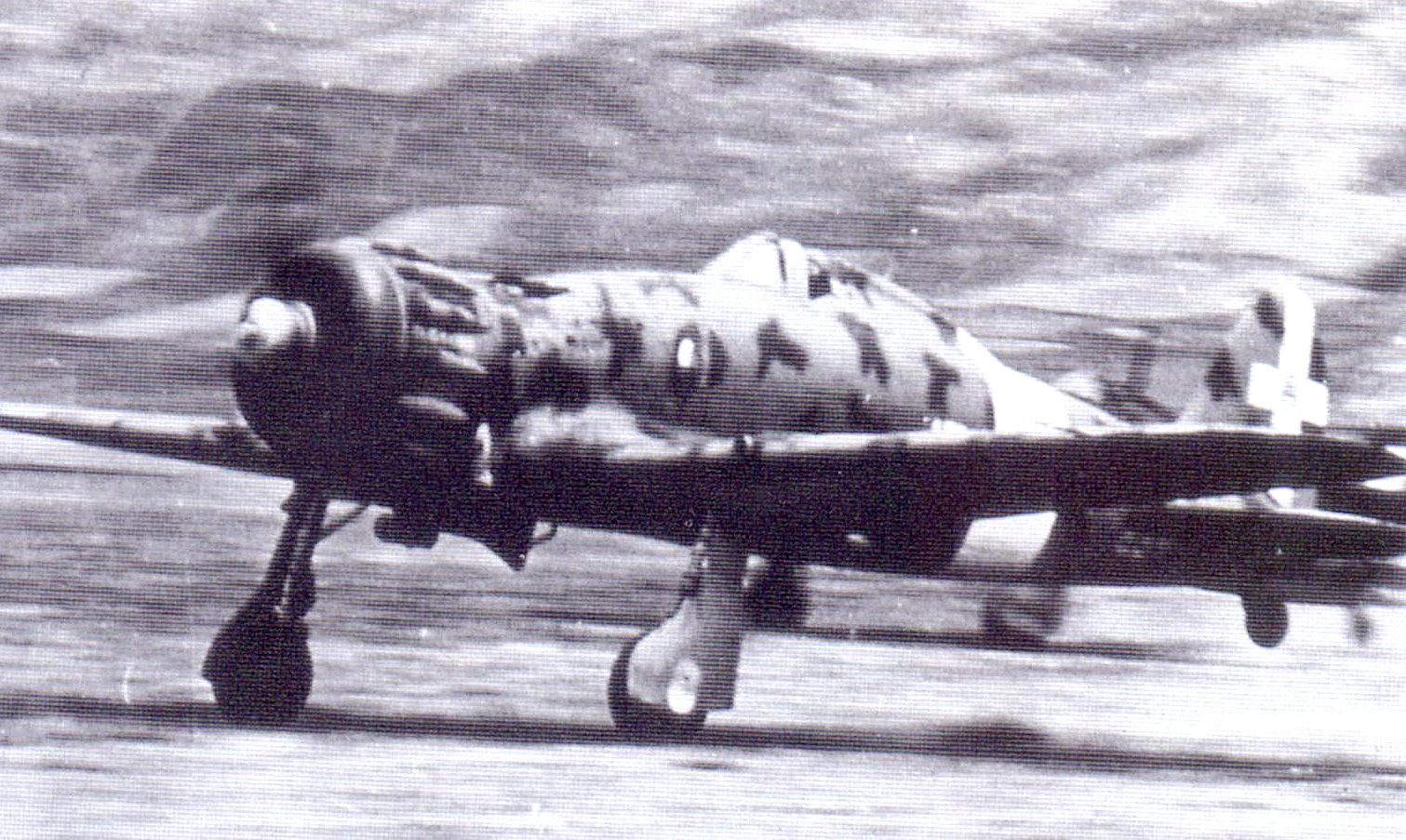
Photo 1 - One of the first 25 examples of the Macchi C.200 1a serie with FIAT-Hamilton propeller and small, dense, spotted camouflage.
|
|
|
|
Photo 2 - Cap. Giorgio Jannicelli next to a AerMacchi C.200 1a serie. Considering the quality of the photo, the fuselage appears to be a two-tone green,
while the wing appears to have some brown spots.
|
|
|
|
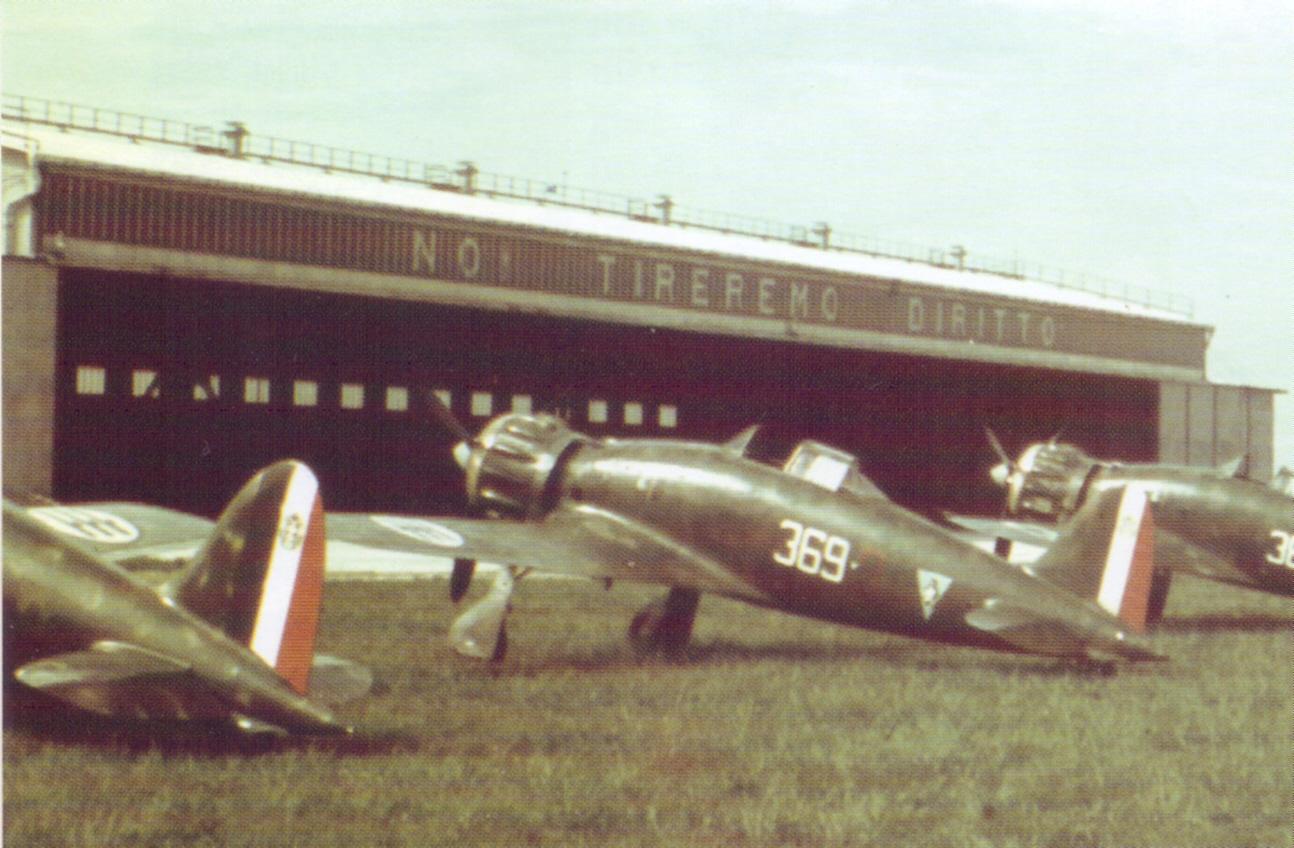
Photo 3 - Other examples from 54° Stormo. The tail in the foreground shows the new C8 camouflage, the other two are still densely spotted with two colors.
|
|
2) Still within the first 25 Macchi C.200 produced, i.e. those equipped with FIAT-Hamilton propellers, and approximately from the end of summer 1939, three colors began
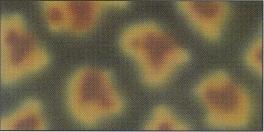 to be applied with an arrangement that would be typical of the Macchi company. This scheme, named C8 or also defined as the "poached egg" camo scheme, characterizes most
of the C.200s produced by the parent company (Photos 3-5 and 22). The analysis of scratches (from wear) on the C.200 wreck exhibited at the Caproni Museum at Trento, which
features this pattern under a second layer of olive green (see Photo 42), shows that the yellow base was applied first, then a layer of green that left more-or-less-rounded
areas of yellow and finally on top of these a brown spot that did not completely cover the underlying yellow and could marginally overflow onto the green.
to be applied with an arrangement that would be typical of the Macchi company. This scheme, named C8 or also defined as the "poached egg" camo scheme, characterizes most
of the C.200s produced by the parent company (Photos 3-5 and 22). The analysis of scratches (from wear) on the C.200 wreck exhibited at the Caproni Museum at Trento, which
features this pattern under a second layer of olive green (see Photo 42), shows that the yellow base was applied first, then a layer of green that left more-or-less-rounded
areas of yellow and finally on top of these a brown spot that did not completely cover the underlying yellow and could marginally overflow onto the green.
|
|
|
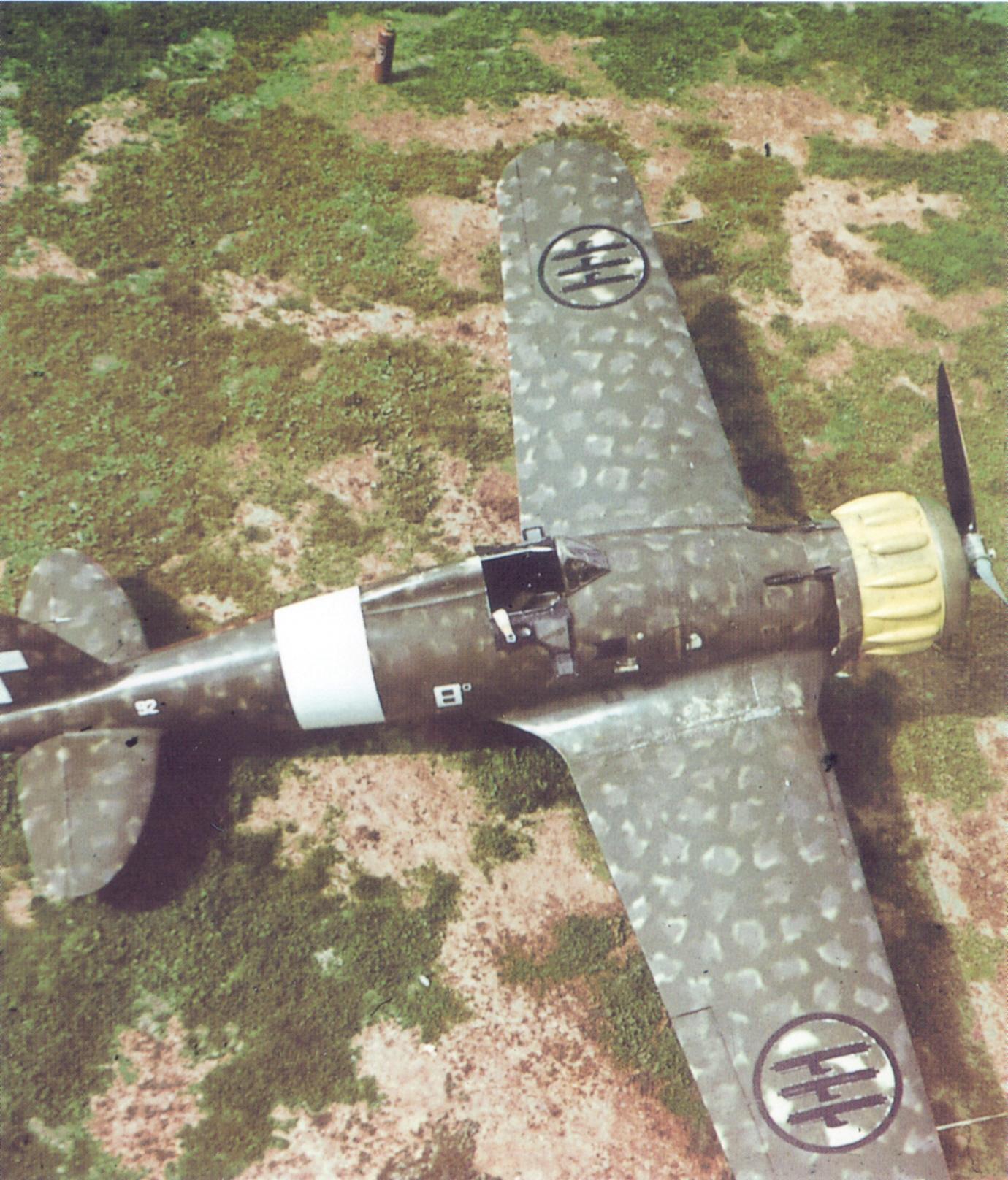
Photo 4 - Macchi C.200 MM 6537, Macchi 6a serie, personal mount of Magg. Vincenzo La Carrubba, CO of 8° Gruppo. The white background of the wing insignia
has been partially covered with green paint.
|
|
|
|
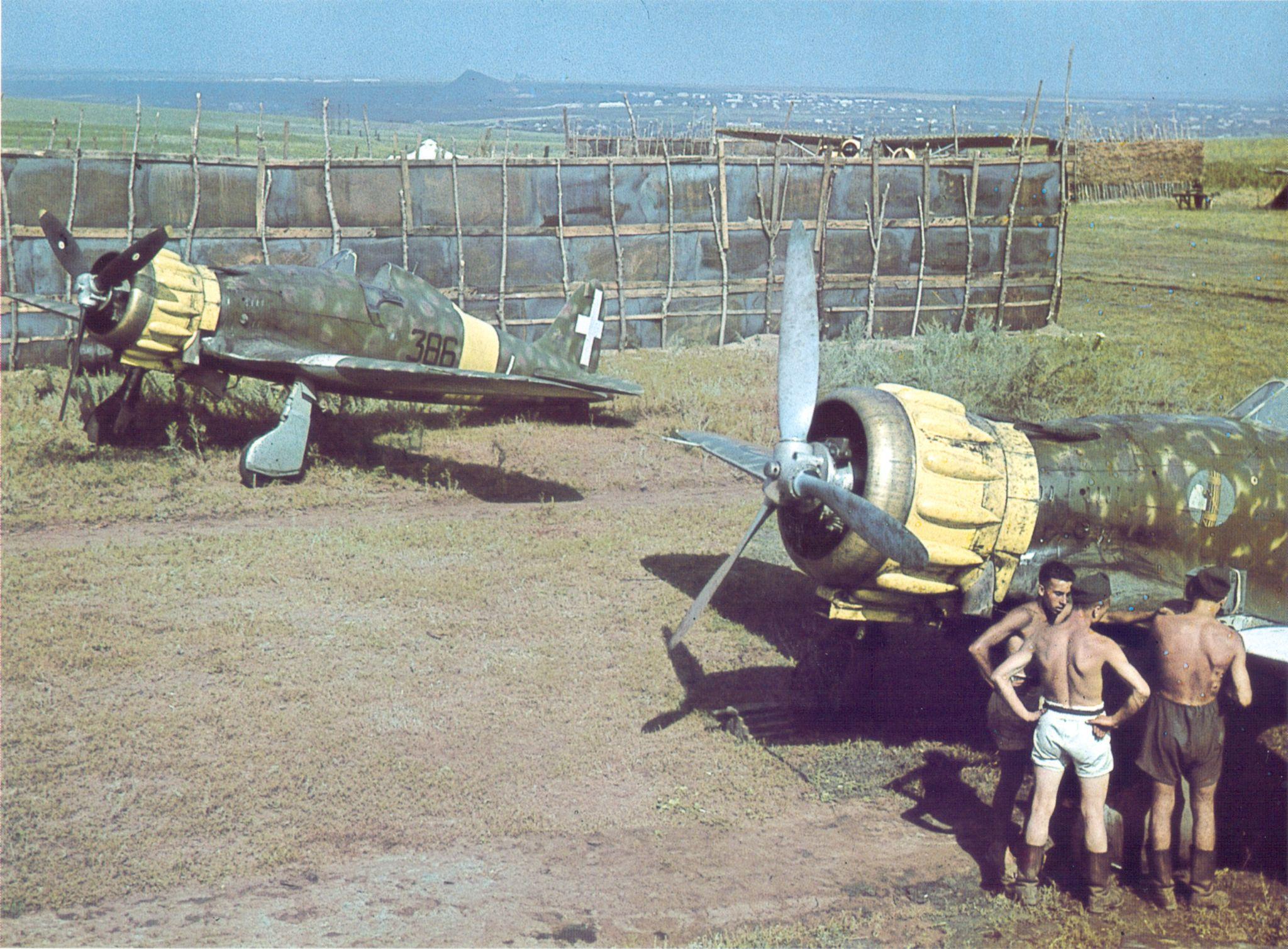
Photo 5 - C.200 two examples during the Russian campaign. Note the pale blue color on the undercarriage cover of 386-4 and on the propeller of
the example in the foreground.
|
|
With the introduction of new camouflage regulations, the aircraft were as told painted in parallel with the new C.202s and therefore, according to the Massimello study,
we have the following schemes:
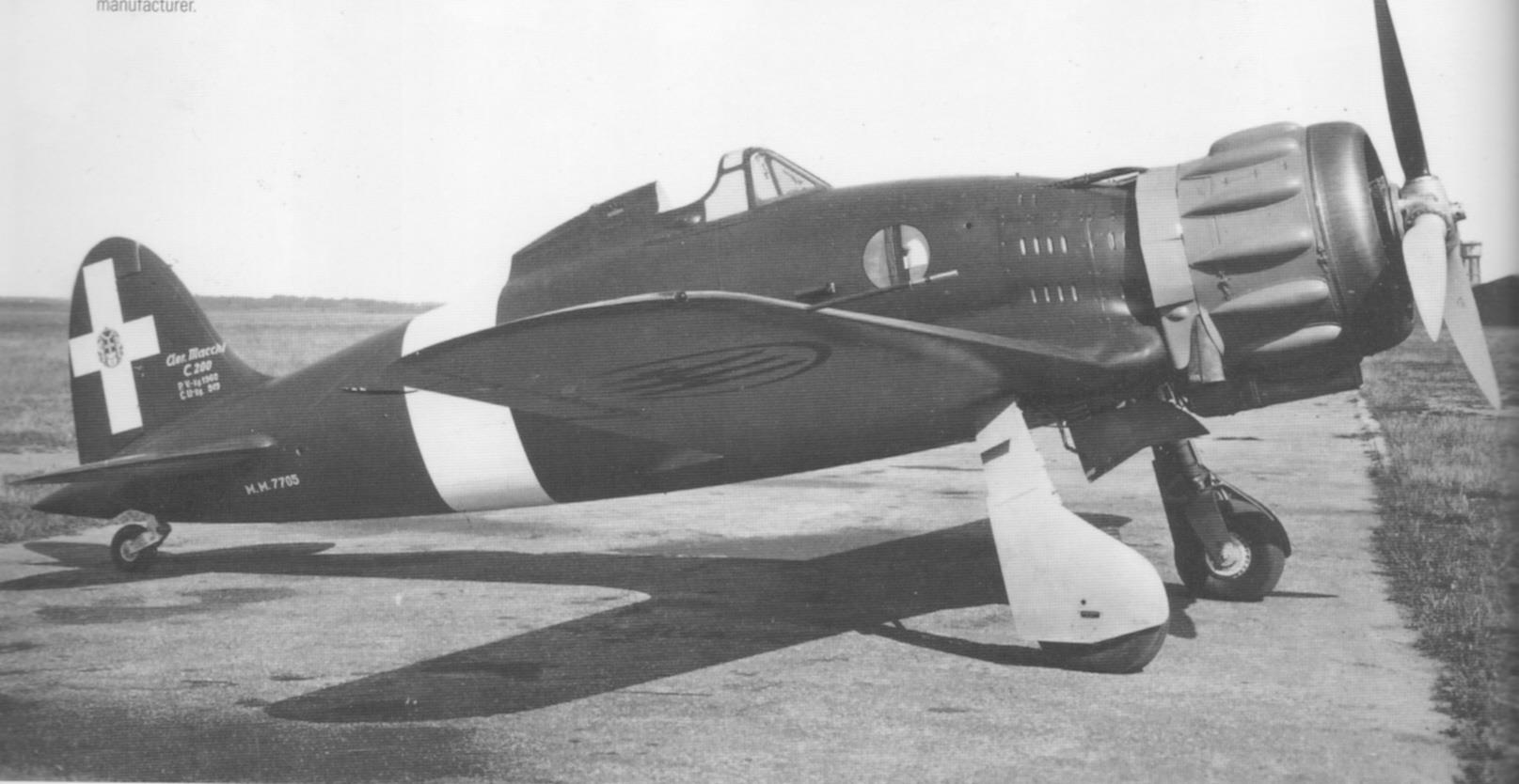
 3) By Autumn 1941, starting from the last examples of 6a serie at least from MM 7705 (Photo 6), the standard "metropolitan" scheme
was Verde Oliva Scuro 2 on top surfaces (F1).
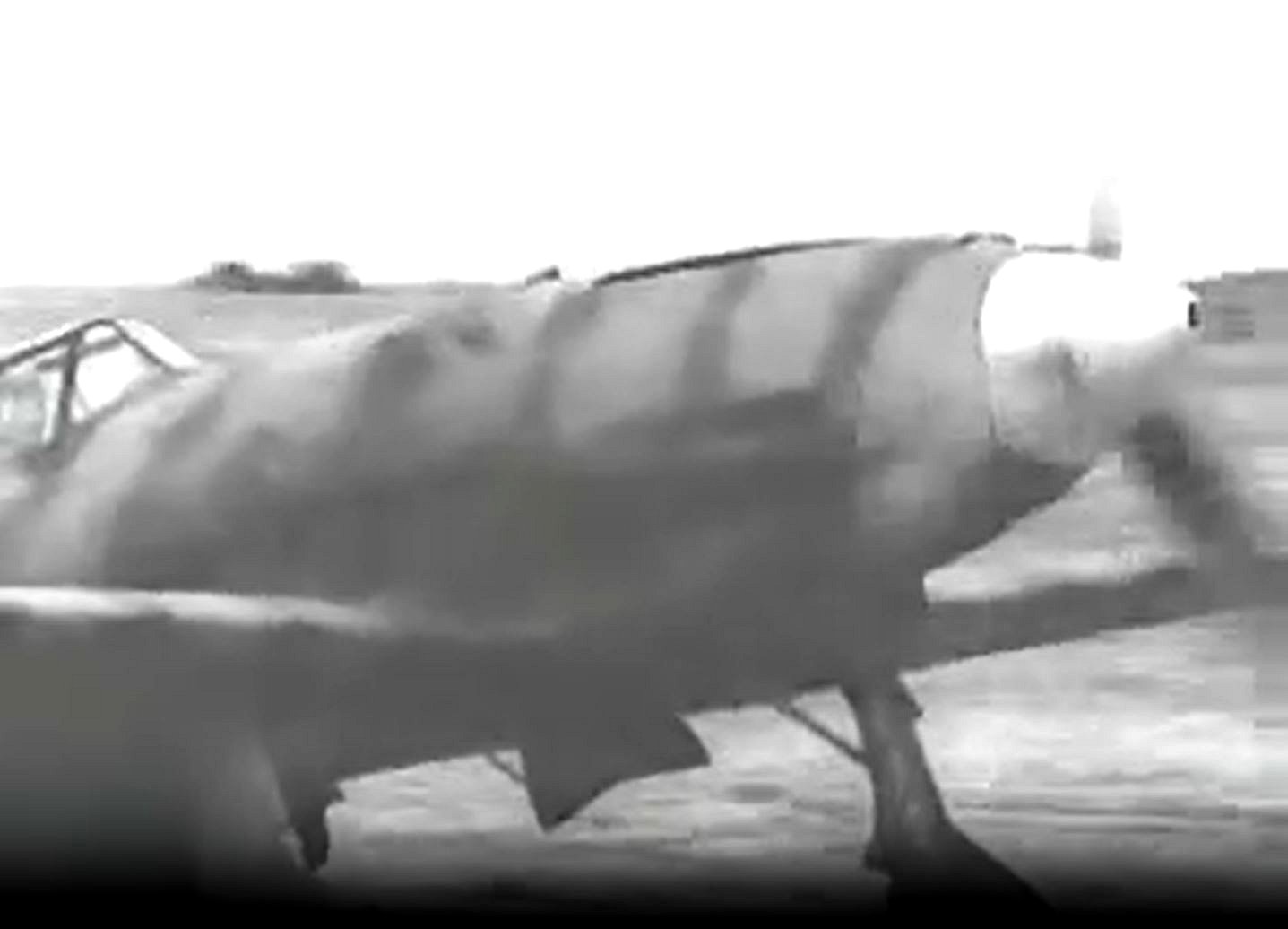
Most of the C.202s that had this scheme, belonging to 1° Stormo and about to be hurriedly sent to North Africa, received a large overspray of Nocciola Chiaro 4 which left areas
of the underlying green in the form of more or less large and shaded patches, or bands, or "tiger-like" streaks (Supplemental Photo 1),
or a soft and irregular transparency. It is not excluded that this may have also been done on some Saettas.
3) By Autumn 1941, starting from the last examples of 6a serie at least from MM 7705 (Photo 6), the standard "metropolitan" scheme
was Verde Oliva Scuro 2 on top surfaces (F1).
Most of the C.202s that had this scheme, belonging to 1° Stormo and about to be hurriedly sent to North Africa, received a large overspray of Nocciola Chiaro 4 which left areas
of the underlying green in the form of more or less large and shaded patches, or bands, or "tiger-like" streaks (Supplemental Photo 1),
or a soft and irregular transparency. It is not excluded that this may have also been done on some Saettas.
|
|
|
Photo 6 - MM 7705 in the "Metropolitan" camouflage.
|
|
|
|
Supplemental Photo 1 - a C.202 of 1° Stormo with diagonal streaks of NC4 applied over factory Verde Oliva Scuro 2. Photo Ref. Luce Video C.200/C.202.
|
|

NEW STORMO MUGS AND T-SHIRTS
|
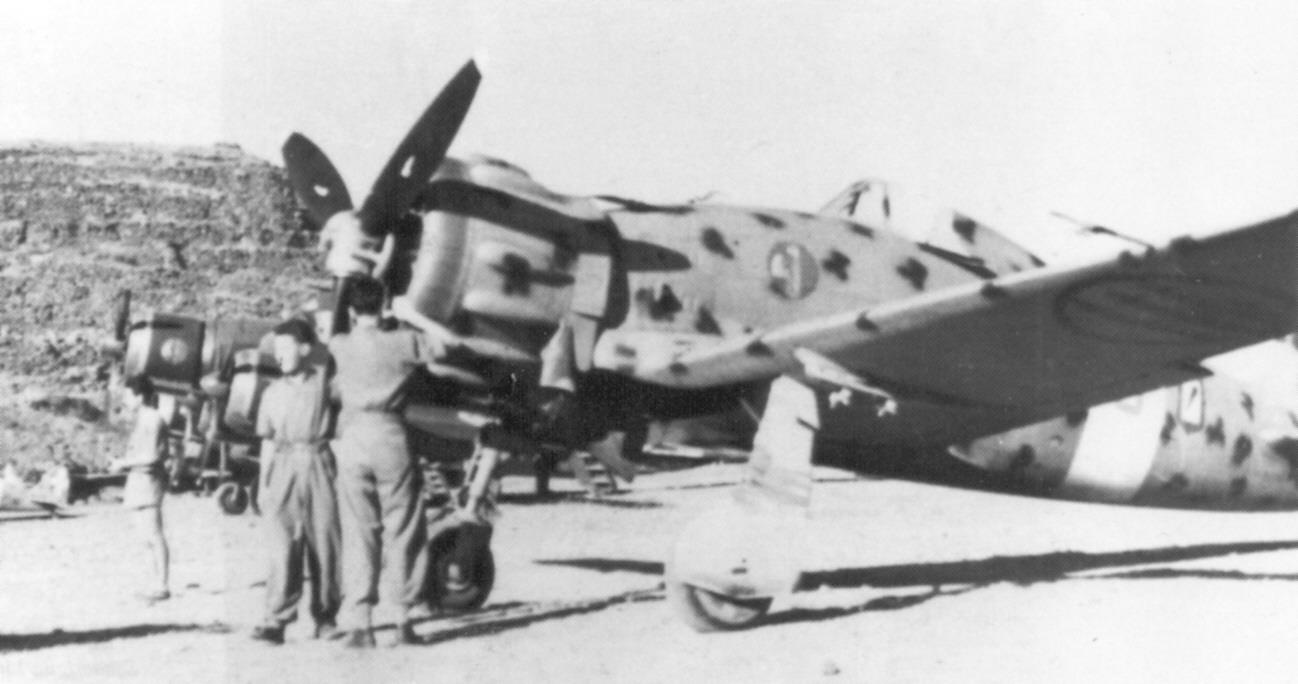
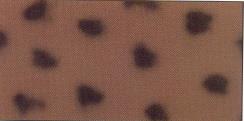 4) From November 1941 to January 1942, small, sparse, rounded or "heart-shaped" olive green spots were applied to the C.202s on light hazelnut (D2B). This is because
the bulk of the Folgores were to be sent to the North African front. It is assumed that just a limited number of Saettas were produced with this scheme, maybe ten or so
of the XXII serie 2 produced in January, because production of the C.200 by Macchi paused between September and December 1941 (Photo 7).
4) From November 1941 to January 1942, small, sparse, rounded or "heart-shaped" olive green spots were applied to the C.202s on light hazelnut (D2B). This is because
the bulk of the Folgores were to be sent to the North African front. It is assumed that just a limited number of Saettas were produced with this scheme, maybe ten or so
of the XXII serie 2 produced in January, because production of the C.200 by Macchi paused between September and December 1941 (Photo 7).
|
|
|
Photo 7 - Likely 373-8 at Pantelleria, a rare example of a C.200 with D2B camouflage. The MM is unreadable, but it should have been between 8794 and 8804.
|
|
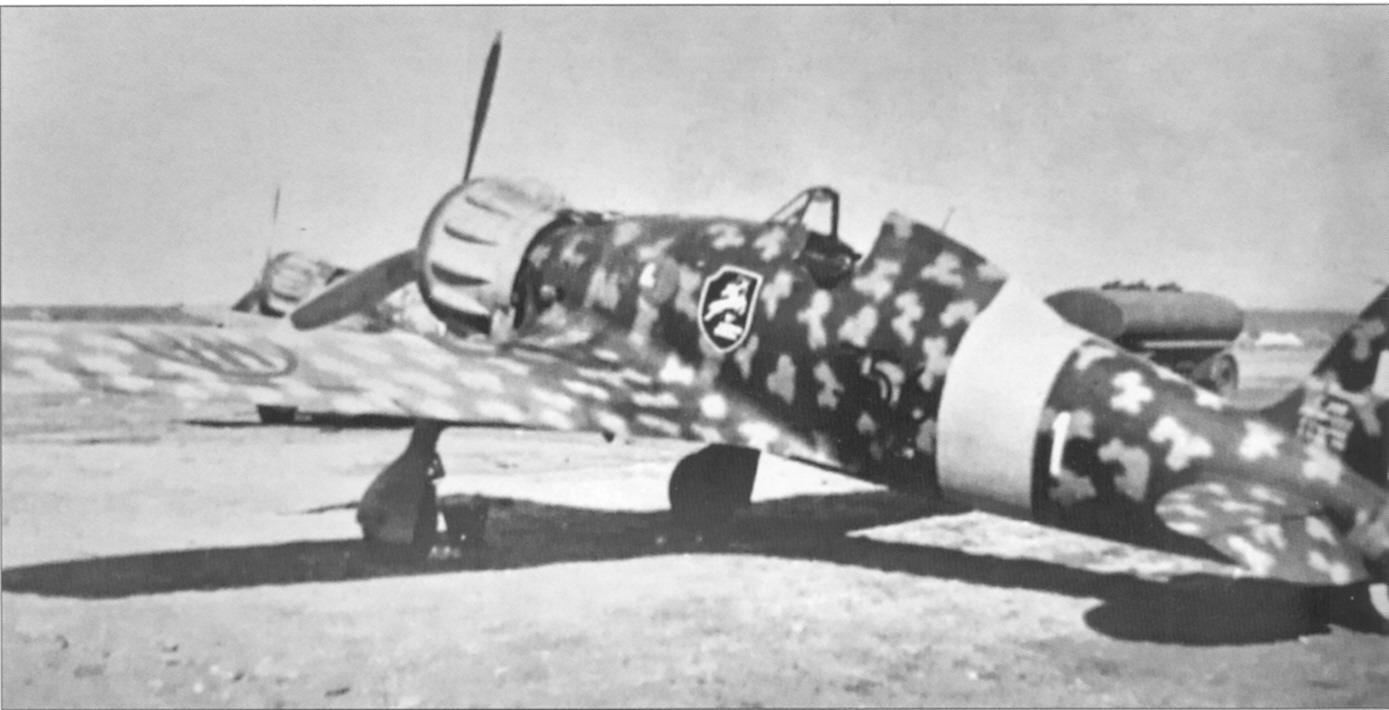
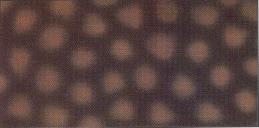 5) From February to April 1942, probably due to a literal application of the rules issued for the colonial environment 3, a pattern of small
light hazelnut spots on an olive green background was used (D1). Basically, it was the previous scheme reversed, but with more dense spotting
(Photo 8). Soon deemed inadequate for the desert environment, this scheme was applied to only thirty Folgores, and probably more
or less as many Saettas of the XXII serie, certainly at least starting from MM 8805, which were mainly sent to the Eastern front with 21° Gruppo (especially 356ª Squadriglia)
and to the Mediterranean front with 153° Gruppo.
5) From February to April 1942, probably due to a literal application of the rules issued for the colonial environment 3, a pattern of small
light hazelnut spots on an olive green background was used (D1). Basically, it was the previous scheme reversed, but with more dense spotting
(Photo 8). Soon deemed inadequate for the desert environment, this scheme was applied to only thirty Folgores, and probably more
or less as many Saettas of the XXII serie, certainly at least starting from MM 8805, which were mainly sent to the Eastern front with 21° Gruppo (especially 356ª Squadriglia)
and to the Mediterranean front with 153° Gruppo.
|
|
|
Photo 8 - 356-1 MM 8812, serie XXII, in Ukraine with the "colonial" camouflage. This should have been the personal aircraft of 356ª Squadriglia CO, Cap. Virginio
Teucci who was KiA on July 27, 1942.
|
|
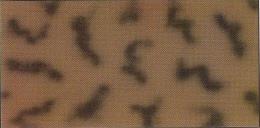 6) In April 1942, probably realizing the poor effectiveness of the previous scheme in desert environments, Macchi painted some examples of the C.202 with a
light hazelnut background and olive green "worms", in a scheme similar to the one used at the same time by Breda (D2A, see below). This was applied by Macchi to
just eight Folgores and it is possible it was also applied to some Saettas: one of them could have been the aircraft of the commander of 92ª Squadriglia which can
be seen in Photo 23. If ever, MMs should have been in the range around 8825-8830.
6) In April 1942, probably realizing the poor effectiveness of the previous scheme in desert environments, Macchi painted some examples of the C.202 with a
light hazelnut background and olive green "worms", in a scheme similar to the one used at the same time by Breda (D2A, see below). This was applied by Macchi to
just eight Folgores and it is possible it was also applied to some Saettas: one of them could have been the aircraft of the commander of 92ª Squadriglia which can
be seen in Photo 23. If ever, MMs should have been in the range around 8825-8830.
|
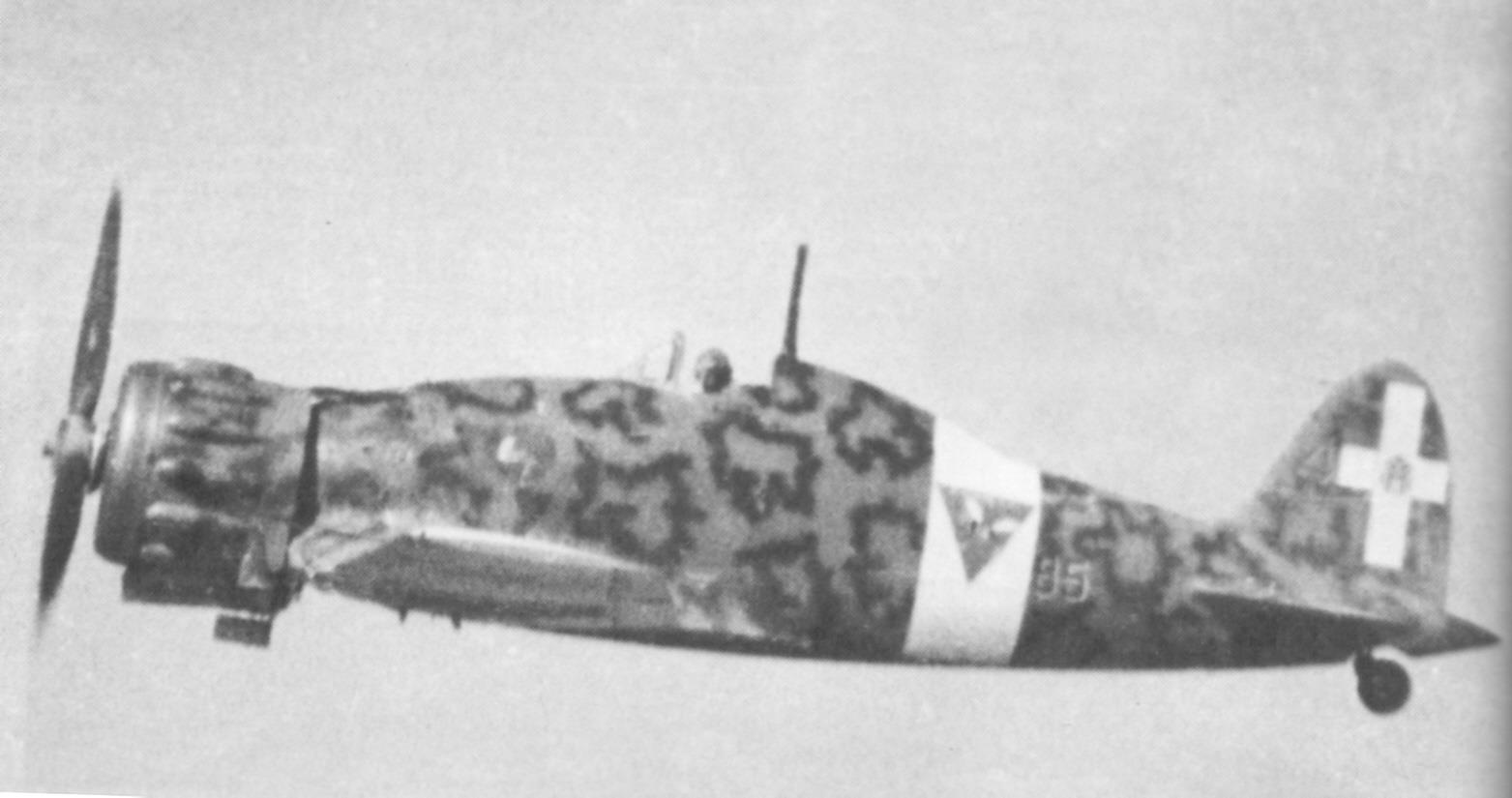
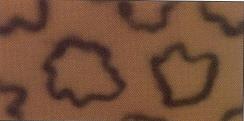 7) From the beginning of May 1942, the definitive camouflage for the Macchi fighters came into use, with olive green "smoke rings" or "amoebas" on a
light hazelnut background (D3). All the C.202s of the VII, IX and XIII series and the C.205s of the Regia Aeronautica had this scheme, but only
the last examples of the C.200s of the XXII serie, perhaps one dozen or two, were camouflaged in this way (Photo 9), other than some repainting carried out in
the same period (Photo 10).
7) From the beginning of May 1942, the definitive camouflage for the Macchi fighters came into use, with olive green "smoke rings" or "amoebas" on a
light hazelnut background (D3). All the C.202s of the VII, IX and XIII series and the C.205s of the Regia Aeronautica had this scheme, but only
the last examples of the C.200s of the XXII serie, perhaps one dozen or two, were camouflaged in this way (Photo 9), other than some repainting carried out in
the same period (Photo 10).
|
|
|
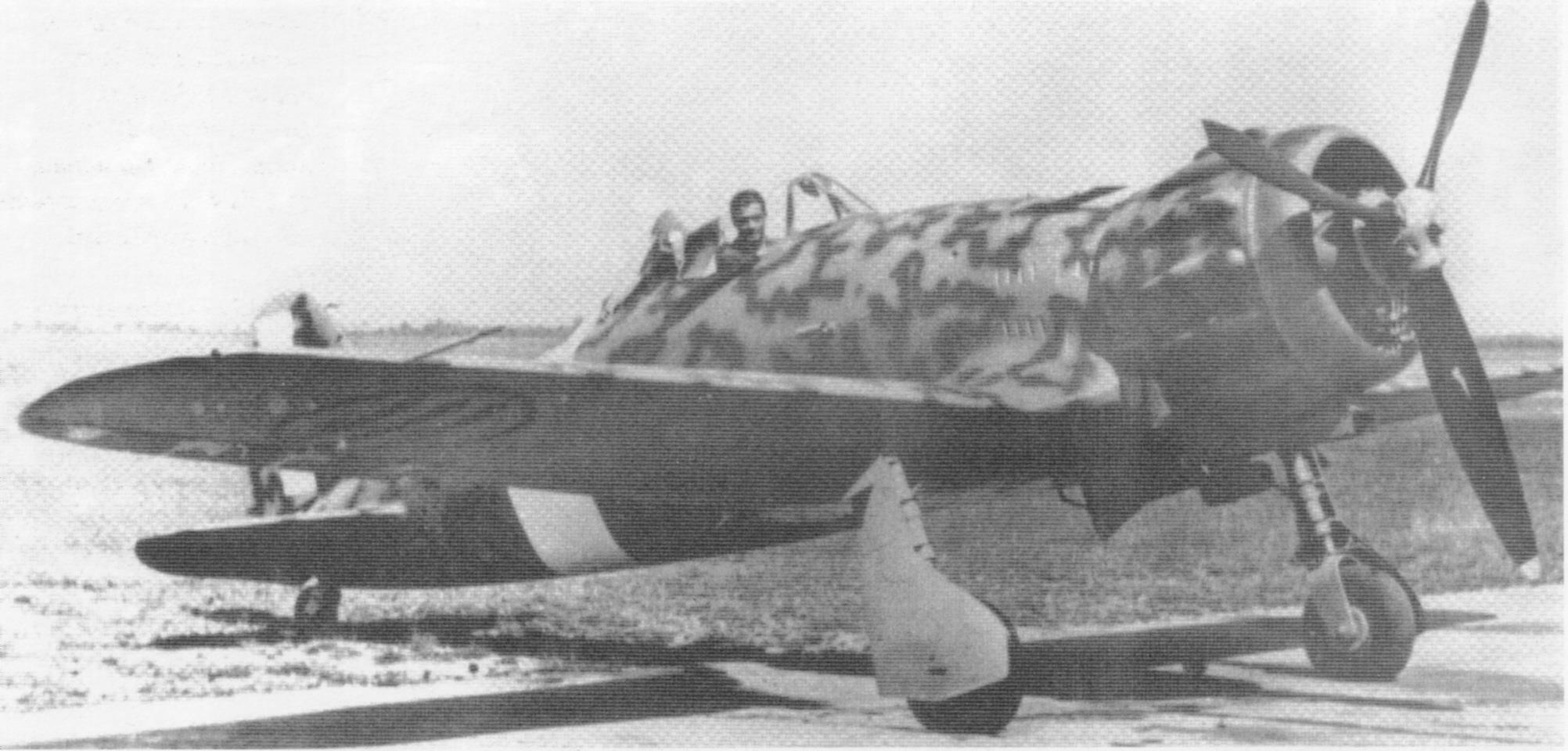
Photo 9 - 85-4 MM 8841 assigned to S.Ten. Giuseppe "Peppo" Re, XXII serie and third-to-last C.200 produced by Macchi, with the definitive colonial
camouflage of the fighters built by the parent company. Note the underwing bomb racks: in active duty, this very aircraft was also loaded with captured
British 250 lb bombs!
|
|
|
|
Photo 10 - MM 5835, Breda 5ª serie overhauled by Macchi after May 1942, and repainted with the D3 scheme. As in the picture above, the propeller bears the Macchi logo.
|
|
|
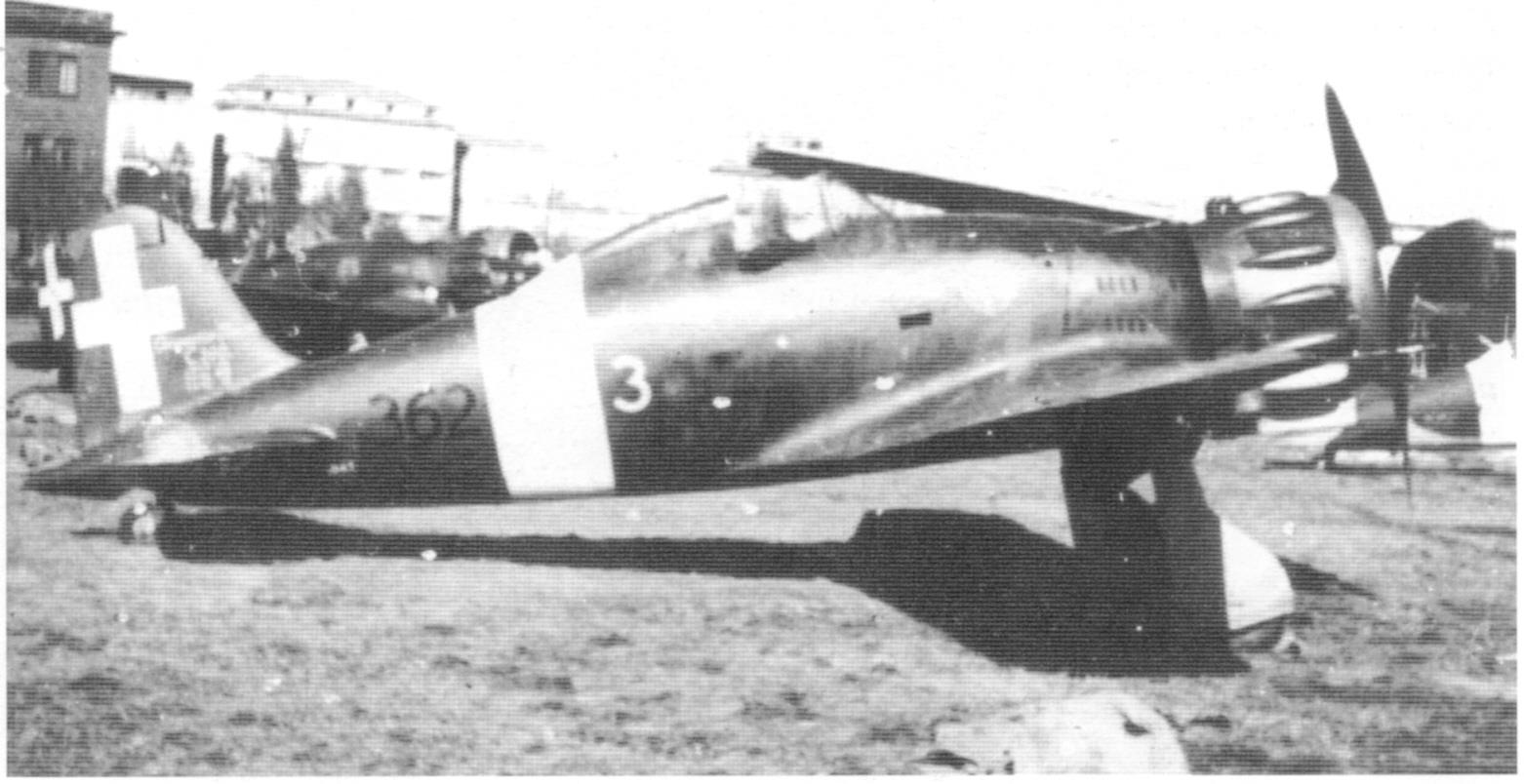
8) Towards the end of the war, during the defense of the Motherland, aircraft undergoing overhaul at the factory were generally repainted again with
upper surfaces in Dark Olive Green 2 (scheme F1) as in Photo 11.
|
|
|
Photo 11 - Capodichino (Naples), summer 1943. 362-3, likely MM 6841, Macchi 3ª serie, overhauled. Despite the poor image quality, the uniform olive
green paintwork is evident. Note the script on the fin "Aeronautica Macchi" in extended form, quite rare on Saettas, followed by the a/c type, serie, and weights.
Ahead of the nose, in the background, a Breda example, also in F1 but with a different color separation line (see below).
|
|
Breda
Breda produced about half of the C.200s. For the first five serie, up to September 1941, at least two schemes can be observed, each with small variations in application.
|
1) A network of small, shaded spots of a single color on a lighter background. Existing color photographs confirm that the spots were two shades of green (C4),
in a pattern which could be so thick that the camouflage appeared almost as a solid color (Photos 12-16, 24).
|
|
|
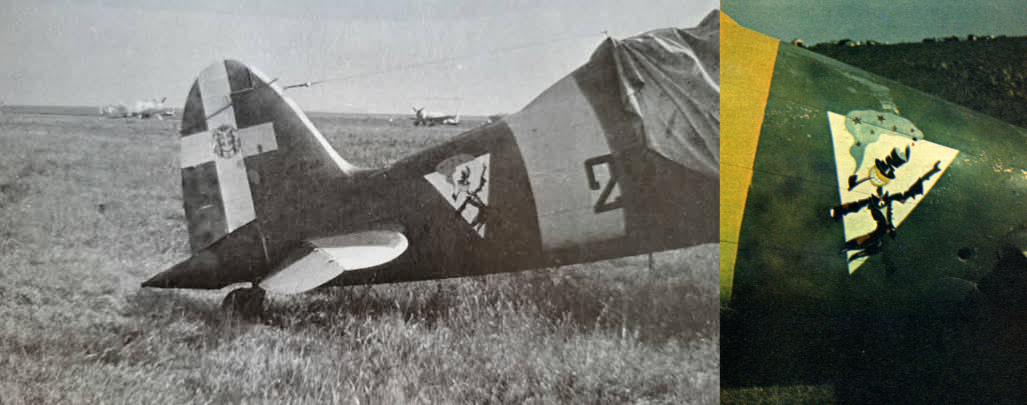
Photos 12 and 13 - Two images of the aircraft of the first CO of 22° Gruppo in Russia, Magg. Giovanni Borzoni, which featured a dense grid of
two greens (C4) that in b/w almost appears to be a single color. The lettering on the fin identifies it as Breda-built machine,
but the rudder has been replaced with one made by SAI. Note the leading edges of the fin and rudder planes painted white, possibly as an identification
marking during combat.
|
|
|
|
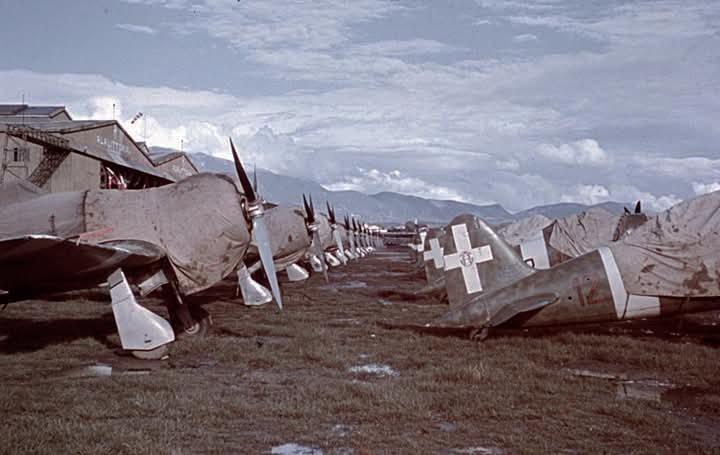
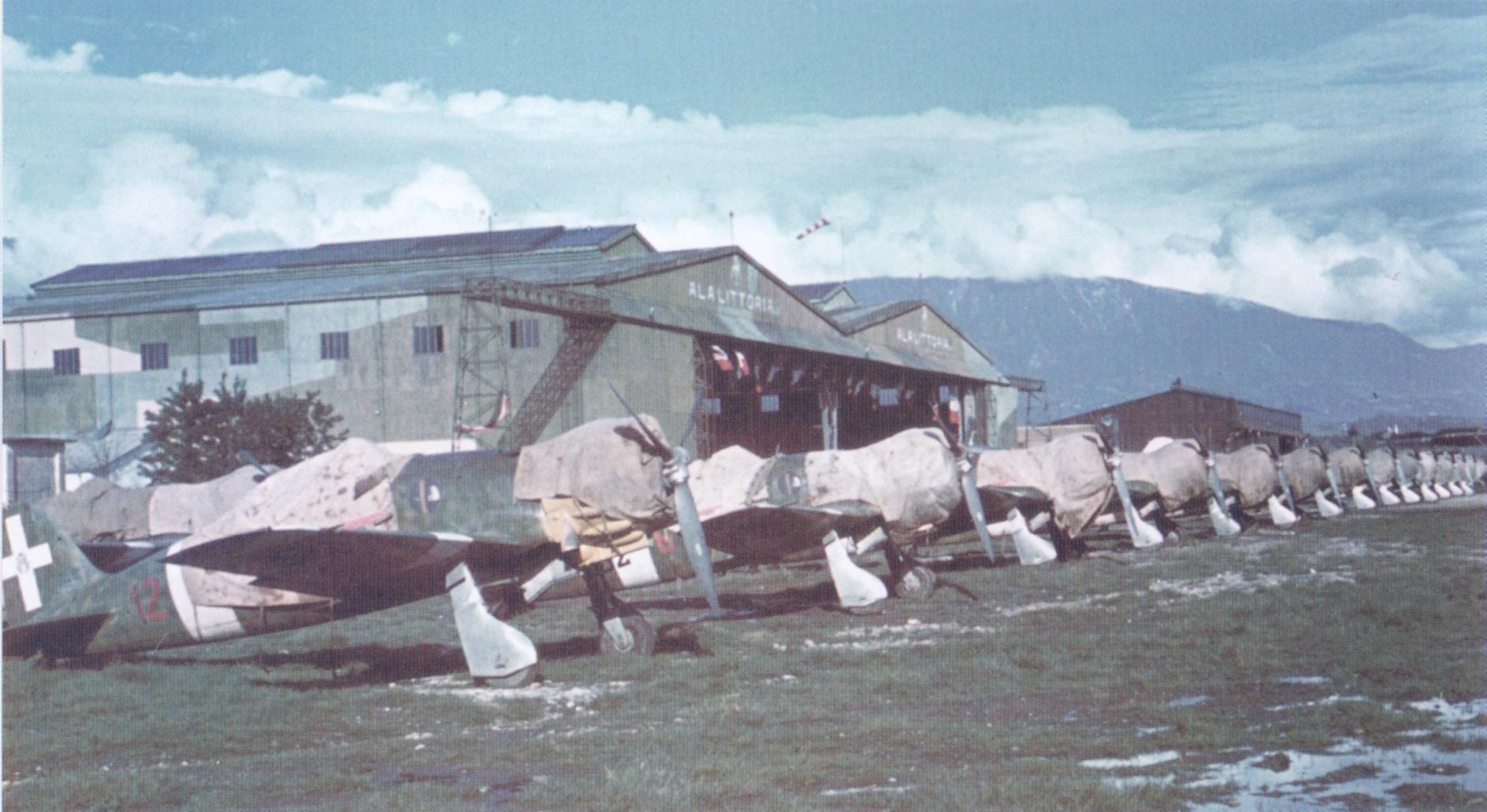
Photos 14 and 15 - C.200s lined up in Tirana before being shipped to Russia. The first two examples in Photo 15 (probably 369-12 and 362-6), both built by Breda,
are camouflaged in the two-tone green. Note the silver landing gear doors on several aircraft.
|
|
|
|
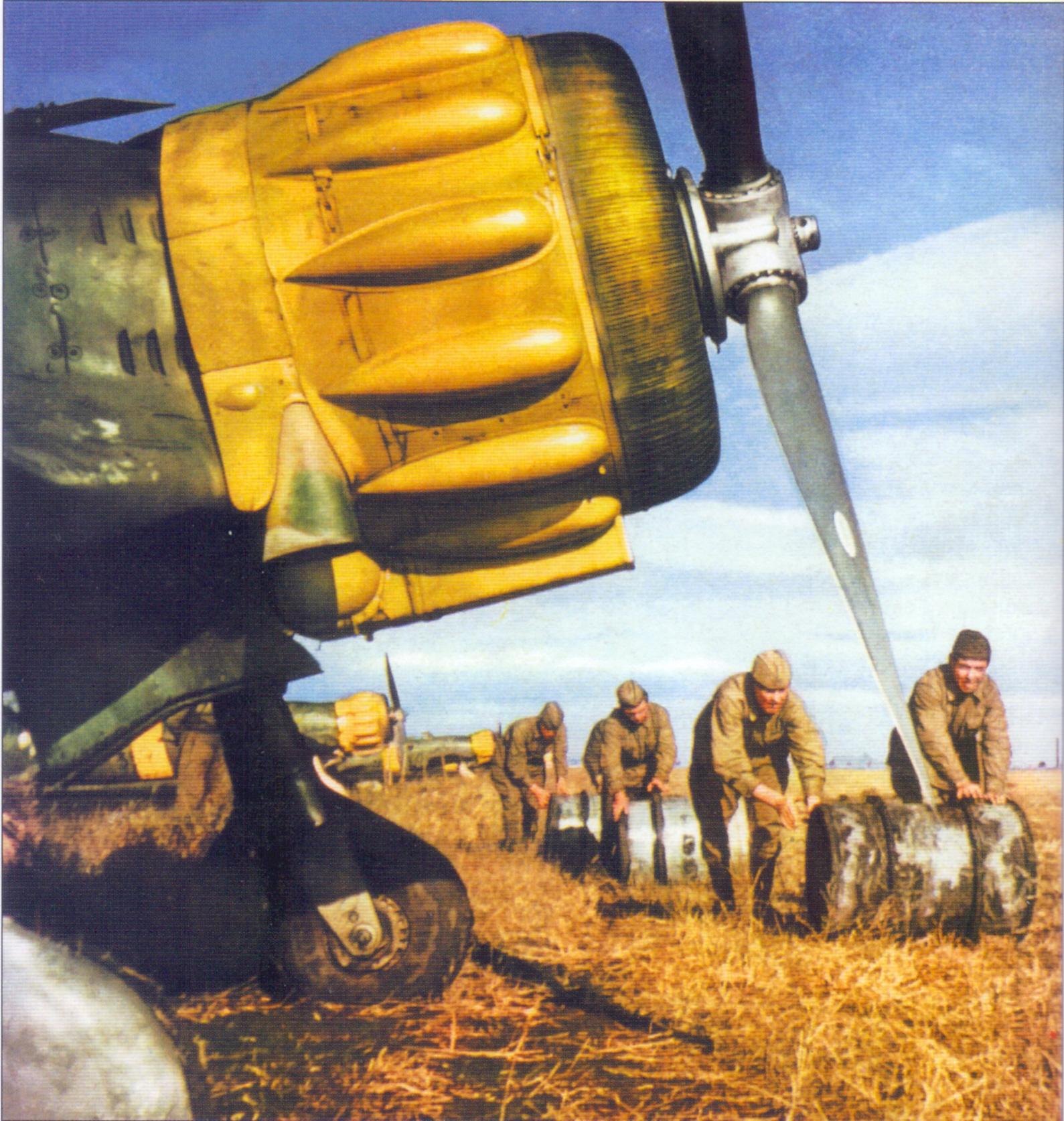
Photo 16 - This original color image of aircraft on the Eastern Front from the cover of an issue of Ali d'Italia magazine, features aircraft from
359ª Squadriglia, and confirms the green paint on the upper surfaces and the silver paint on the lower surfaces. Note the medium gray color of the
original Piaggio propeller.
|
|
|
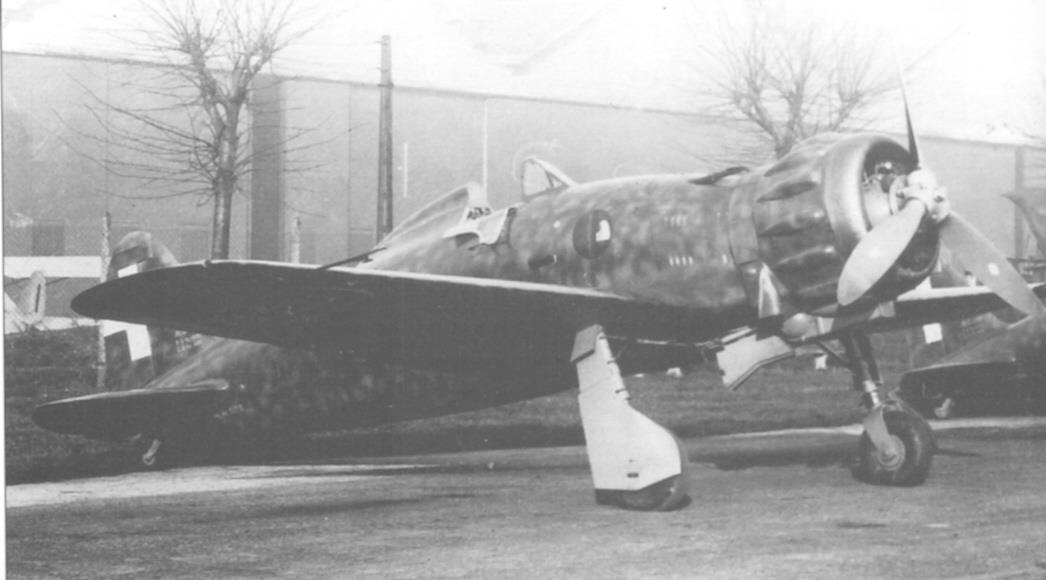
In some aircraft between the end of the 2nd serie and the beginning of the 3rd, a third tone seems to appear, but it is difficult to confirm the
presence of another color rather than a diluted layer of the second (Photos 17 and 18). It is
conceivable, however, that there may have been a transition period between the camouflage patterns of small, dense patches of two shades of green
to another with small but less thicker spots in green and brown (or two greens) on a yellow background. If ever, this could have evolved into the later pattern.
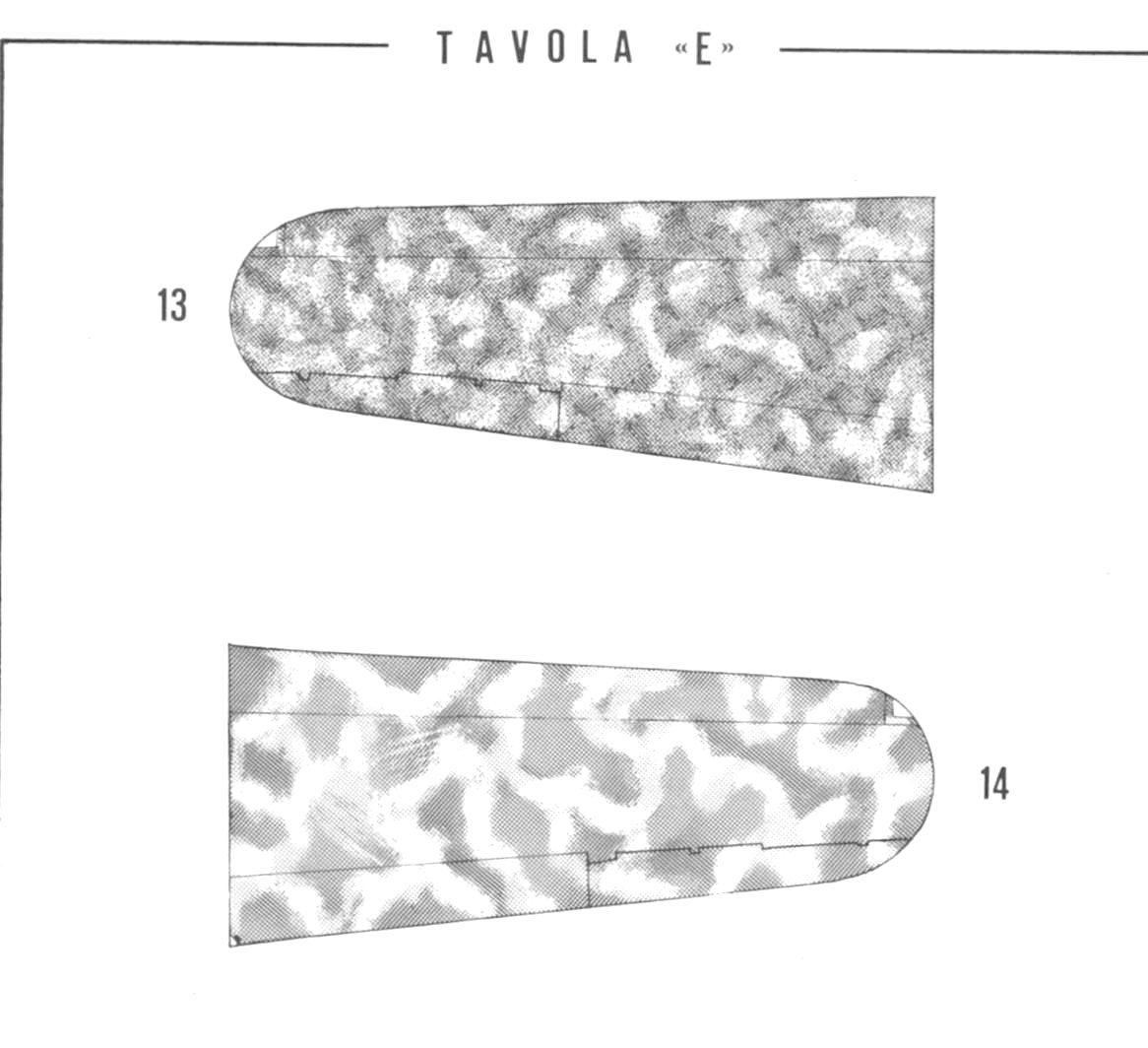
There is no direct correspondence to this in the table in the CMPR-GMT-GAVS book, but the distribution is better shown in Scheme 13 (Tavola E) of the
first edition of the book.
|
|
|
|
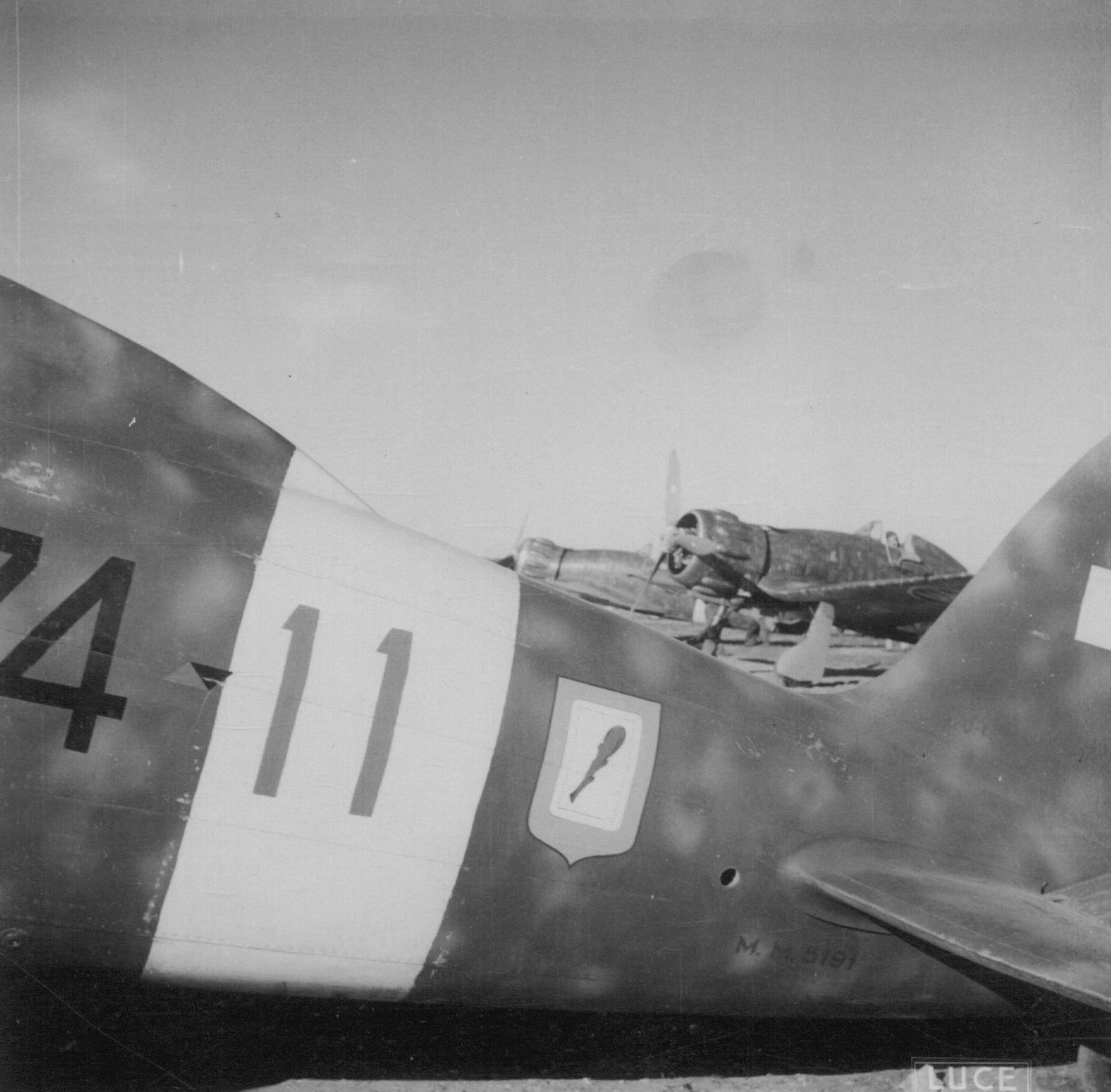
Photos 17 and 18 - Two consecutive examples of the Breda 2ª serie: 374-11 MM 5191 on the Mediterranean front and MM 5192 newly built, outside the Bresso factory,
show a dense and shaded camouflage pattern for which it is difficult to establish whether it was two or three tones.
|
|
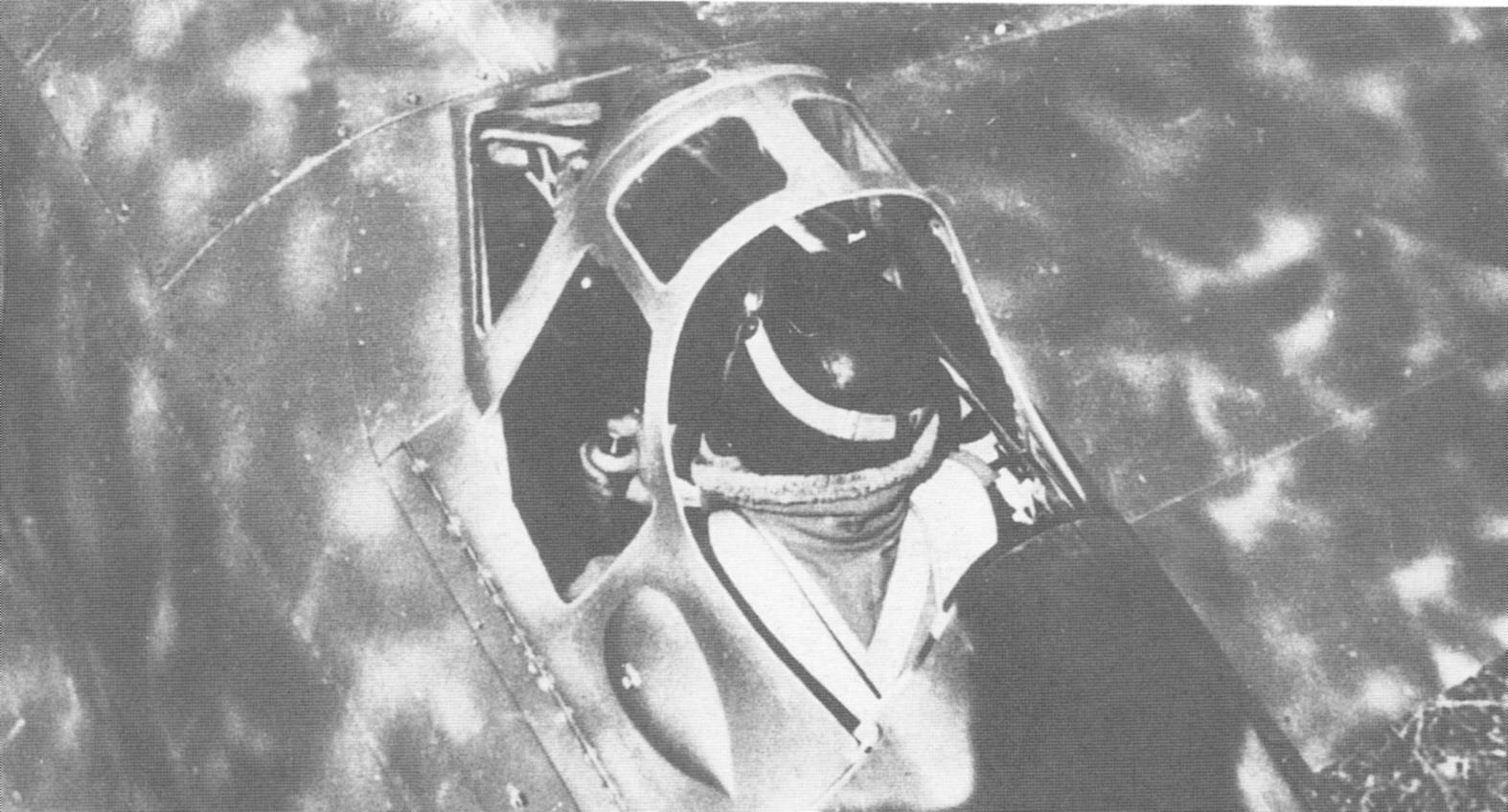
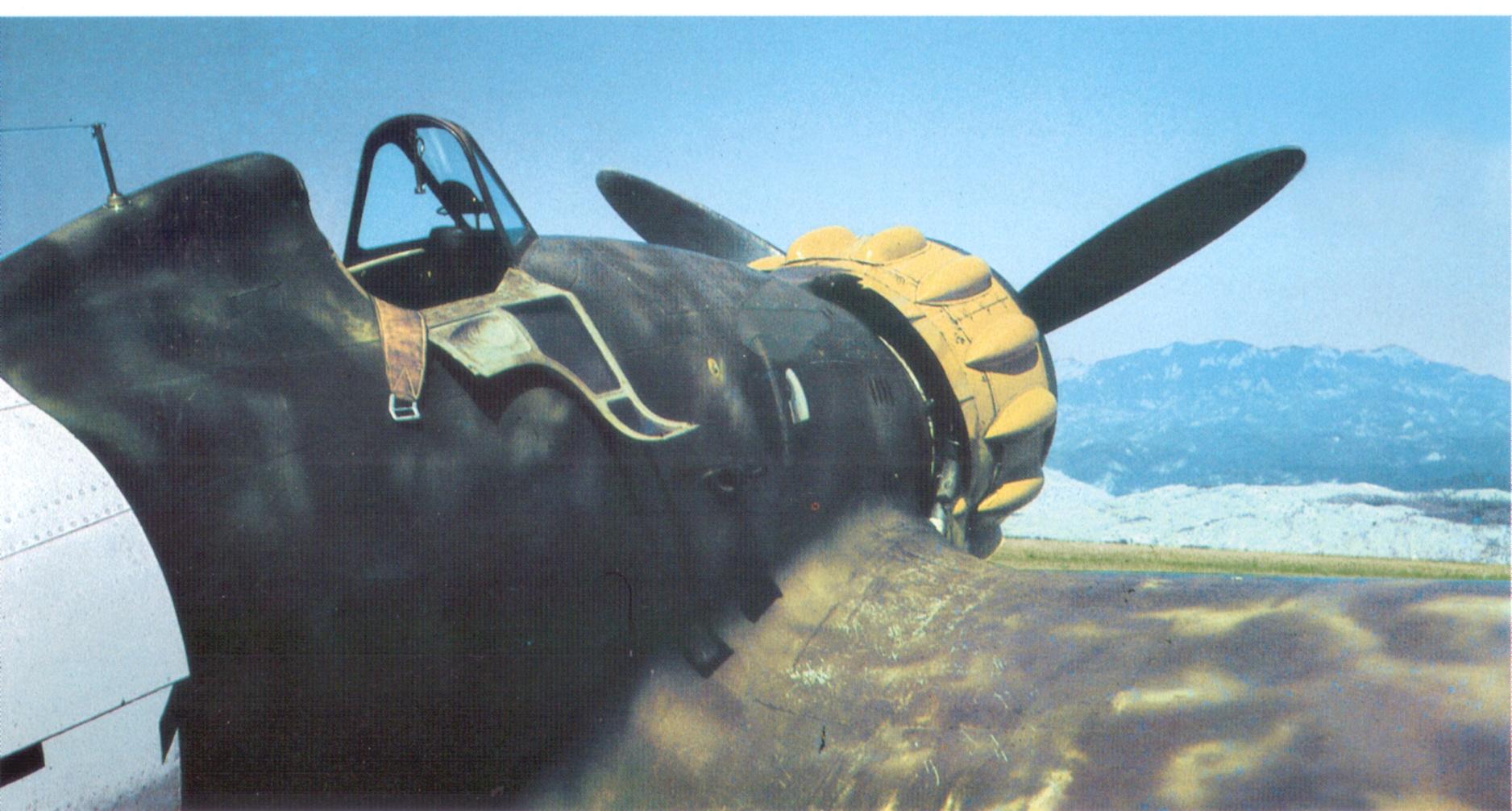
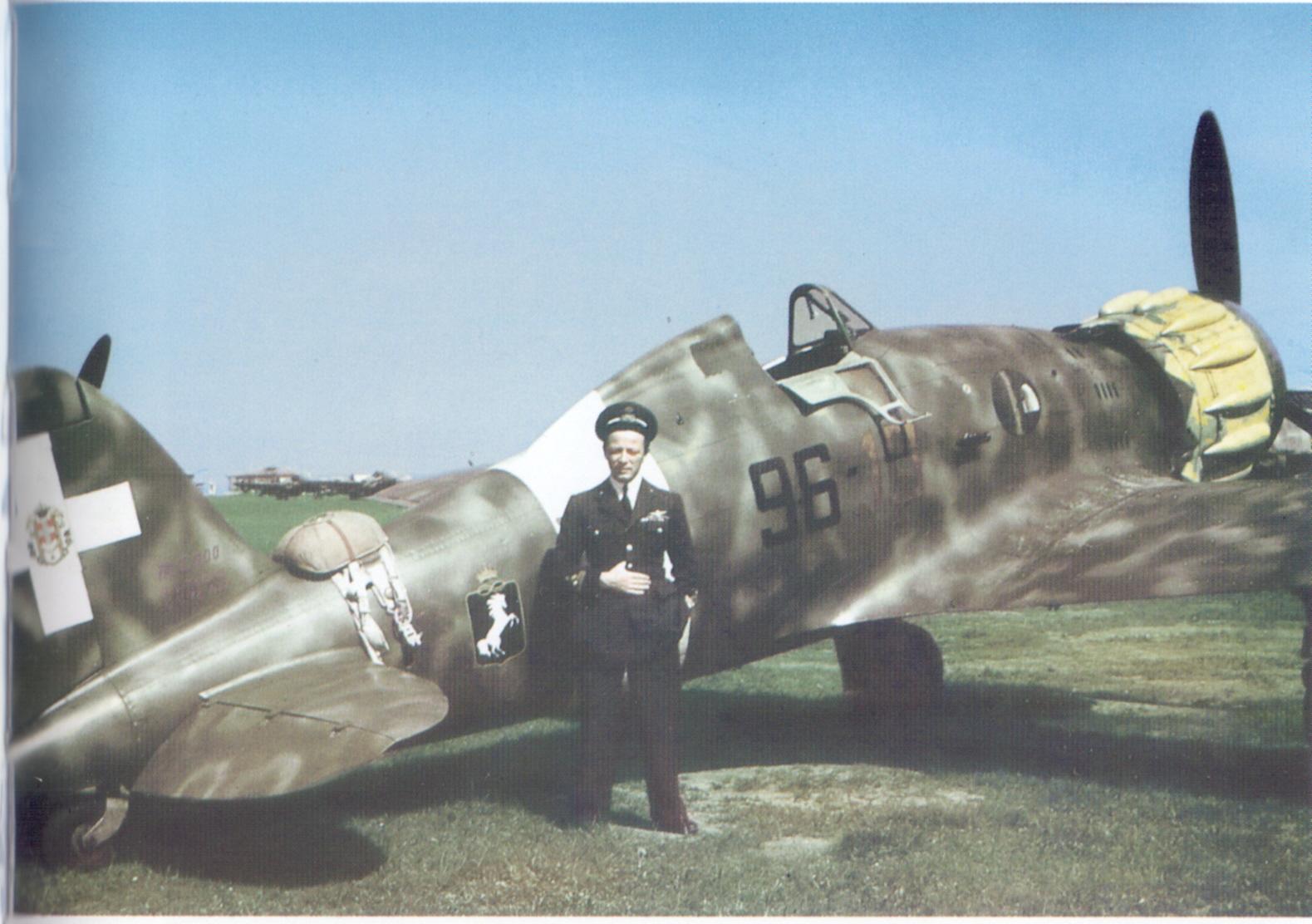
2) The second type of pre-Tavola 10 pattern featured spots that were still shaded, but larger and with three clearly identifiable colors, where the background appears noticeably lighter
than those mentioned above, confirming the use of a yellow. There are some variations of this, as the spots can be elongated and branched (Scheme 14 (above),
Photos 19-20), or with the green closed in a grid (Photo 22) or finally in large, overlapping patches
(Photo 23). The application analysis includes an initial layer of sand yellow, then generally brown spots,
and finally green ones, but sometimes vice versa for the last two. This pattern seems more frequent by January 1941.
|
|
Photo 19 - Breda's three-color, broad-spotted scheme is clearly visible on the wing of this aircraft.
|
|
|
|
Photo 20 - C.200 365-1 and the three-color Breda camouflage. Note the unusual black individual a/c number and the windshield frame metal structure with
a clear anti-corrosion treatment. The brown paint was sprayed last.
|
|
|
|
Photo 21 - A C.200 coded 96-10, MM 5294, Breda 3ª serie, of 9° Gruppo, 4° Stormo. The yellow and red colors in the image are noticeably faded. Here,
the brown is applied before green.
|
|
|
|
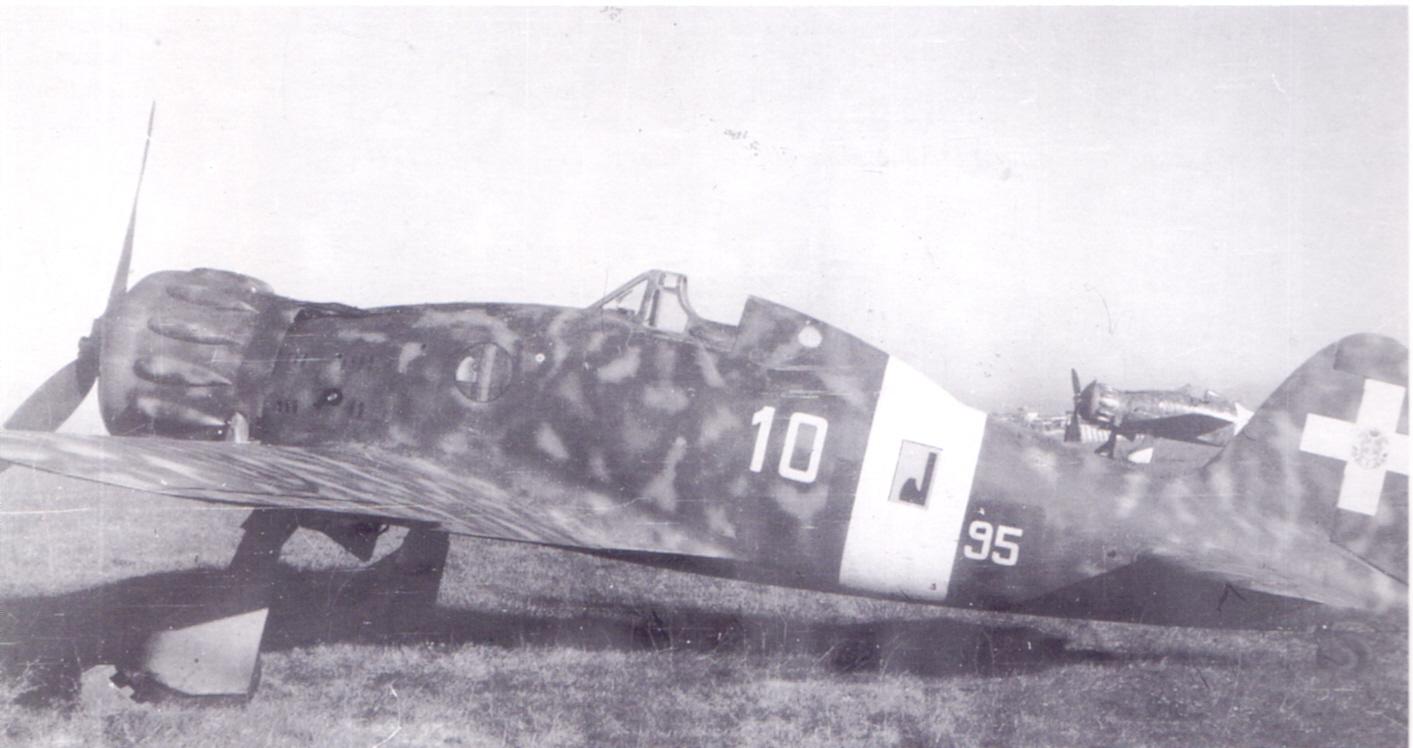
Photo 22 - Green spots linked in a "network" pattern on 95-10, a Breda 6ª serie at Ciampino Sud, between October and December 1941.
|
|
|
|
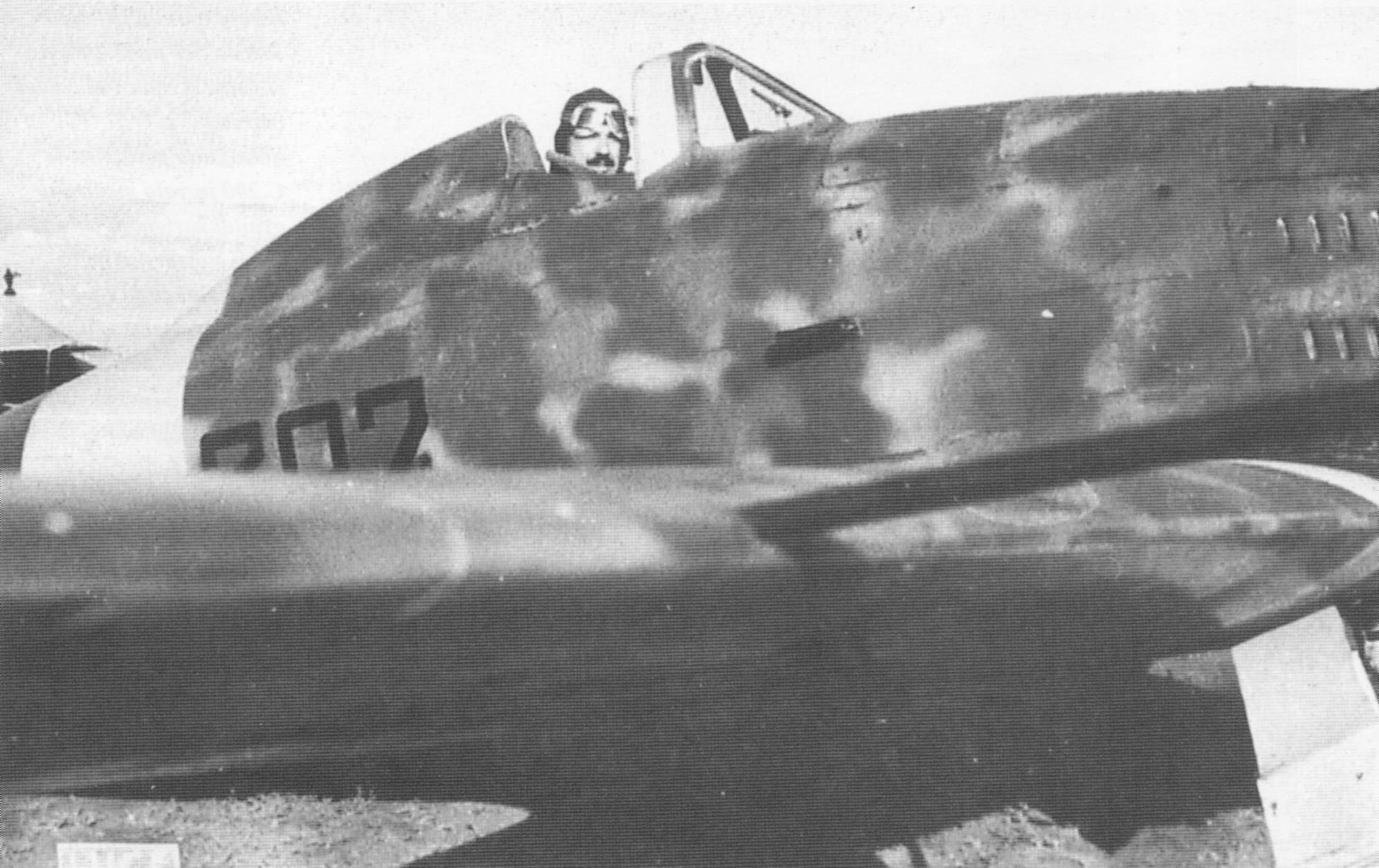
Photo 23 - Latest version of the three-color Breda camouflage on an aircraft of 382ª Squadriglia in Ukraine, 1942. The spots are now wider and almost alternating.
|
|
|
|
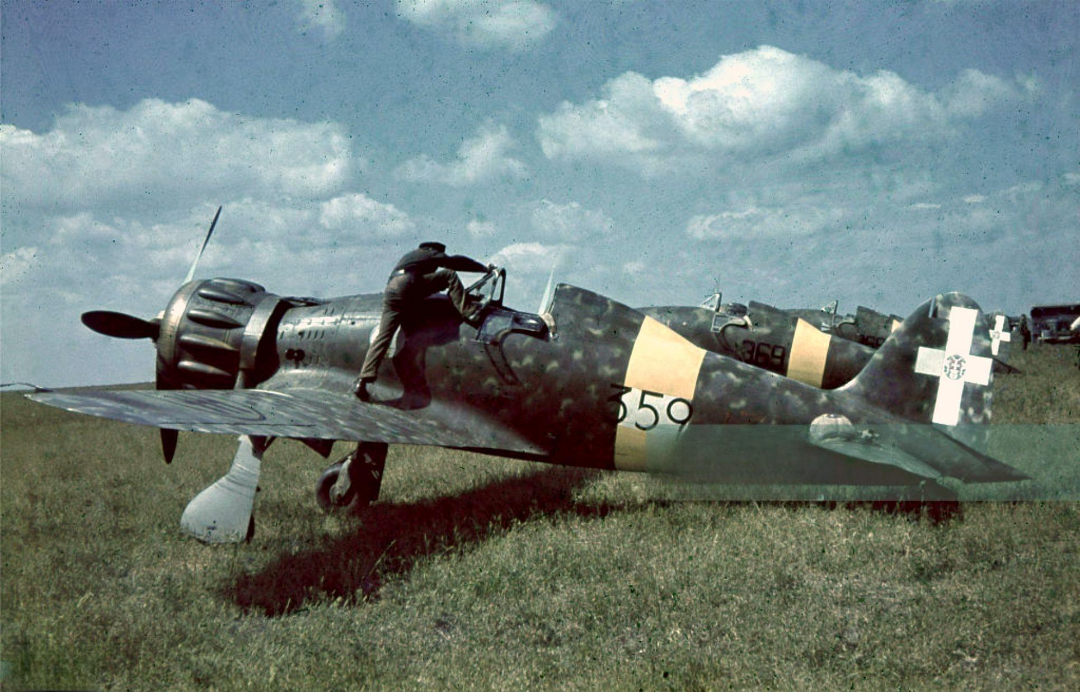
Photo 24 - Detail of a color image of aircraft of 22° Gruppo at Tudora (Romania), showing in the foreground a Macchi-built aircraft (359-13)
with C8 scheme, in the middle a Breda (369-10?) with three-color camouflage and in the background the aircraft (369-1?) of
Cap. Giorgio Jannicelli, commander of 369ª Squadriglia, another Breda C.200, but with the two type green (C4) and an enlarged cross;
note on the latter the commander's pennant which will presumably be covered with the famous Scarecrow unit coat of arms.
|
|
The available documentation also shows a scheme of uncertain placement, likely still pre-Tavola 10, but adapted to the desert environment:
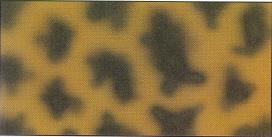 3) Large green patches on a yellow background (C2). Some reliefs such as the cross with equal arms and the separation line with the upper surface edge of
the "low" type (see below) suggest that this scheme precedes the following two (Photo 25, a/c 92-2).
3) Large green patches on a yellow background (C2). Some reliefs such as the cross with equal arms and the separation line with the upper surface edge of
the "low" type (see below) suggest that this scheme precedes the following two (Photo 25, a/c 92-2).
|
Certainly, from Tavola 10 and therefore starting from about November 1941, Breda also adopted new desert-type schemes with the new standard paints, with two possible variants:
|
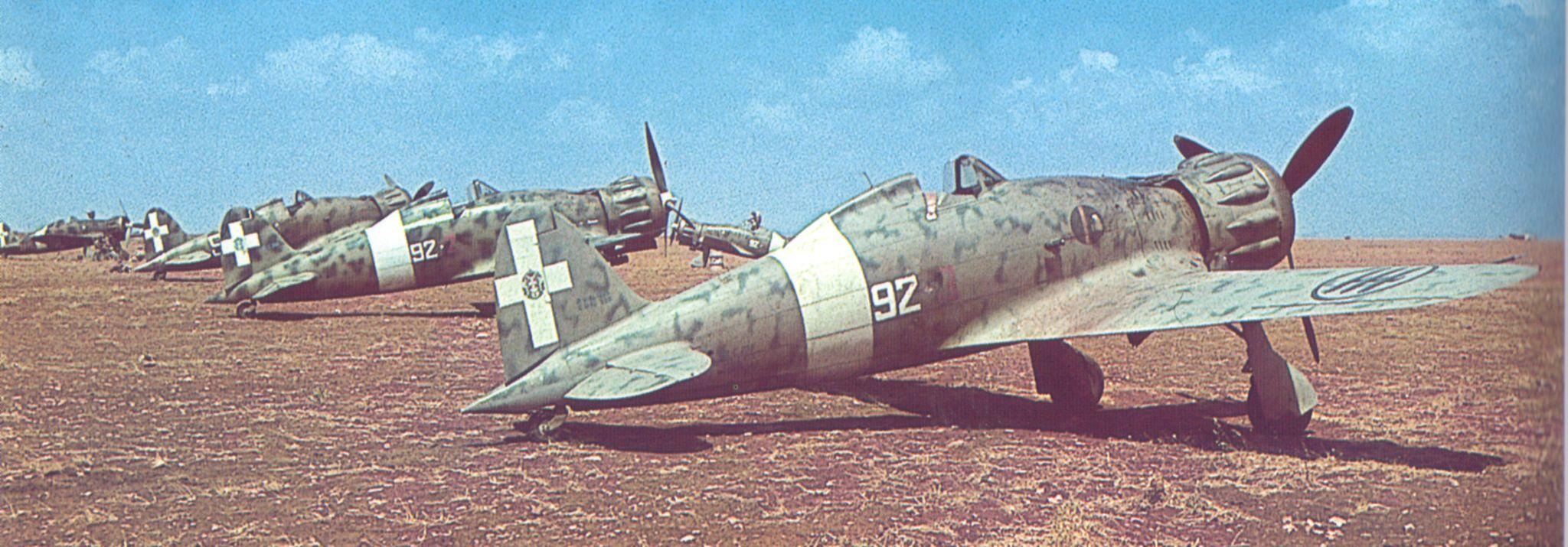
4) Sparse olive green "worms" on a light hazelnut background (D2A), for the 5th and partially 6th series, documented at least up to MM 8201, but
probably even beyond (Photo 25, a/c 92-3).
|
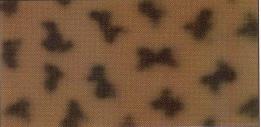 5) Subsequently, from March 1942 and at least in the C.202s, sparse olive green patches began to be applied, larger and sometimes branched
on a light hazelnut background (D2).
5) Subsequently, from March 1942 and at least in the C.202s, sparse olive green patches began to be applied, larger and sometimes branched
on a light hazelnut background (D2).
|
|
|
Photo 25 - Examples of the 92ª Squadriglia with different camouflage patterns. In the foreground, the 92-3 MM 8163, Breda XIX serie, built in spring 1942,
with D2A camouflage pattern and Macchi-type cross. Behind, 92-2 with C2 pattern and short
Breda-type cross. In the third row, the squadron commander's aircraft (92), of Macchi construction with sparse, elongated patches (D2).
In the background on the left, an SAI example with large green patches (C2 pattern). Note the different shades
of both green and sand color between the various aircraft.
|
|
For Breda D2A and D2 schemes, a careful analysis of the shape of spots reveals, a curious and apparently
illogical application method: the upper surfaces were first painted entirely in olive green, then extensively over sprayed in light hazelnut to leave the green spots "in negative".
This was probably done to comply with the instructions in the Bollettino Tecnico Informativo no. 8 (see Note 3) but,
unlike Macchi (D1 scheme), Breda at least immediately conceived a scheme more suited to the desert environment 4.
Furthermore, by D2-D2A on, the schemes are characterized by a curved separation line between the upper and lower camouflage along the fuselage, which joins the wing
trailing edge and the tailplanes leading edge (Photos 11, 25 and 26). This also characterizes
the Tavola 10 Breda-built C.202s.
|
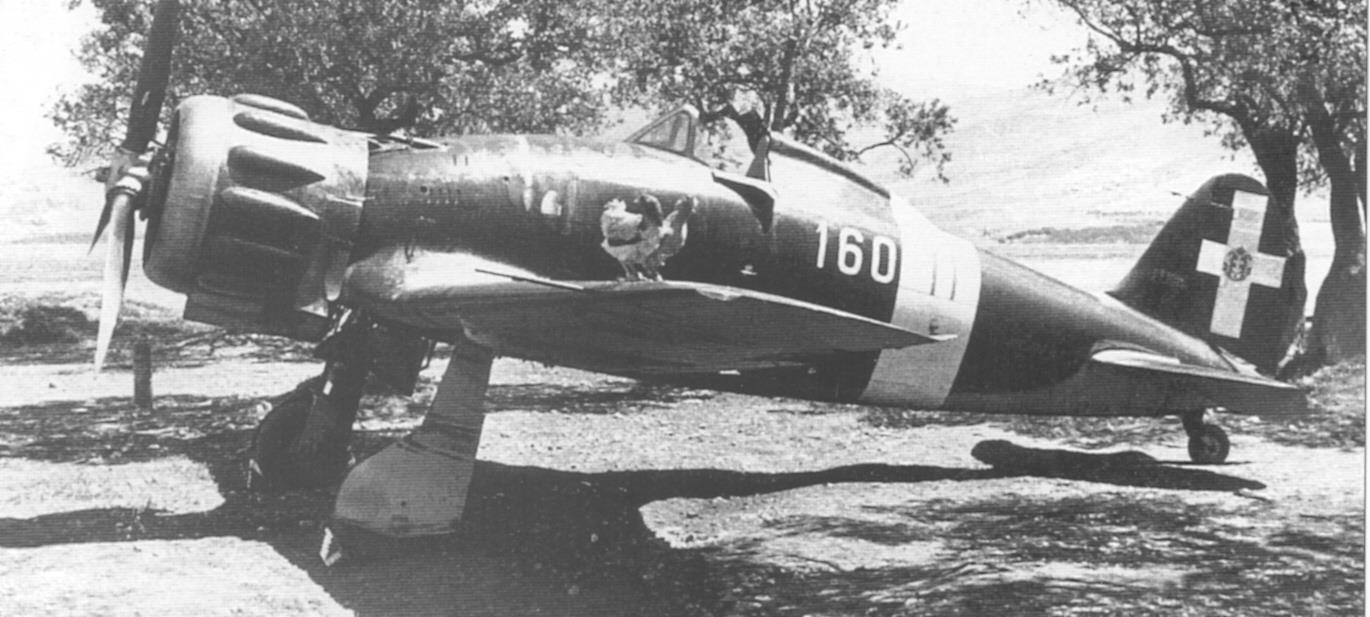
6) After the retreat from Africa, it is not uncommon to see operational examples of Breda built machines in only olive green (F1). These aircraft are also distinguishable
by the curved separation line (Photos 11 and 26).
|
|
|
Photo 26 - Sicily, 1943. A Breda-built C.200, last series, with continental camouflage. Note the dividing line between the upper green and lower gray,
which typically joins with a curve at the tailplane insertion, as also appears on examples with colonial camouflage. The tail cross is now identical to
the Macchi one. What could seem a curious unit badge on the fuselage are actually two real hens on the wing!
|
|
SAI Ambrosini
For SAI too, a pre-Tavola 10 and a Tavola 10 period can also be identified.
|
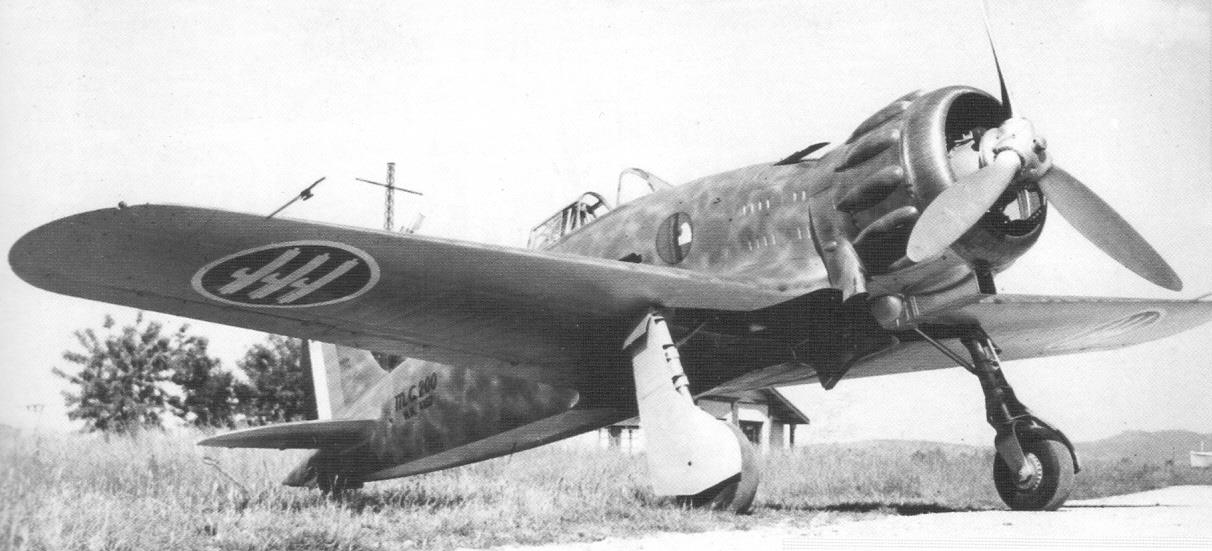
1) From the first example produced, the images show an apparently three-color scheme, therefore green and brown - or maybe two types of green - on a yellow background,
with a type 13 Scheme of Tavola E very similar to Breda (Photos 27-29).
|
|
|
Photo 27 - MM 4857, the first C.200 produced by SAI Ambrosini, shows a probable three-colour camouflage.
|
|
|
|
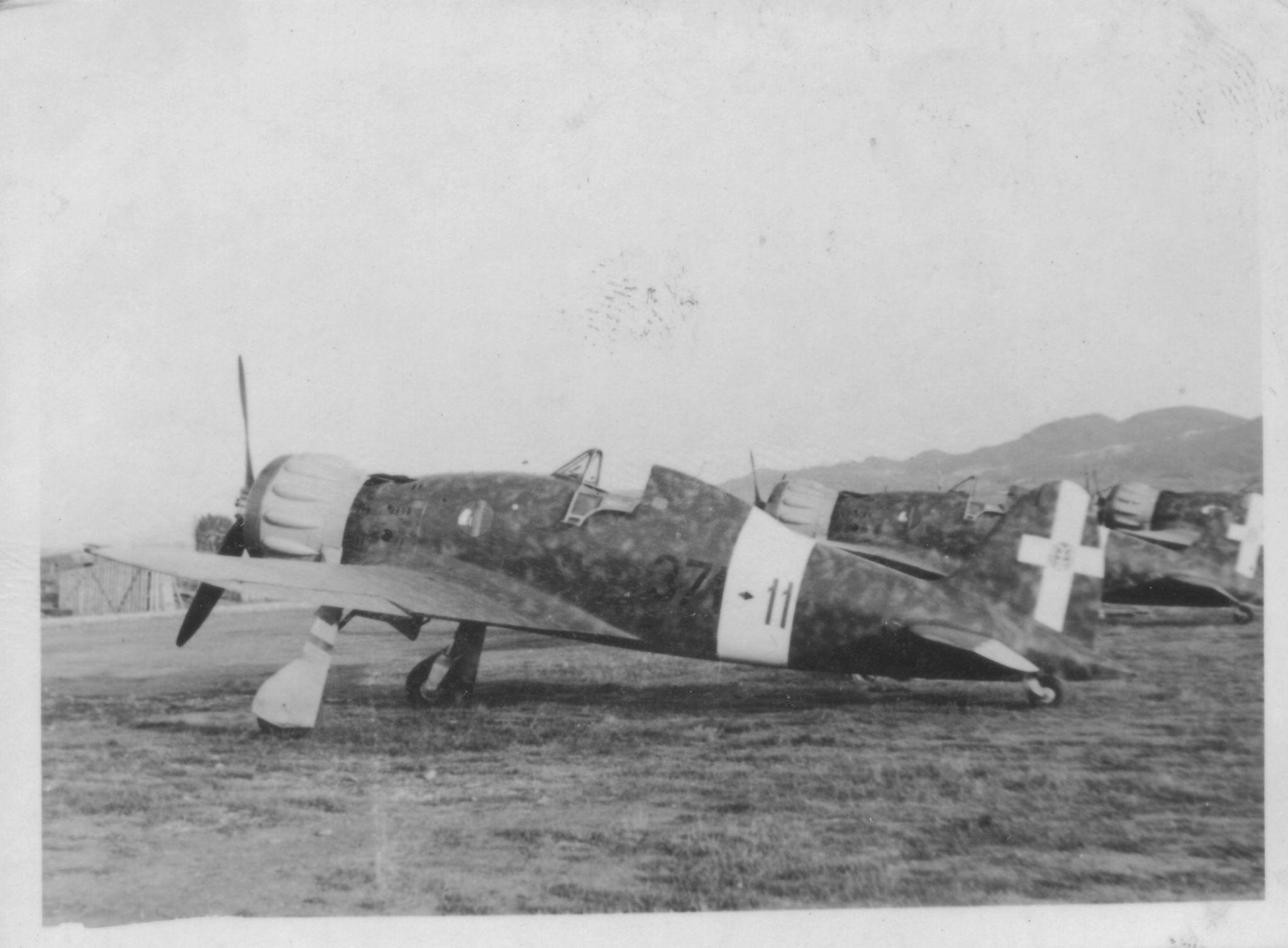
Photo 28 – 371-11 built by SAI, probably the 3rd to 5th series, in Tirana (Albania) in the summer of 1941. The camouflage still appears in small,
dense patches of three colors.
|
|
|
|
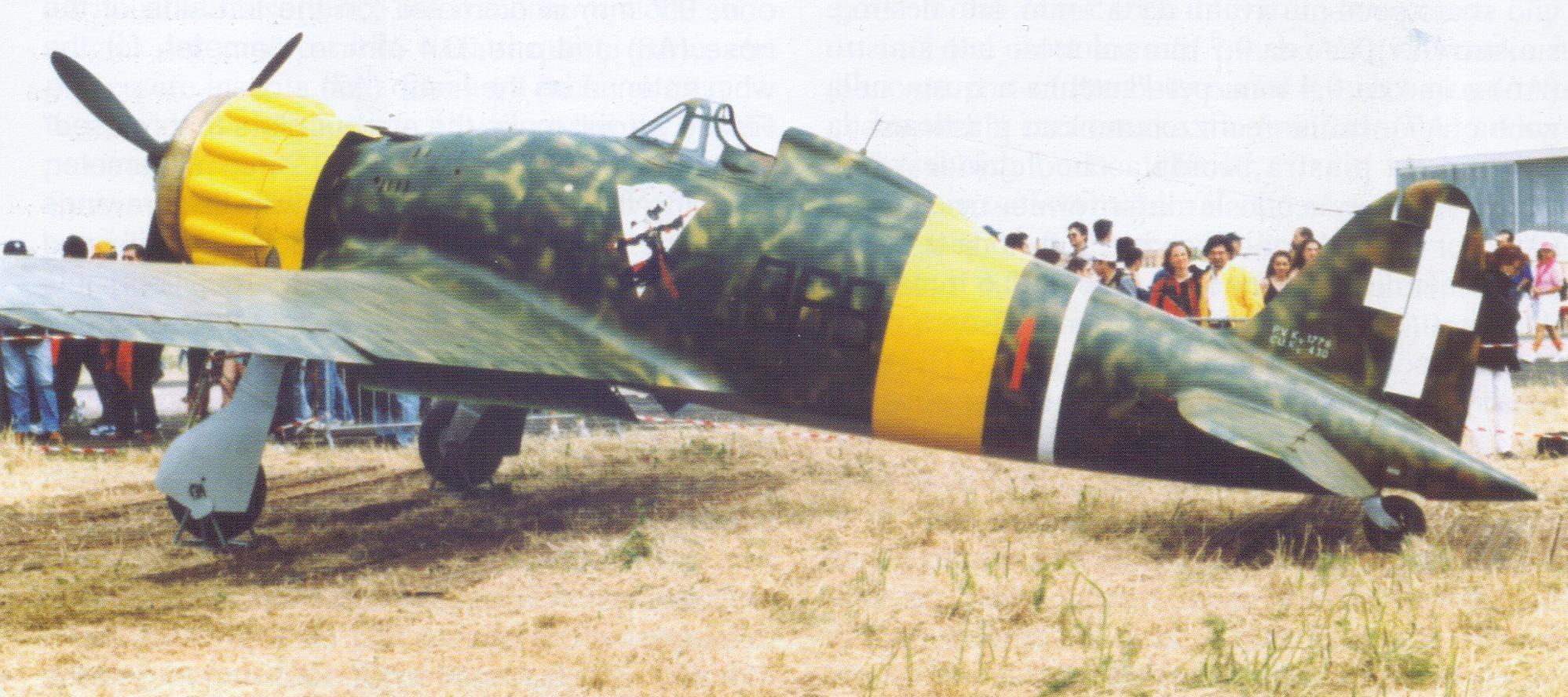
Photo 29 - The only complete C.200 existant in Italy, reproducing 369-1 on the Eastern Front. Despite some small heraldic inaccuracies and the
fact that the original 369-1, built by Breda, was almost certainly camouflaged with two shades of green, the camouflage effect of small, dense patches
of three colors is well rendered.
|
|
Subsequently, Tavola 10, the SAI camouflage patterns also seem to have evolved:
 2) A fine network of small, dense spots can be observed in some specimens destined to the African front, but with a more evident contrast between
the colors than the two greens of the other two factories, so it is assumed that they were green and hazelnut. The pattern would correspond to the D1B
scheme and it could be a further interpretation of the colonial camo rules already mentioned above, as it seems that the background was in the prescribed metropolitan
olive green and dense mottles in hazelnut color (Photo 30). This pattern is found in a few examples.
2) A fine network of small, dense spots can be observed in some specimens destined to the African front, but with a more evident contrast between
the colors than the two greens of the other two factories, so it is assumed that they were green and hazelnut. The pattern would correspond to the D1B
scheme and it could be a further interpretation of the colonial camo rules already mentioned above, as it seems that the background was in the prescribed metropolitan
olive green and dense mottles in hazelnut color (Photo 30). This pattern is found in a few examples.
|
|
|
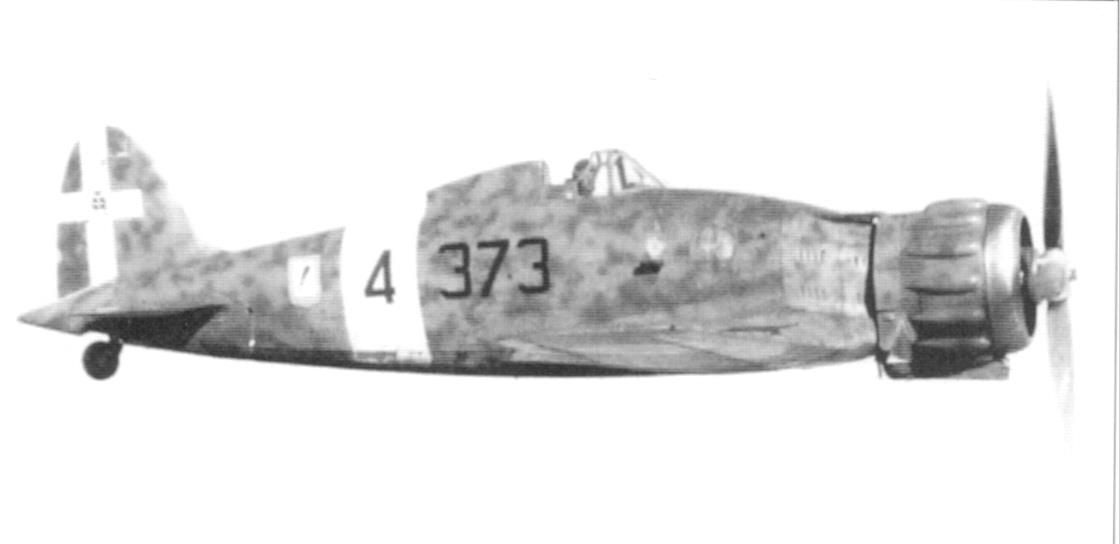
Photo 30 - 373-4 of SAI production with initial colonial camouflage, apparently obtained with a dense network of hazelnut on an olive green background.
|
|
|
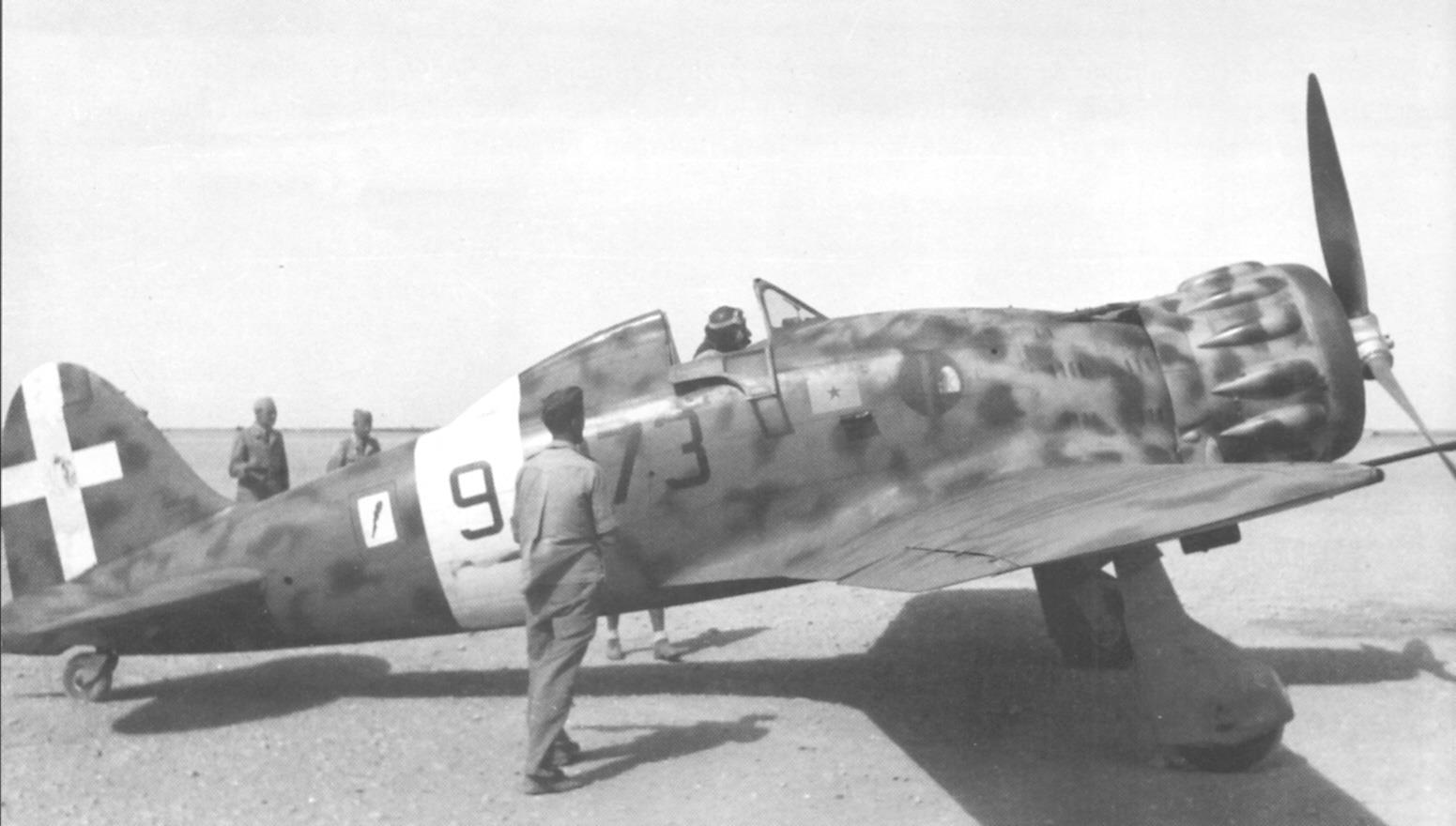
3) Very soon the green spots became larger and more defined (D2), but still "in negative" due to a wider application of the light hazelnut color on the green background
(Photos 31 and 32).
|
|
|
Photo 31 - SAI-built 373-9, assigned to Gen. Ferdinando Raffaelli, commander of the Aviazione della Libia Orientale,
wearing the D2 camouflage. On the nose, the paintwork was retouched using a lighter sand and a darker green,
with the latter sprayed over the sand base, unlike the original application.
|
|
|
|
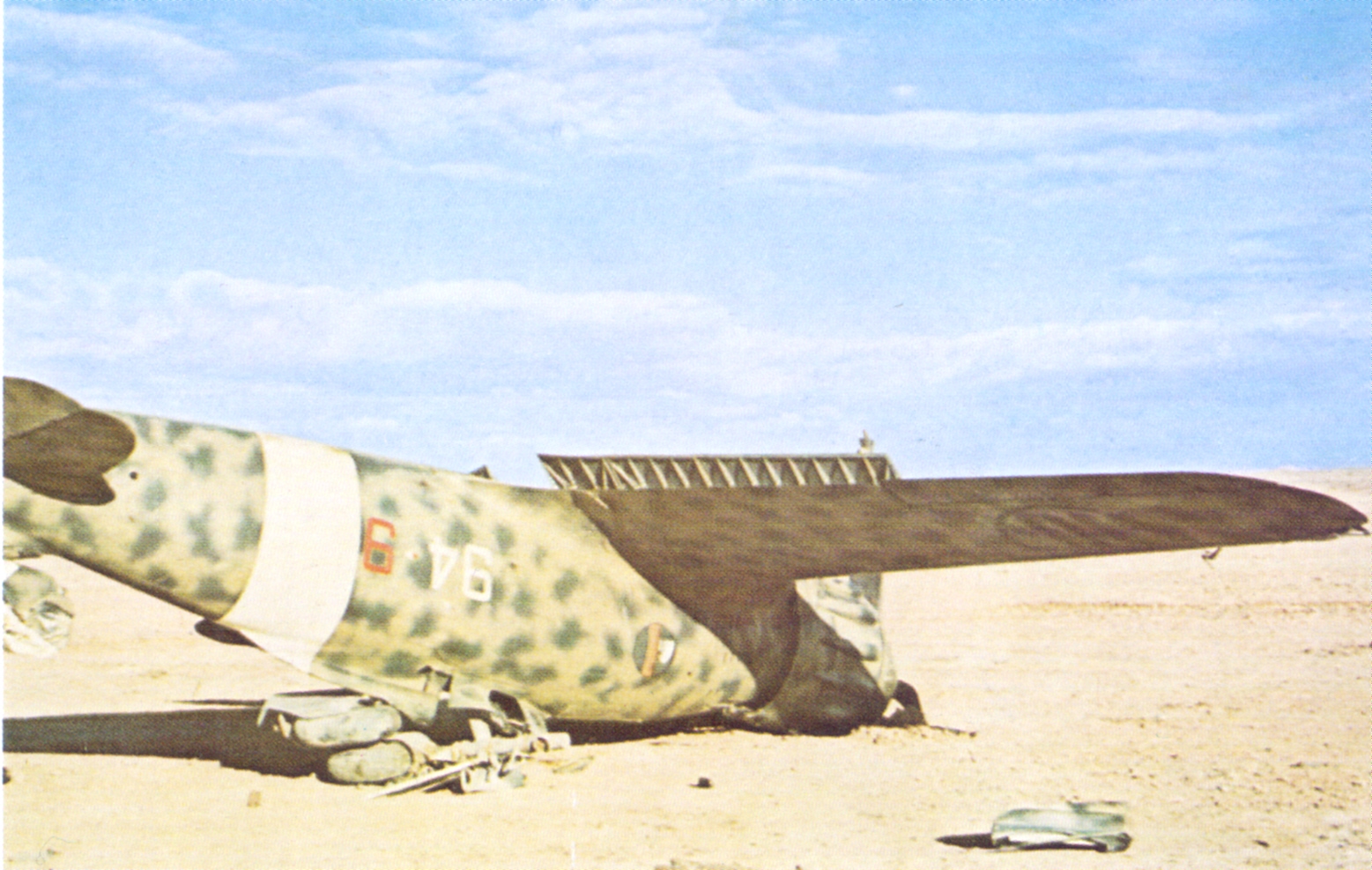
Photo 32 - 94-9, SAI construction, likely 6ª serie, overturned on landing at En Nofilia on 14 January 1942 (Serg. Giordano Casadio) still
shows the green spots "in negative". Note the gray coloring of the inside of the flap.
|
|
|
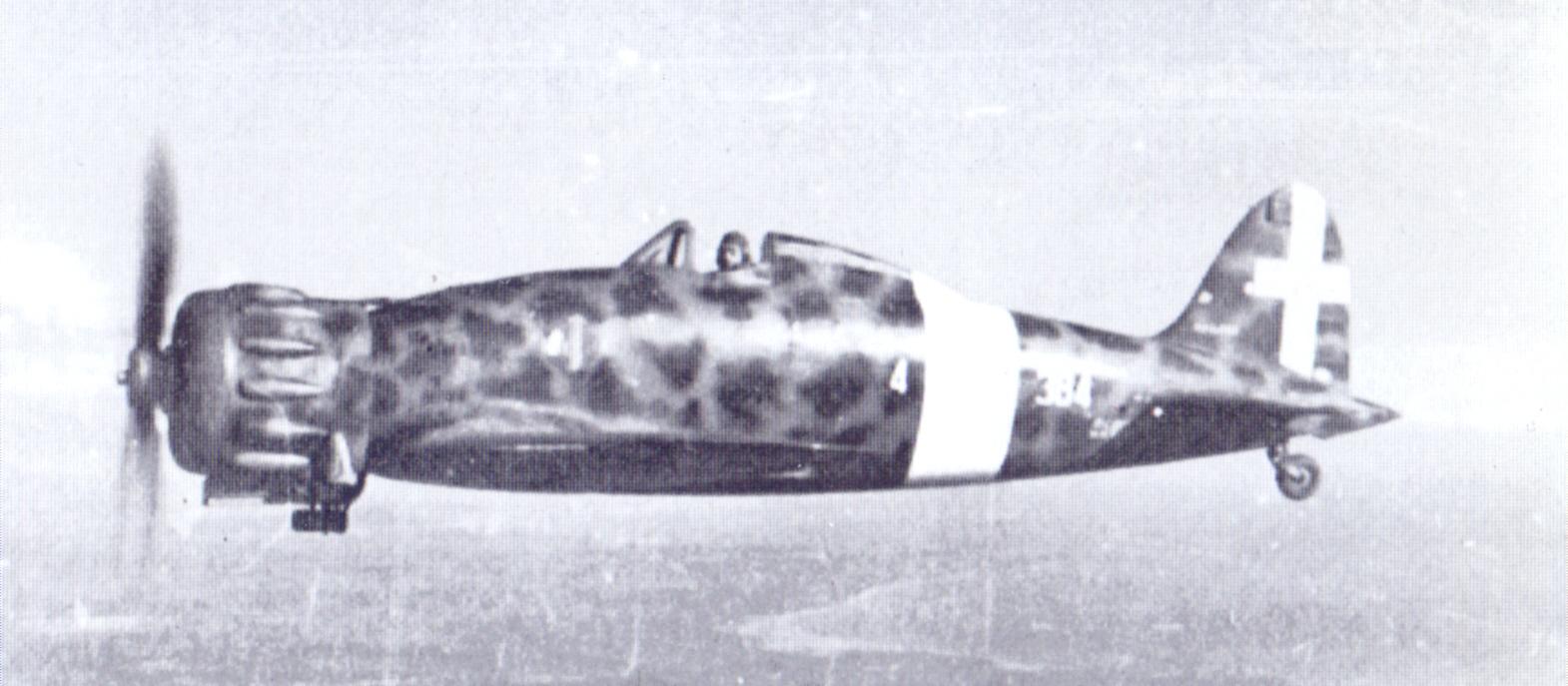
4) The evolution of the previous scheme was a more logical application of large, irregular and dense green spots at last sprayed on a hazelnut background,
similar to the C2 (pre-Tavola X colors) pattern, as evident on several examples of 157° Gruppo (Photo 33).
|
|
|
Photo 33 - 384-4 of SAI manufacture, probably 6ª serie, with large, irregular and dense spots. The service markings have changed to white.
|
|
|
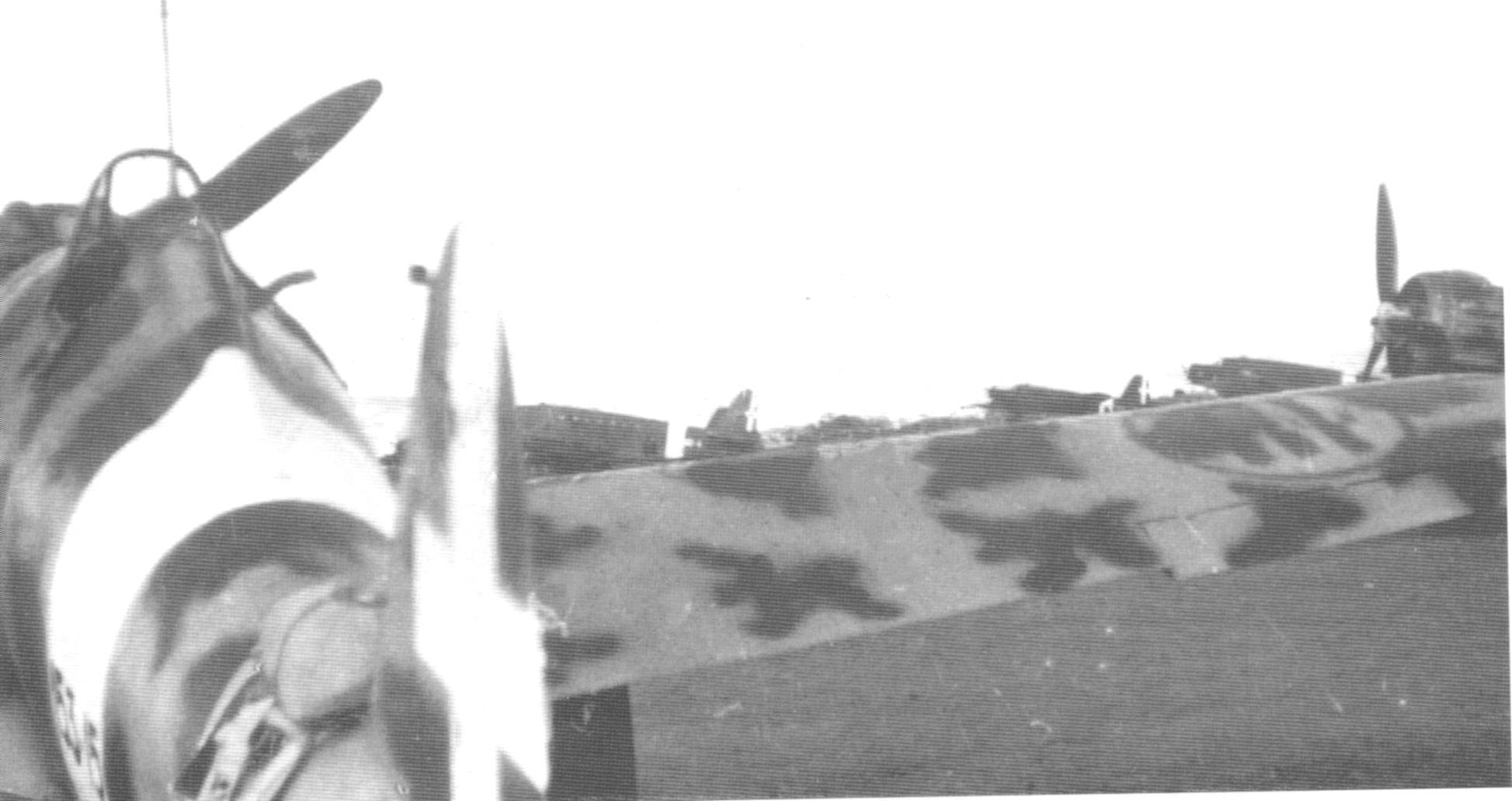
5) Subsequently the spots, always large, became sparser and polylobed, similar to the D2 pattern, but bigger (Photo 34).
|
|
|
Photo 34 - SAI production, intermediate camouflage Tavola 10 with still large, but sparser and more branched spots.
|
|
|
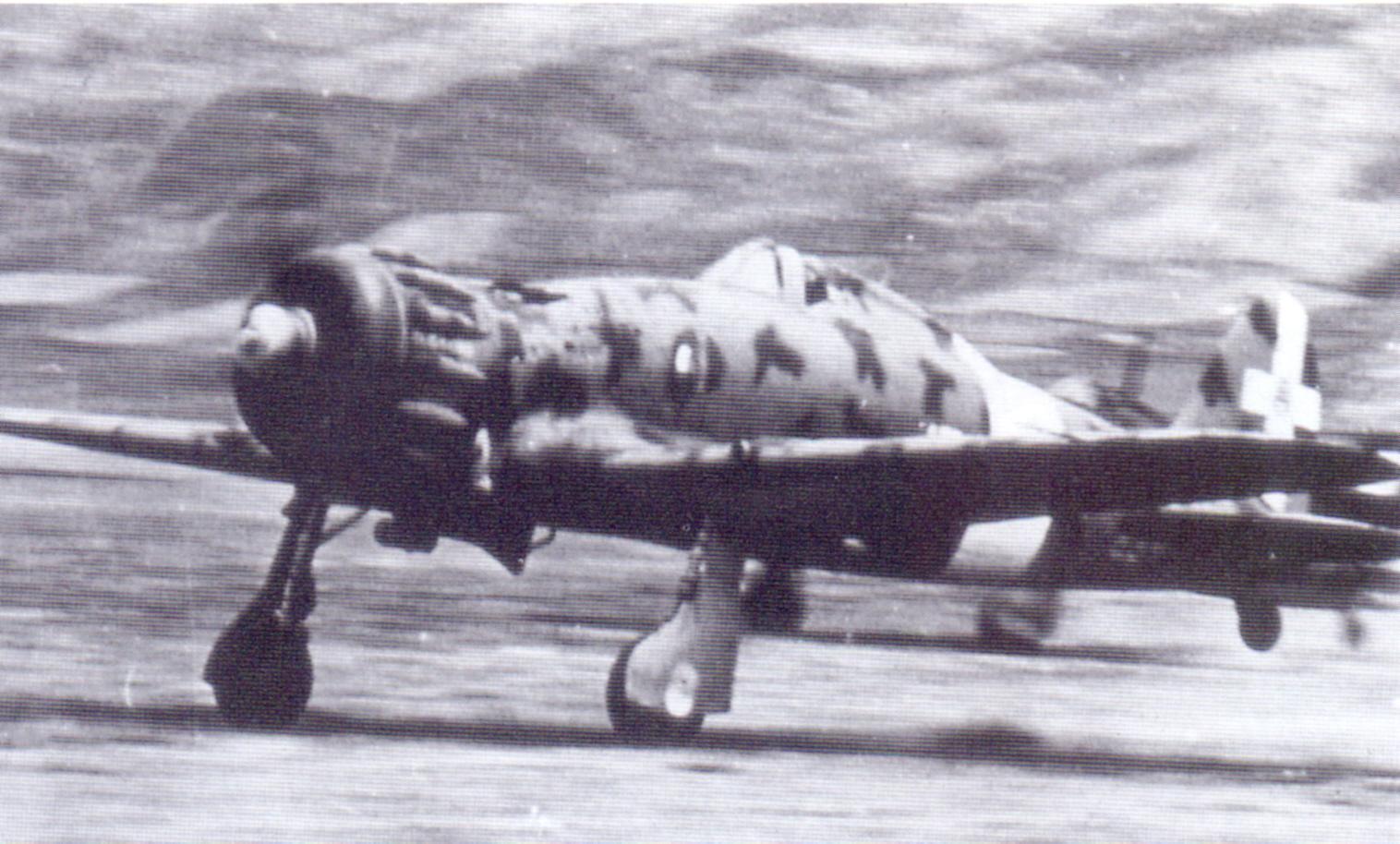
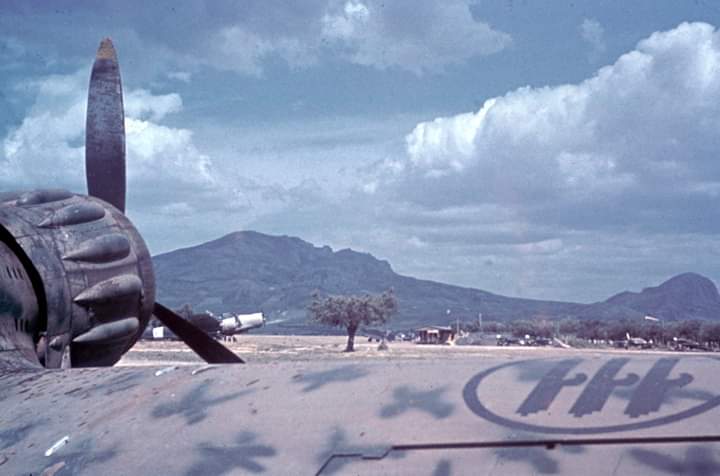
6) In the final evolution of the SAI colonial scheme, in 1943, increasingly sparse spots became smaller and X-, T-, or starfish-shaped
(Photos 35-36).
|
|
|
Photo 35 - SIAI final colonial camouflage scheme as evident on MM 4874, a 2ª serie machine refurbished with the installation of two cameras on the wing leading-edges, and repainted.
|
|
|
|
Photo 36 - Another example of late SIAI colonial camouflage, with sparse branched spots in the shape of an X, T, or starfish. Note the standard wing
insignia with the "full" handle version of the fasci, quite rare on Saettas but often seen on SAI-built ones. The wing now is the same as the C.202.
|
|
|
7) As in the two other firms, especially after the retreat from the African front, but also before, the upper surfaces were painted in olive green (F1) with a low separation line.
|
SPECIAL CASES
Normally, the paint lines of the various companies maintained a certain uniformity in the application of camouflage for periods of time, and small variations could be due to
individual paint workers. Generally, even the touch-ups tried to conform to what already existed, perhaps with available paints that were not necessarily identical
(Photo 31).
The greatest variations were found in the case of complete repaints carried out at SRAM (Squadra Riparazioni Aeromobili e Motori) workshops on the various fronts. These
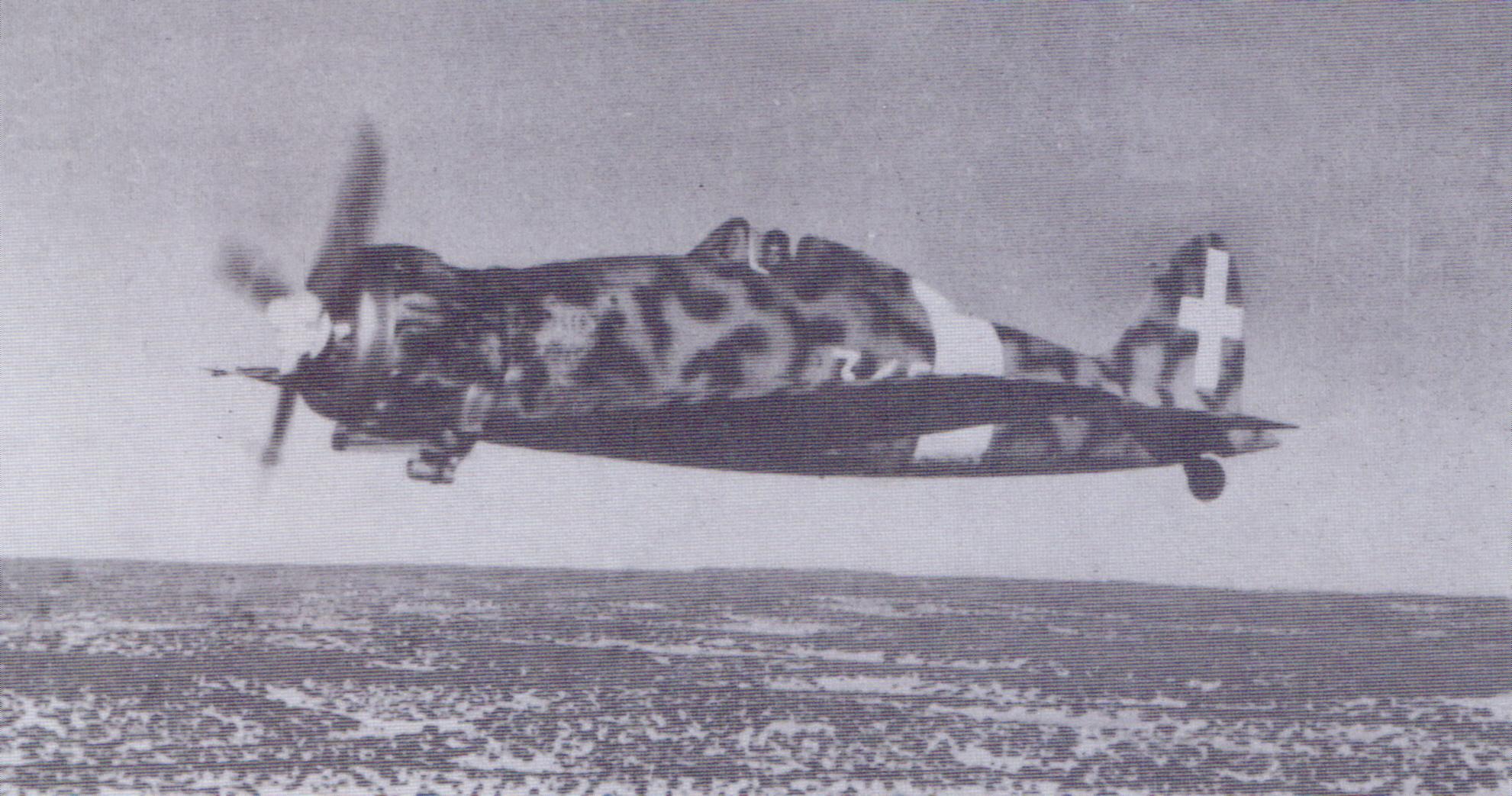
variations could concern either the colors themselves and their distribution. For instance, a type of large, elongated, branched, roughly trilobe-like spots found on a C.200 of
365ª Squadriglia from a North African SRAM, probably the one in Benghazi (Photo 37), as it was also found on at least two overhauled C.202s: 96-9 and 84-3
(then 83-4) MM 7901.
|
|
Photo 37 - A 365ª Squadriglia C.200 in flight over the Cyrenaica desert, sporting atypical camouflage. The non-standard camo pattern, the lack of
application of the Fascio decal on the fuselage and of the Italian coat of arms on the tailfin suggest that it was repainted by a SRAM.
|
|
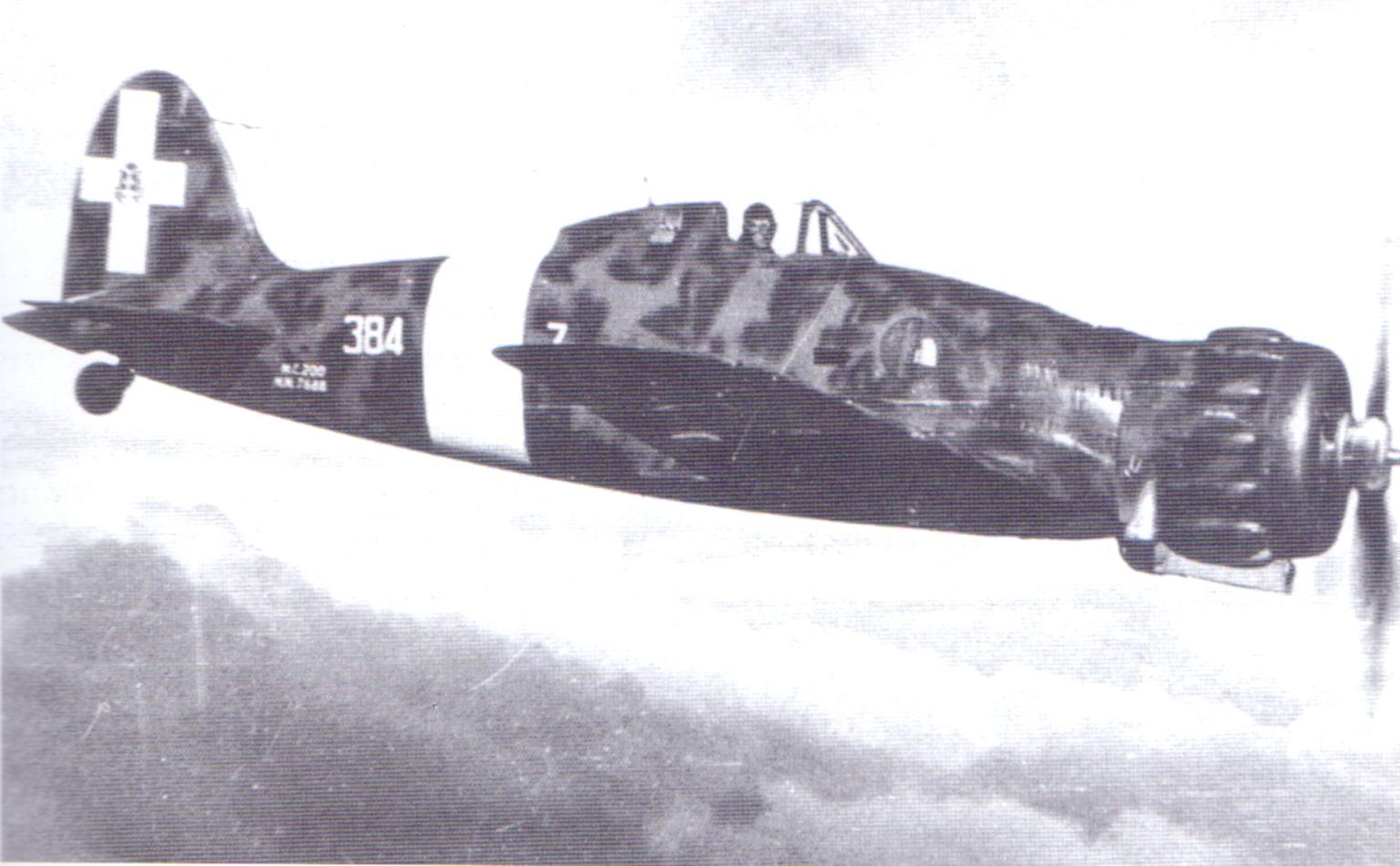
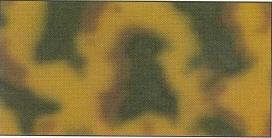 Sometimes it's not easy to distinguish a repaint from a factory scheme, but often a few clues can help: in Photo 38 you can see a C.200 with apparent
factory camouflage, but a closer look suggests it was a repaint (see the caption). Cases like this can lead to the suggestion of schemes that did not exist
as a standard, or were limited to a few cases, due to the creativity of individual painters outside the factories. It is possible that the scheme C1C,
hypothesized in the second edition of the CMPR book as typical of the C.200, refers to the example cited above.
Sometimes it's not easy to distinguish a repaint from a factory scheme, but often a few clues can help: in Photo 38 you can see a C.200 with apparent
factory camouflage, but a closer look suggests it was a repaint (see the caption). Cases like this can lead to the suggestion of schemes that did not exist
as a standard, or were limited to a few cases, due to the creativity of individual painters outside the factories. It is possible that the scheme C1C,
hypothesized in the second edition of the CMPR book as typical of the C.200, refers to the example cited above.
|
|
|
Photo 38 – C.200 coded 384-7 and MM 7688, Macchi 7ª serie. The aircraft was supposed to originally have the "poached egg" paint scheme,
but was evidently overhauled and repainted, as evidenced by the canopy, which is no longer of the semi-closed type, and the non-standard type lettering
of the serial number. The green mottles appear to contain lighter-colored areas within them: a brown, a lighter green, or the same sand of background?
|
|
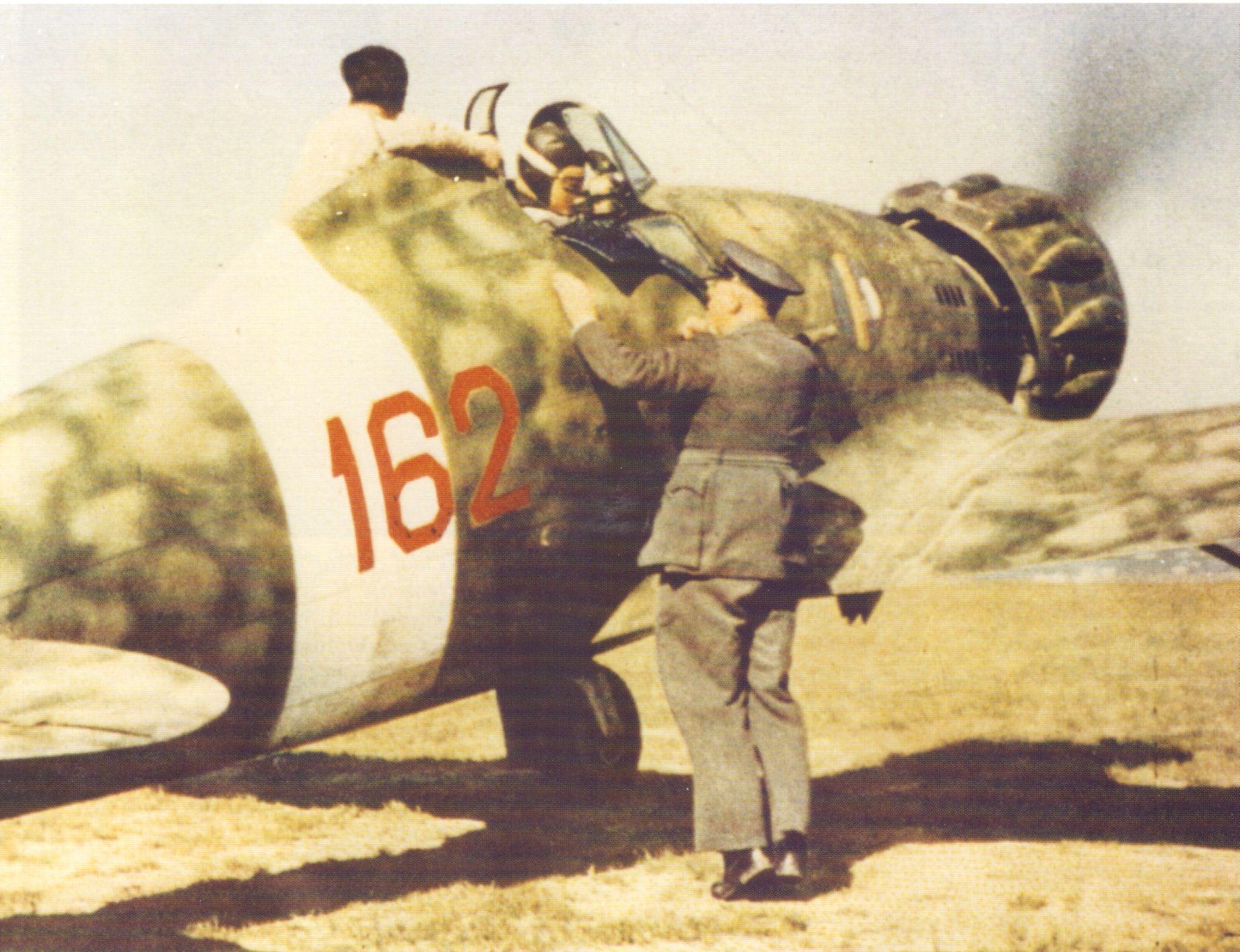
 Otherwise, it could concern a well-known color image of a Saetta in charge with a Flight School (Photo 39), built by Macchi, which features thick rounded sand
patches on a green background, similar to the D1 scheme, but believed to have preceded this scheme and classified as C11A. Instead, it would be the old
C8 scheme in which the brown
spots are barely visible (you can just glimpse them along the side of the fuselage) due to the characteristics of the film or the print, or less probably to retouching.
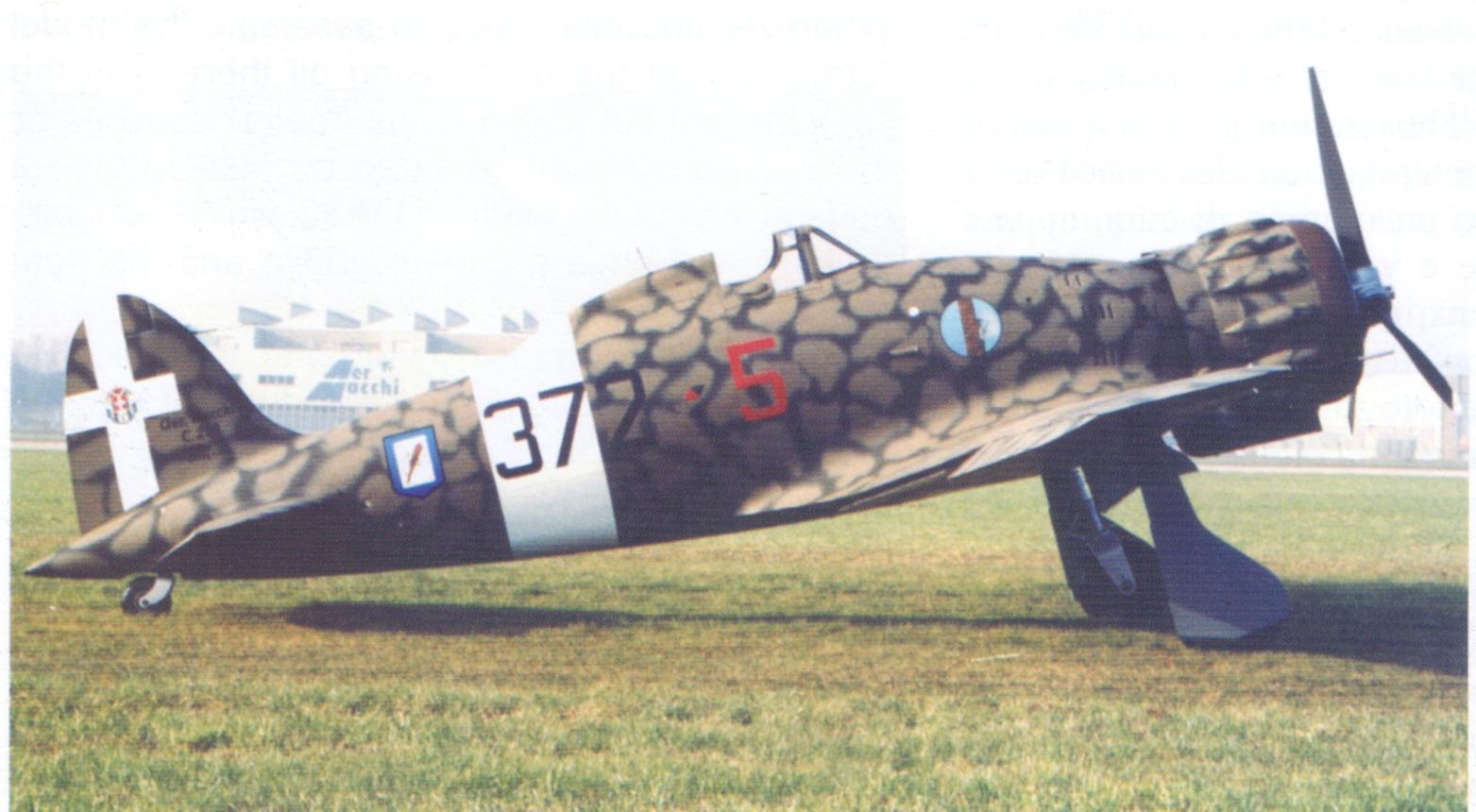
This scheme was adopted to restore the C.200 currently on display at the US Air Force Museum in Dayton (Photo 40), with the codes with which it was captured
in Benghazi in November 1942. It would in fact be 372-5 MM 8146, a Breda XIX serie which should have had another scheme, namely the
D2A. Furthermore, the cross on the rudder
of the restored example is typical of SAI, and this is because there is a photo of the wreck of another 372-5 from this company, probably an earlier example with the same codes.
Otherwise, it could concern a well-known color image of a Saetta in charge with a Flight School (Photo 39), built by Macchi, which features thick rounded sand
patches on a green background, similar to the D1 scheme, but believed to have preceded this scheme and classified as C11A. Instead, it would be the old
C8 scheme in which the brown
spots are barely visible (you can just glimpse them along the side of the fuselage) due to the characteristics of the film or the print, or less probably to retouching.
This scheme was adopted to restore the C.200 currently on display at the US Air Force Museum in Dayton (Photo 40), with the codes with which it was captured
in Benghazi in November 1942. It would in fact be 372-5 MM 8146, a Breda XIX serie which should have had another scheme, namely the
D2A. Furthermore, the cross on the rudder
of the restored example is typical of SAI, and this is because there is a photo of the wreck of another 372-5 from this company, probably an earlier example with the same codes.
|
|
|
Photo 39 - Macchi-built example with apparently non-standard camouflage, but possibly with degraded or retouched colors.
|
|
|
|
Photo 40 - The Macchi 200 preserved in Dayton, restored with a camouflage that is certainly amazing, but probably incorrect.
|
|
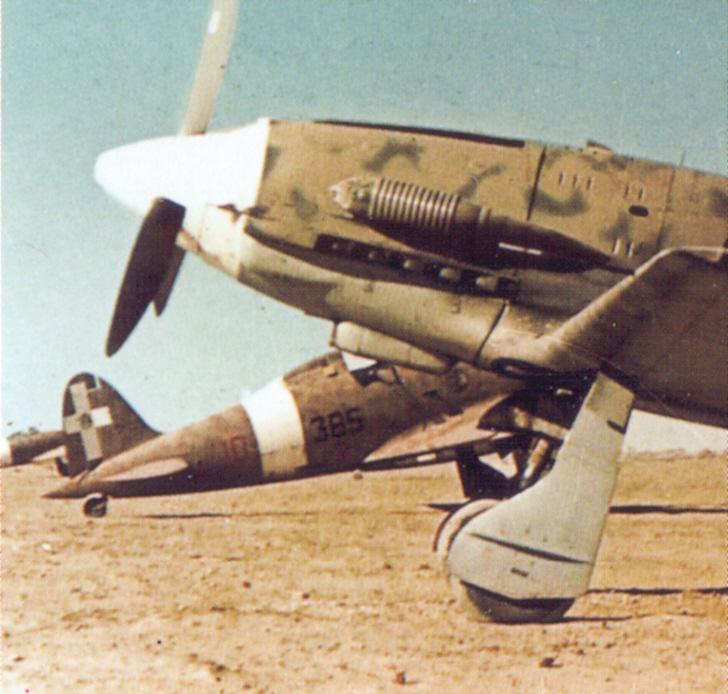
There were also some variations in the colors, probably field-based, for example a brick-red brown on a sand background on at least one example from 385ª Squadriglia
in North Africa (Photo 41). This is a Macchi-built plane that—judging by the appearance of the unusual speckled spots—had been repainted in the field.
Before the discovery of original color photographs, such camouflage would have been unimaginable. For example, according to a witness, BR.20bis of 13° Stormo were also
camouflaged with reddish brown spots on a sandy background when they were transferred to North Africa. This may therefore not have been an isolated occurrence, and it tells us once
again that we can never be certain about the camouflage of Regia Aeronautica aircraft (or any other combatant for that matter).
|
|
Photo 41 - Example of a C.200 (385-10) built by Macchi with small, shaded reddish brown spots on a sand background, to be compared to the
D2A camouflage
of the C.202 Breda (81-4 MM 7879, 1ª serie) in the foreground. The propeller of the latter wears the Piaggio logo, and is painted in a similar gray as the undersides.
|
|
THE PAINTS USED
Before standardization and the use of color-matched paints, each company independently sourced its paints from different paint suppliers, which explains the vast variation
in the colors used. Based on testimonies, original specimens, and images, we’ll try to shed as much light as possible on this matter. The main sources are still the two studies
by GAVS and Tosco (VITO Charts). For color hues, we will cite for convenience and with appropriate clarifications the Federal Standard references.
Note on the Nocciola Chiaro: the today-known color Nocciola Chiaro 4 derives from the original Tavola 10 found, and corresponds to FS 30219, a neutral
medium brown, similar to Marrone Mimetico 1 of CMPR. Color photos of C.200s (also for many 202s) instead show a lighter sand color at least until 1943,
so much so that the gray tone in b/w photos almost corresponds to that of the lower surfaces. A change in tone towards dark is observed only on the latest Macchi C.202s and for C.205s,
all in the D3 scheme. The color photos, considering the quality of the time, show a sand that can be assimilated to Giallo Mimetico 4 (FS 30266) or even lighter types found
in various wrecks, whose shades range from FS 33303-33448 of the Vitocharts 10 - Colore 4 in variante sabbia to a lighter FS 33446-30475 (see below). In addition
to the Vitocharts, Nino Arena and Giorgio Pini also cited a light hazelnut color variant. It cannot therefore be ruled out that there was an initial official version of a
lighter hazelnut, suited to the desert environment, which was later replaced by a darker color corresponding to the only example found in Tavola 10.
Aeronautica Macchi
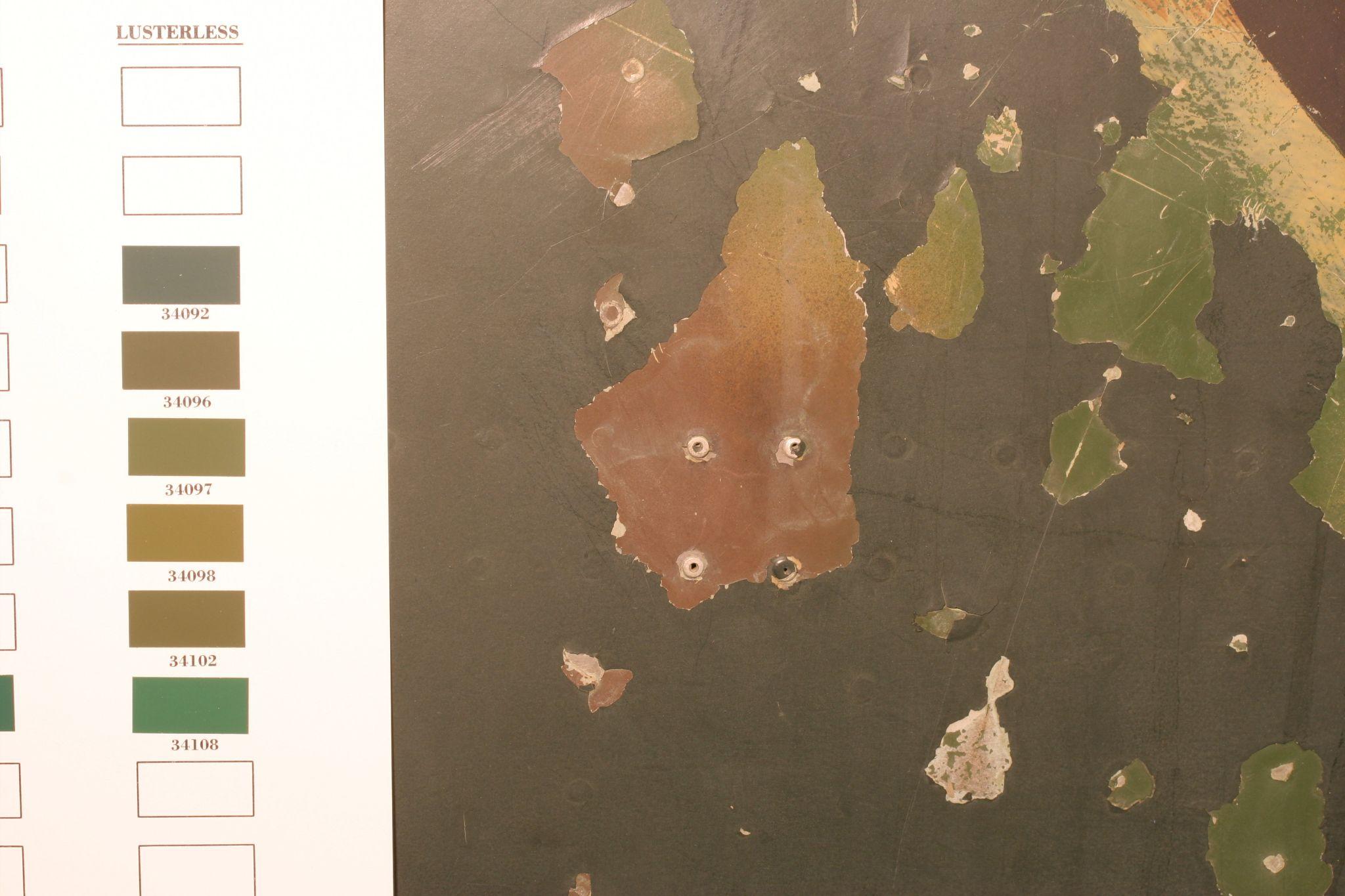
Upper Surfaces: The colors proposed at the time by CMPR were the same Giallo Mimetico 4 (see above), Verde Mimetico 2 (FS 34092) and
Bruno Mimetico (FS 30215), with lower surfaces Grigio Mimetico (FS 36231). Researcher Maurizio Longoni found slightly different shades on the wreck
at the Caproni Museum (Photo 42): yellow FS 30318, green FS 34097 and brown 30448-30117; the last two should correspond approximately to
Verde Mimetico 53192 and to Marrone Mimetico 53193 5. Personally, on the same wreck, I found colors more compatible with the latter
than with those hypothesized by the CMPR: a yellow FS 33446-30475, a lighter green FS 34151 (Vitocharts 14 - Verde Mimetico Chiaro 1940, in turn slightly
lighter than Verde Mimetico 53192) and a brown matching Marrone Mimetico 53193. The various shades detected on the relic are believed to be due
to the overlapping of the colors when spraying the paints.
|
|
Photo 42 - C8 camouflage emerging from under a layer of Verde Oliva Scuro 2 on the C.200 wreck at the Caproni Museum in Trento.
Note how the density of the spray and how it affects the color tones. (Courtesy of Riccardo Trotta)
|
|
For the Tavola 10 period, the only note to be made is that in both color and b/w photographs Nocciola Chiaro 4 always appears in the light version. For the green,
it is worth quoting Virginio Tosco, according to whom Macchi itself mixed its supplies of 14 - Verde Mimetico Chiaro 1940 with the new Verde Oliva Scuro 2,
obtaining a dark green (39 - Verde Mimetico Scuro Macchi 1940, FS 34096) in fact almost identical to Verde Mimetico 3.
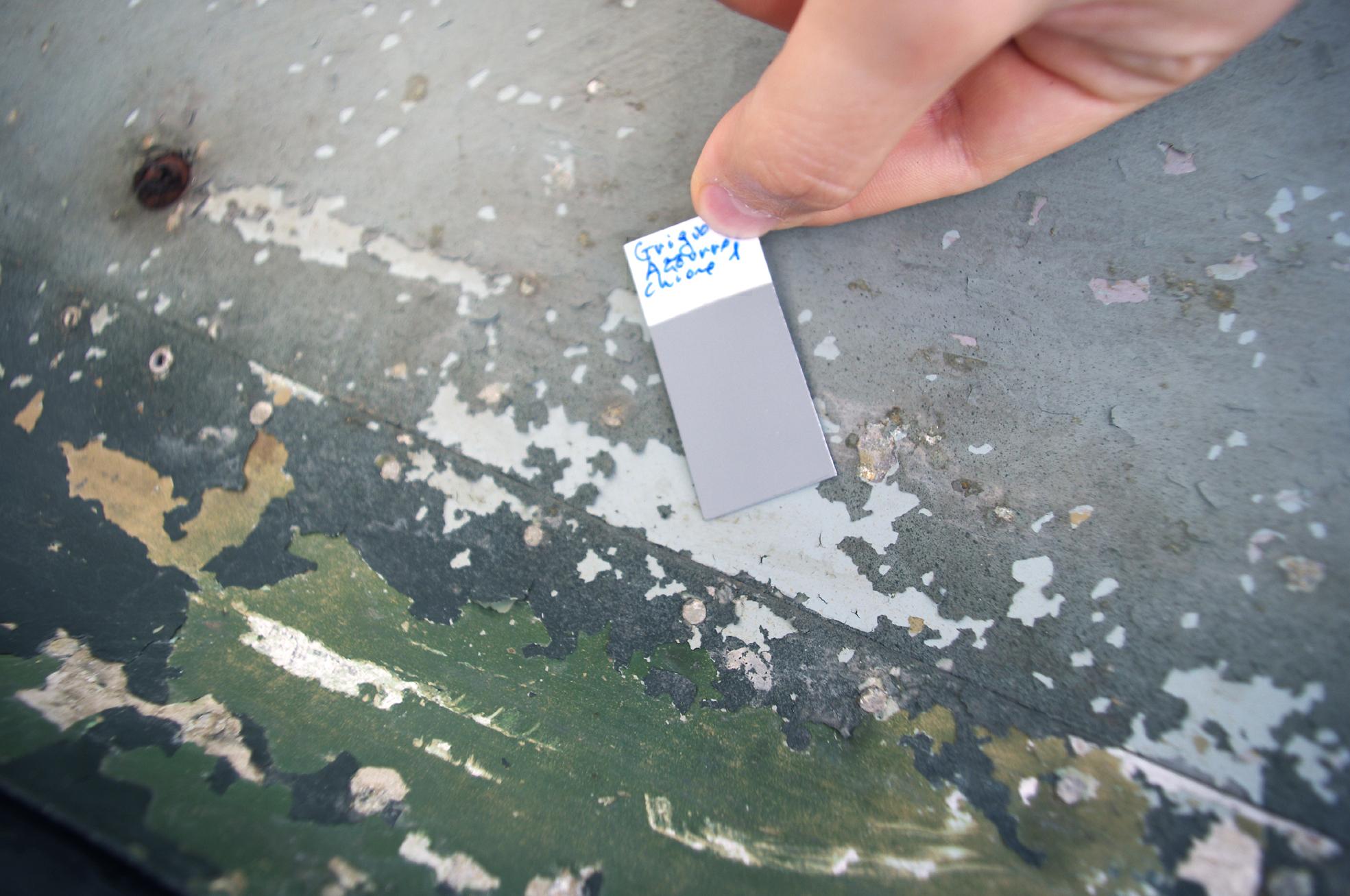
Lower Surfaces: They are mentioned in Longoni's note only for the last layer of paint, which complies with the new standards with Verde Oliva
Scuro 2 (FS 34052, detected as FS 14096) above and mentions its color Grigio Azzurro Chiaro 1 lower - which actually was a neutral light gray without any
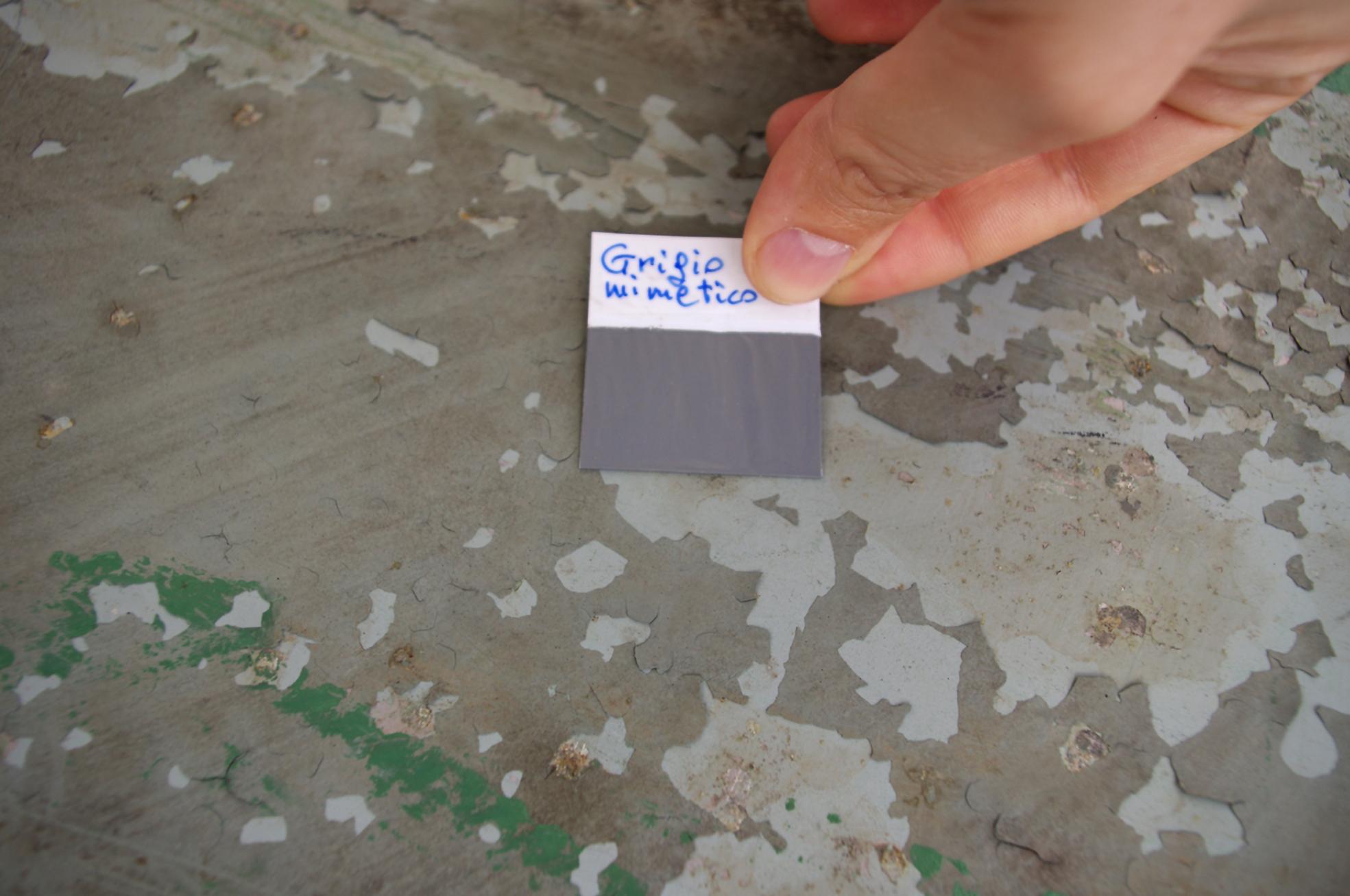
bluish tinge - as corresponding to FS 26493. Longoni ignored the underlying layer, which presents a "true" light blue gray and not the darker and more neutral Grigio Mimetico
proposed by the CMPR. the light blue gray is in fact still detectable on the wreck where the surface layer of Grigio Azzurro Chiaro 1 chipped away. The underlying color is
lighter and decidedly bluish compared to the latter. I have not found an exact match for this color with the Federal Standards, but it could be FS 34516 with a touch of blue
or to FS 35526 (Luftwaffe RLM 65) lightened by 25-30%. This color, although slightly darker and more intense, is also present in the Vitocharts palette as 7 - Colore 1 in variante
Macchi e Reggiane (FS 35414 lightened by 30-40%). Practically, though not a perfect match, in the FS palette 35622 could be the closest to the original.
|
|
Photo 43 - Comparison between a sample of Grigio Azzurro Chiaro 1 and the paints used for the lower surfaces of the C.200 wreck. Although the surface layer
appears darker, the paint is quite dirty, but it matches the sample well on the inside of the removed chips. The underlying color is decidedly lighter and bluish.
(Courtesy of Riccardo Trotta)
|
|
|
|
Photo 44 - Comparison with a sample of Grigio Mimetico, hypothesized by the CMPR for the lower surfaces in the first period, but which is even darker than
the second, though dirty, layer of Grigio Azzurro Chiaro 1. (Courtesy of Riccardo Trotta)
|
|
Interiors: The CMPR study detected the presence on some wrecks of a Verde Anticorrosione (FS 34558, or according to Longoni the similar 34491), a color that among
modelers is too widely used for the interiors of almost all Regia Aeronautica aircraft models. Actually, it seems that a pale green finish was typical of Macchi aircraft,
with slightly different shades on the Reggianes, and probably also for IMAM. After the issuing of painting regulations, however, in the aircraft produced from autumn 1941
onwards green interiors should have been covered with Grigio Azzurro Chiaro 1. This overpainting could have been made only on visible parts such as the cockpit,
wheel wells or inner side of flaps, and leaving in green the hidden parts of the structure. In the C.200 MM 7707 held in the Aeronautica Militare Museum at Vigna di Valle (Rome)
the original interiors initially had not been repainted and the gray was still visible in the parts as above, but the Verde Anticorrosione covered the inner parts of the
structure. Only towards the end of the war, perhaps to spare time and paint in that frantic period, the whole interiors of several aircraft such as the C.205s and the Reggiane
fighters were left green.
A characteristic of Macchi is the black coloring of the interior canopy frame.
Breda
Upper Surfaces: The paints used by Breda in the pre-Tavola 10 period were partly different from those of Macchi. The color photos and the statements made by either
CMPR and Vitocharts, document the use of a fairly saturated yellow ochre which should be Giallo Mimetico 3 (FS 34434), of at least two types of green, attributable to
Verde Mimetico 3/Vito 8 - Verde Mimetico Scuro 1940 (FS 34102-34094) and to Verde Mimetico 1/Vito 14 - Verde Mimetico Chiaro 1940 (FS 14257-34151), and a medium-dark
neutral brown Marrone Mimetico 53193 (FS 30102) rather than light and reddish Bruno Mimetico also suggested by CMPR.
For the Tavola 10 period, Nocciola Chiaro 4 was of the lighter version, the same as Macchi. However, there is photographic evidence of a Breda-built C.202 with
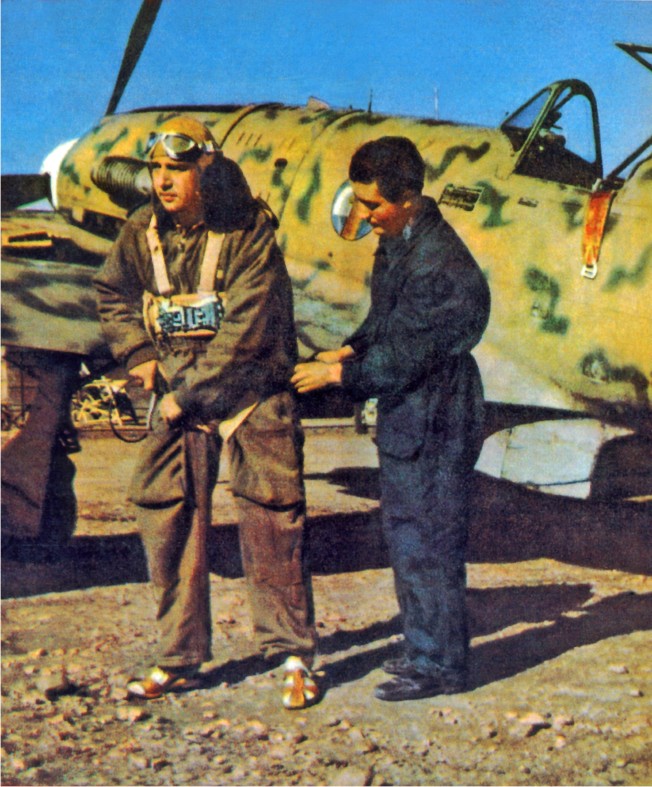
the D2A scheme on the fuselage and left wing is replaced by a Macchi-built one with the D3 scheme (Photo 45):
the fuselage shows a yellow ochre with green "snakes" on the fuselage, a lighter green than the Verde Oliva Scuro 2 smoke-rings on the port-side wing, which confirms both the
possession of the above-mentioned colors by Breda and their use as warehouse stock until they ran out, even in the first period of color standardization.
|
|
Photo 45 - This original color photo of C.202 377-3 (ex-168-11 MM 7948, Breda 1ª serie, confirms the use of old paint stocks by the manufacturers even
after the paint scheme had been standardized. The
D2A
fuselage camouflage features colors compatible with Giallo Mimetico 3 and a lighter, more saturated
green—perhaps Verde Mimetico 3—than the dull Verde Oliva Scuro 2; the latter itself appears on the replaced wing built by Macchi with
D3 camouflage,
together with the light version of Nocciola Chiaro 4. Curiously, this aircraft was built later than MM 7879 of Photo 41,
which had full NC4 and VOS2.
|
|
Lower Surfaces: It seems these were in Alluminiata (silver) in the period roughly corresponding to the two greens, and neutral light gray in the three-color one;
the gray should already be the color that will later be classified by the CMPR as Grigio Azzurro Chiaro 1 (FS 36307-26493).
Interiors: The color images - also of the Breda-built C.202 - show a gray like the same Grigio Azzurro Chiaro 1, as mentioned for the interior coloring
and certified in an official document as "already in use" even in the pre-Tavola 10 period.
A characteristic of Breda seems to be that of having treated the metal parts - at least that of the canopy structure - with a yellow-greenish anti-corrosion galvanization;
this treatment was transparent and allowed the metallic reflection to be seen (Photo 18) 6. It is not excluded that some examples may have had this
finish for the entire interior. From at least Tavola 10, as mentioned above, it was in any case expected that this treatment would have been covered with a gray finish. The
inner structure of the front windshield was instead painted black for anti-glare purposes.
SAI Ambrosini
For this company, there are no certain color photographic references prior to Tavola 10, nor any relic, nor notes from previous studies. Given the type of patterns observed,
like those of the Breda company, it can be assumed that the same paints were used as those of Breda.
The lower surfaces appear to be a uniform light gray color, although the use of a light blue or, at least in one example, Alluminiata cannot be ruled out.
The interior appears to have been light gray (Photo 32) and the interior of the windshield but the side frames were black.
For the Tavola 10 period, here too all specimens show the lighter version of the hazelnut color.
INSIGNIA
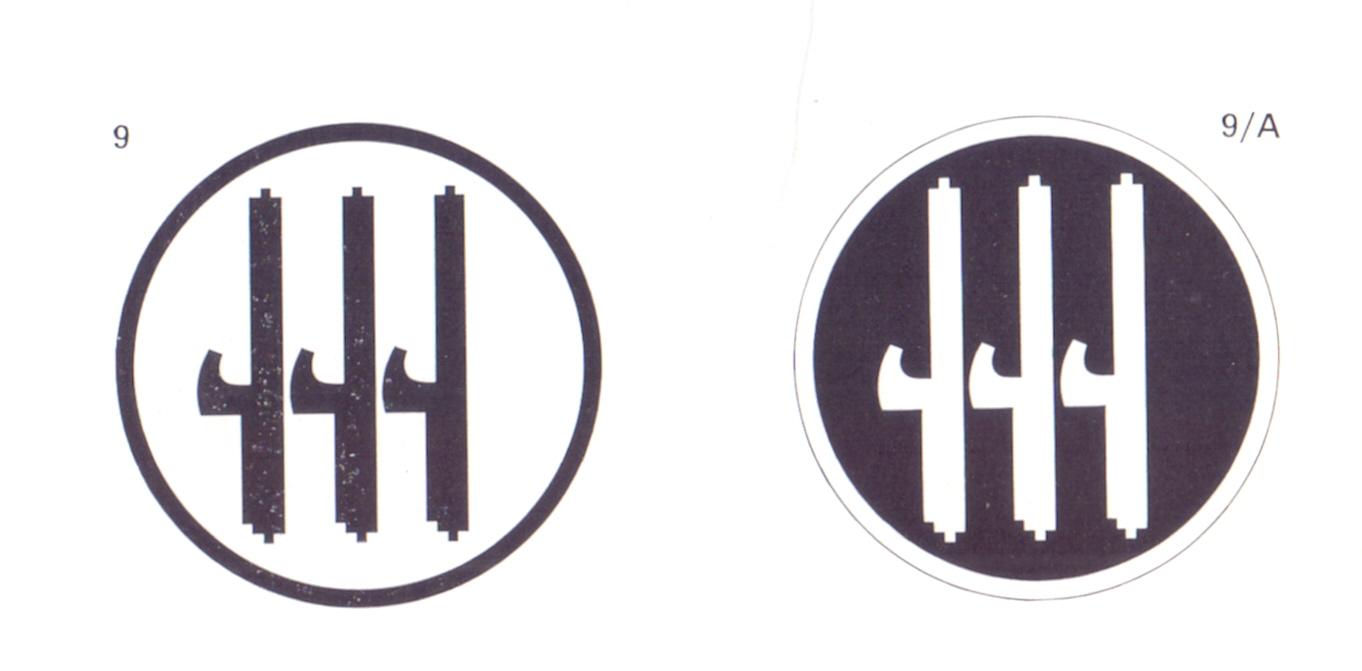
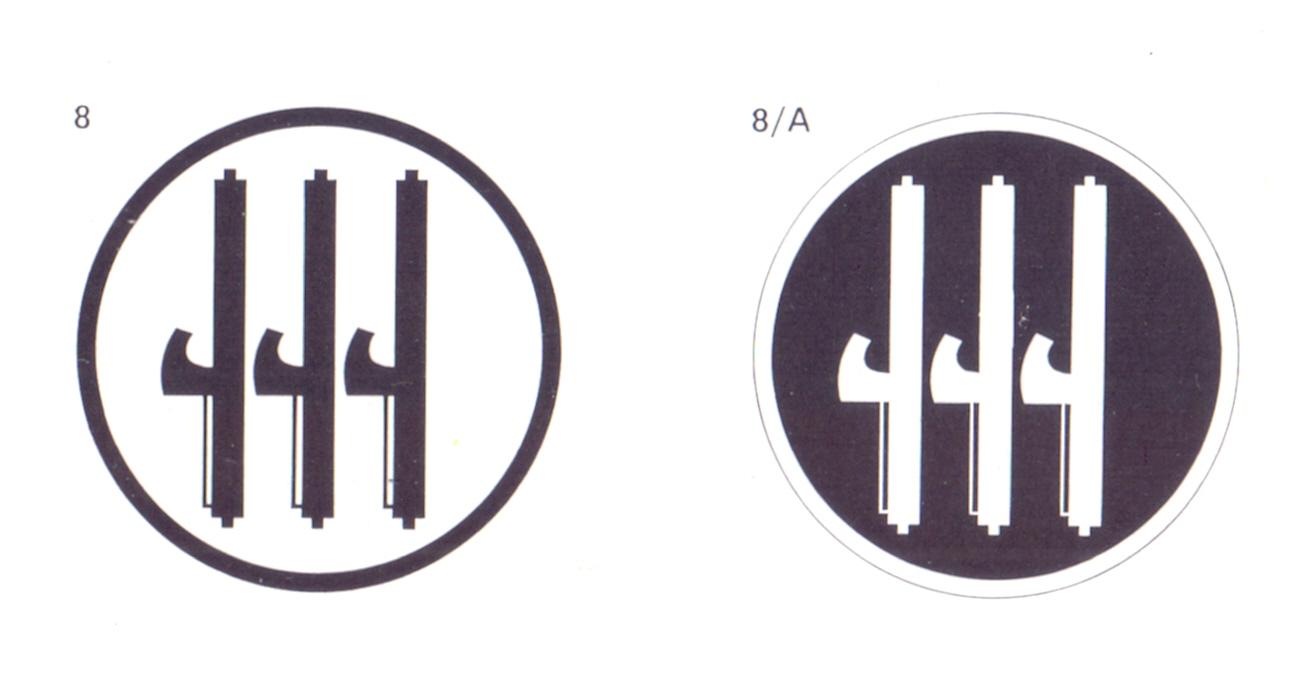
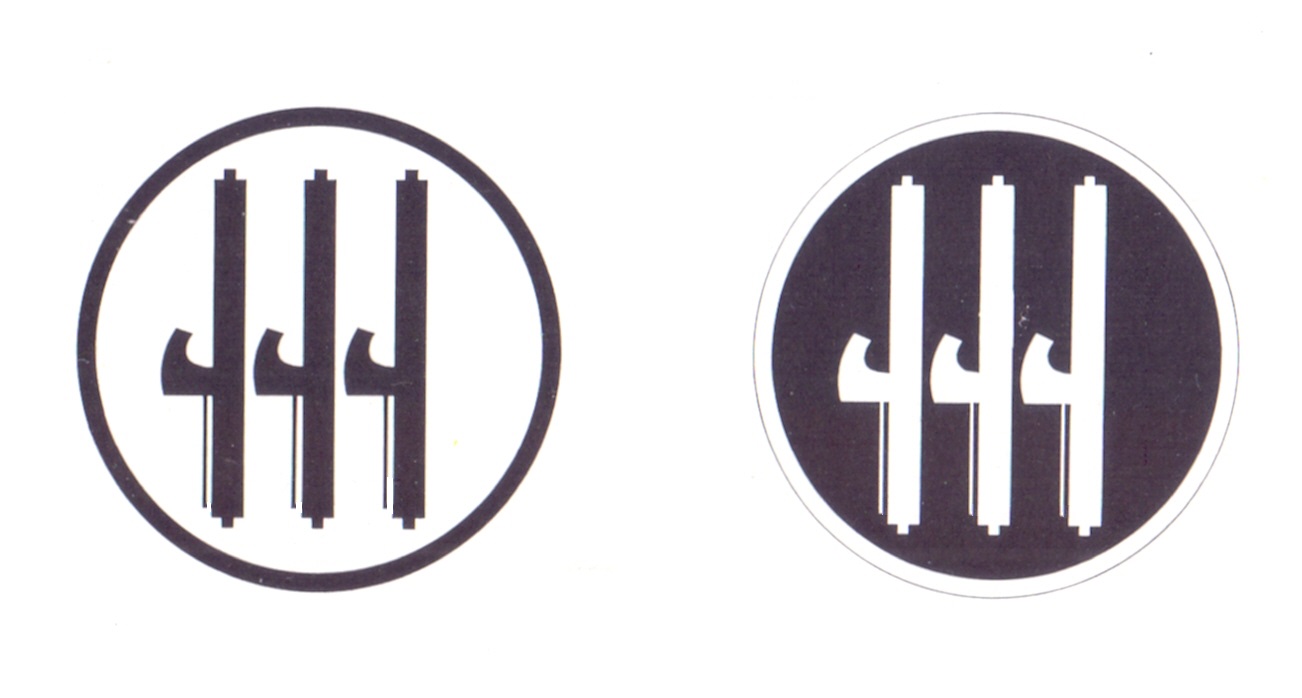
Wing insignia 7: were 960 mm in diameter, initially in two standard types, both with a "full" axe handle
(applied with a stencil, type 9-9/A, drw. 1), or a "contoured" handle (decal, 8-8/A, drw. 2), or even with a "detached" handle
typical of Macchi fighters (stencil, modified from 8/8A, drw. 3). The white-backgrounded fasci were applied to the top surface areas and were rarely
found on the lower surfaces, where usually these markings had a black-background. The wing fasci were always oriented forward, with the axe blades
facing the wingtips. Generally, the application was accurate, and no variations nor errors in orientation are known.
|
|
Drawing 1 - Typical wing bundles up to early 1941.
|
|
|
|
Drawing 2 - Typical wing bundles up to early 1941.
|
|
|
|
Drawing 3 - Typical wing bundles up to early 1941 (typical Macchi).
|
|
Subsequently, the DGCA note of 29/10/41 ordered that the fasci had to have a neutral background and therefore initially, on the upper ones, the background was hand
painted - sometimes roughly - with a camouflage color (Photo 4). Many aircraft, such as those of 22° Gruppo which were sent to Ukraine, had the old wing fasci removed
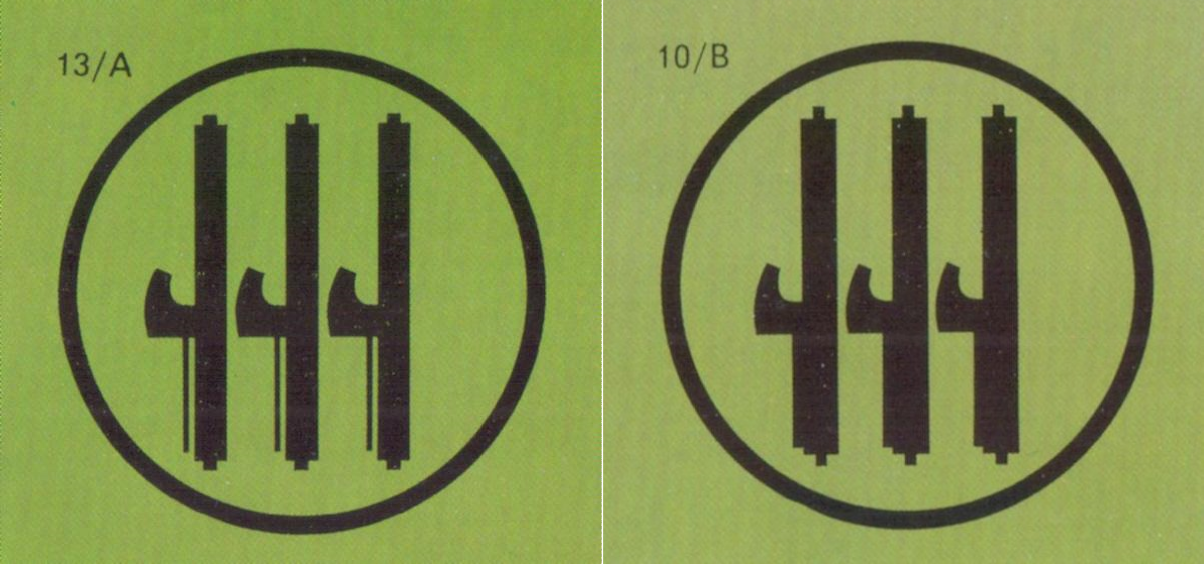
and replaced. The new aircraft instead received at the factory the black fasci with neutral background, mainly of the Macchi type with a "detached" handle (stencil, 13/A,
drw. 4) and more rarely, in SAI aircraft, with a "full" handle (stencil, 10/B, drw. 5) as seen in
Photo 36.
|
|
Drawings 4 and 5 - Neutral background wing bundles.
|
|
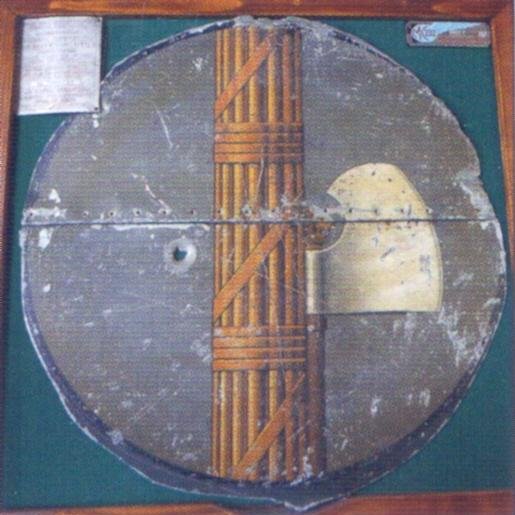
Fuselage Fasci: Most of the fuselage fasci, 350 mm in diameter, were of the "lead gray" background type, i.e. a dark blue-gray FS 15080 (Photo 46).
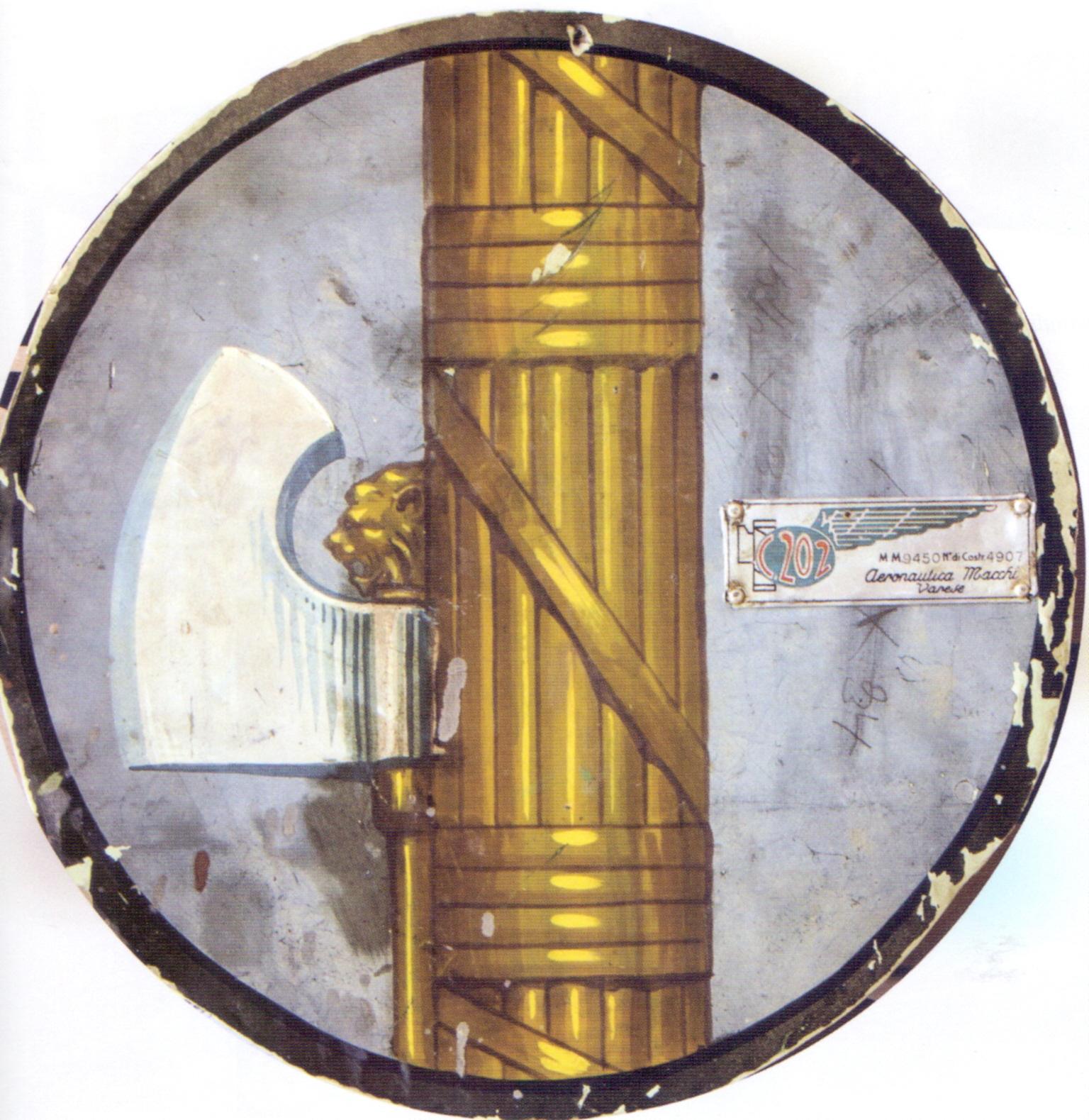
At least until
the beginning of 1941, the old fasci with a light blue background were occasionally present, especially on aircraft built by Macchi (Photo 47). All these insignia were decals,
which sometimes were not re-applied depending on availability or time—after overhauling or repainting, especially in the later period. The design, always of the same theme,
could vary significantly depending on the decal manufacturer. The axe blades always faced forward, and no exceptions are known to exist here either.
|
|
Photo 46 - Fuselage bundles, dark background, from a C.202 wreck.
|
|
|
|
Photo 47 - Fuselage bundles, light background, from a C.202 wreck.
|
|
Tail Insignia: Prior to WWII, the vertical tail bore the Italian tricolor, with the rudder divided into two bands, white and red, while the green one - which had the
same thickness as the white one - was on the fixed fin (Photos 3, 27). At the outbreak of the conflict, to avoid confusion with French aircraft that also flew their own tricolor
in the same position, it was ordered to cover the green and red with camouflage and apply two horizontal white bands of the same thickness as the vertical one, forming the white
cross of the Savoy coat of arms. This modification was carried out locally at various airfields, with varying results from one aircraft to another. Among the aircraft produced
by then, we can see differences between factories, which can be clearly seen in the photographs above:
- Macchi: The cross is asymmetrical, with longer vertical arms and truncated ends (Photos 4, 6,
9, 11, 24 in the foreground, 37, 38).
- Breda: Normally, vertical arms were the same length as the horizontal ones, but with the rear arm reaching the trailing edge of the rudder
(Photos 18, 21, 22, 25 on 92-2).
From around late spring 1941, asymmetric crosses like those on the Macchi appeared alongside these, but with the rear arm still reaching the trailing edge of the rudder
(Photo 14 on 369-12; 24 on 369-1). The "short" crosses seem more frequently
associated with the three-tone and C2 camouflage, the "long" ones with the two-tone green. Later, the
crosses became completely identical to those of the Macchi (Photos 25 on 92-3, 26), as can also be seen on all C.202s built by Breda.
- SAI: Typical of the aircraft produced by this company, including the Folgore, was that in addition to the rear, the upper and lower arms also reached the edges of
the rudder (Photos 28, 30, 31, 33-35). This was also
for SAI-built C.202s.
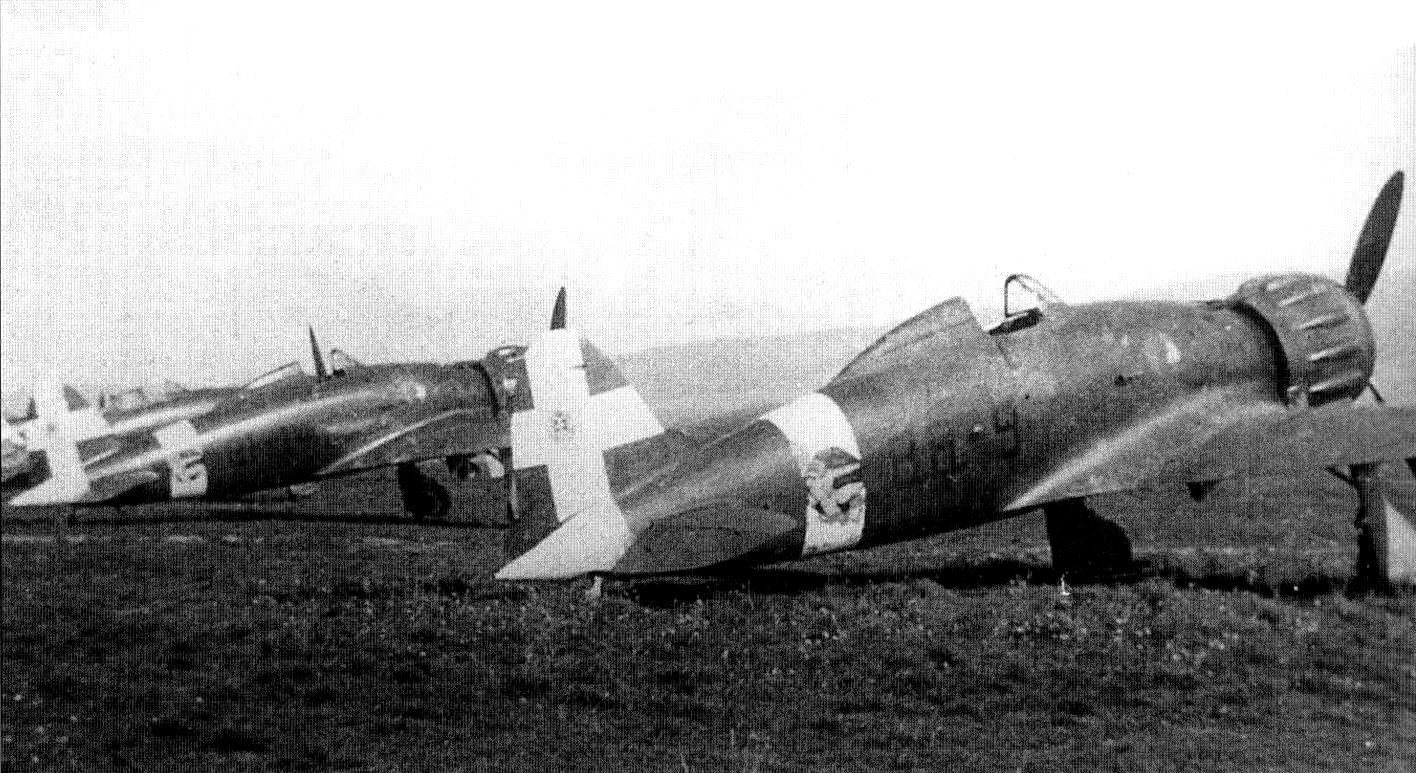
In 6° Gruppo of 1° Stormo, for combat identification purposes, in 1940 the arms of the cross were extended to the edges in all directions—in some cases, the thickness of them
was also increased—with the tail cone often painted white (Supplemental Photo 2). Indeed, there apparently had been some cases of "friendly fire" during the fighting over Malta.
|
|
Supplemental Photo 2 - A line-up of 1° Stormo C.200s at Catania during the early months of 1941. Note how the tail cones have been painted white and the arms of the
Savoy cross have been thickened and extended to the edges of the fin and rudder. These changes were made to rapidly identify C.200s from Hurricanes.
|
|
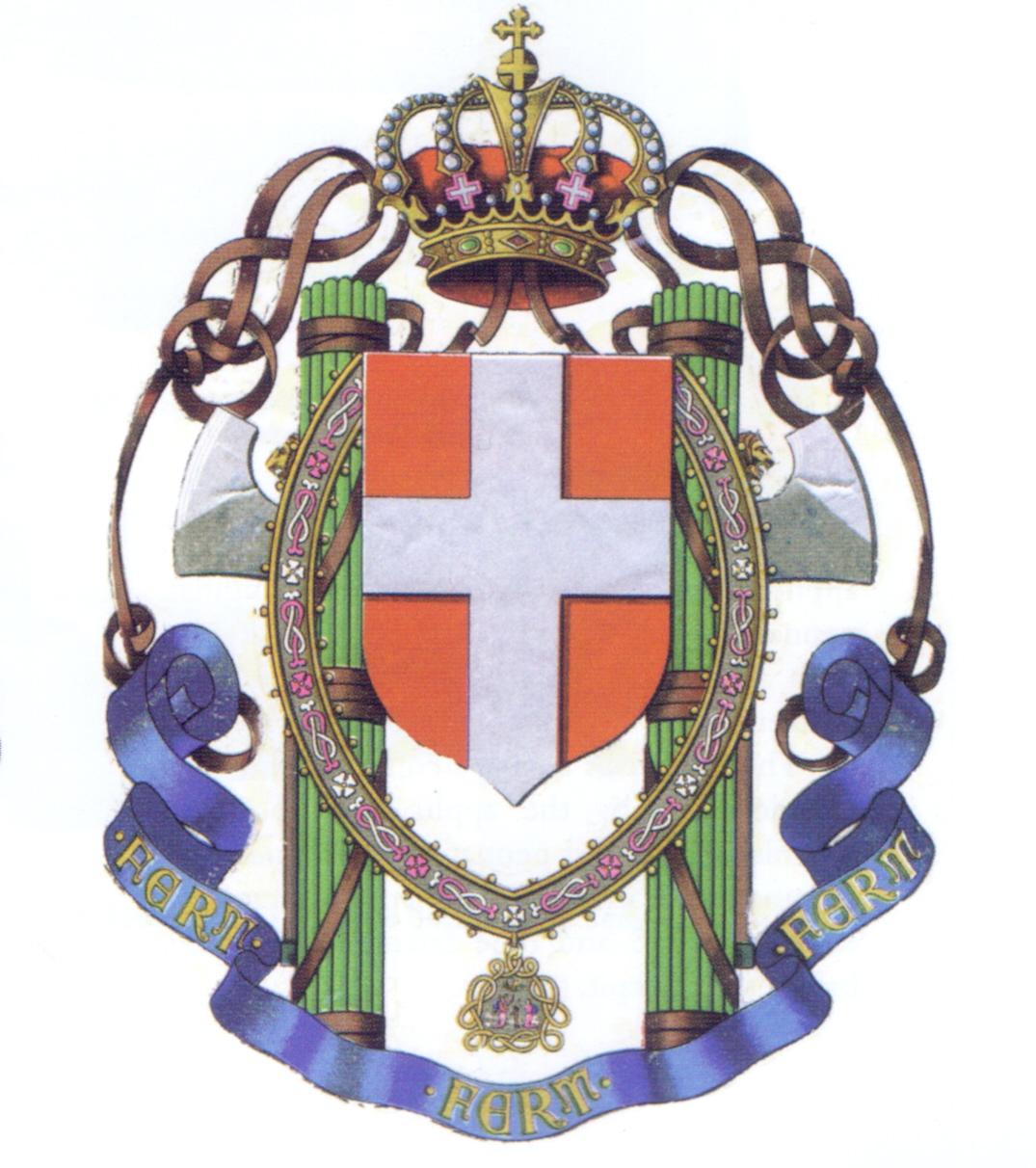
The decal with the State Coat of Arms on aircraft with the Italian flag was placed 4/5 of the way up on the white band. On factory-applied crosses the coat of arms, when present,
was always placed in the center of the white tail cross. In this insignia, the cross of the shield, originally white, was often repainted with silver paint using a stencil
(drw. 6).
|
|
Drawing 6 - The state coat of arms was applied in the form of a decal on the white part of the tricolour on the tail and subsequently at
the center of the Savoy cross.
|
|
Stenciling: Even these, there were differences between the various factories. Except for late production SAI and Macchi, they were all blue in various shades.
- Macchi: On the fixed fin, below the horizontal arm of the white tail cross was the following script Aer.Macchi (or more rarely and later Aeronautica Macchi), below it in
columns C.200, then in script serie, the empty weight (P.V.) and the payload (C.U.) of the aircraft, in kilograms. The M.M.
(Matricola Militare, military serial number) was placed under the leading edge of the tailplanes as M.M. XXXX. Aircraft built around 1943 or those overhauled from
that period could have white lettering, as for the last C.202s and the C.205s.
- Breda: At the beginning, m.c.200 in italics on the fin as above, and below this the weights are reported (not always, or sometimes only the P.V.). M.M.
number as above (Photo 17). The XIX serie aircraft only had the weights reported on the fin, the writing m.c.200 in front of and below the edge of the tailplane and below this,
in column, SERIE XIX and the M.M.
- SAI: At the beginning, was the same as Macchi, but written only Aer.Macchi and never in full extension. Starting at least from the XXIII serie, scritping became white,
with only the weights on the fin and Macchi C.200, the SERIE and the M.M. lined up low in front of the tailplanes.
For all firms, the planes modified for the desert duty had the initials A.S. (Africa Settentrionale, North Africa) under the M.M.
PROPELLERS
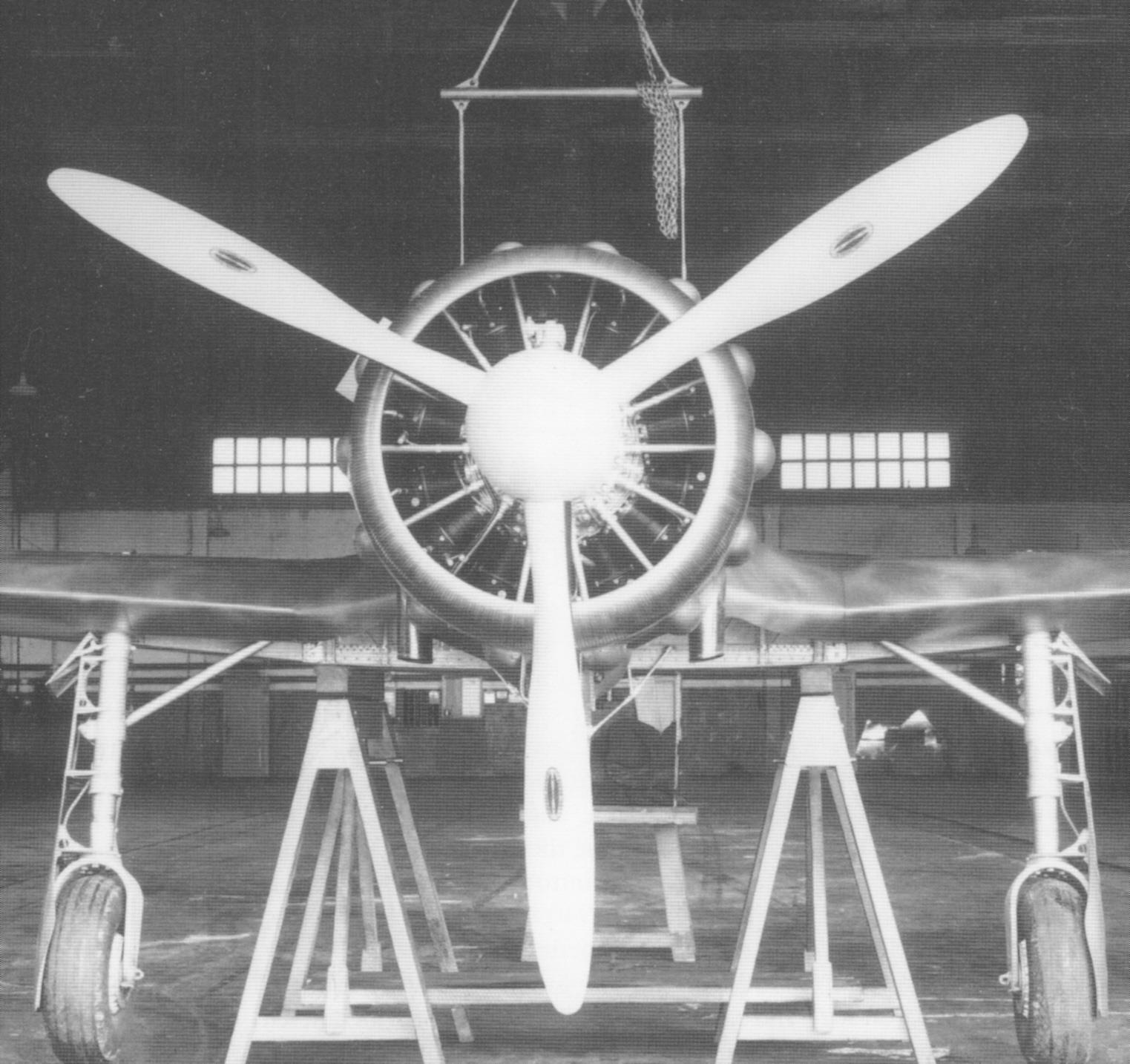
 The first FIAT-Hamilton propellers had the front face of the blades and the nose cone in light blue FS 35466 and the company logo, taken from Hamilton Standard,
applied to 3/5 of the length towards the end, at the larger width of the blade (Photo 48).
The first FIAT-Hamilton propellers had the front face of the blades and the nose cone in light blue FS 35466 and the company logo, taken from Hamilton Standard,
applied to 3/5 of the length towards the end, at the larger width of the blade (Photo 48).
The standard propeller Piaggio 1001s could be produced by Macchi and Breda, as well as by Piaggio itself. Those made by Macchi were a pale blue at the front,
probably the same color as the undersides seen above (Photo 5). The Bredas had the same light-colored parts, perhaps the same light blue as Macchi 8 or
alternatively a light neutral gray; there are no known reliable color images. The Piaggio were initially a light neutral gray (Photo 41, on C.202) and later a
medium-dark gray (Photo 16). The factory logo was rarely present on Macchi and Breda propellers 9 with light front surfaces,
while it was almost always present in the original Piaggio ones, being placed halfway along the length of the blade.
The rear face of the blades was always in a semi-gloss black for anti-glare purposes (see Note 8). SAI did not produce propellers,
but rather purchased Piaggio ones.
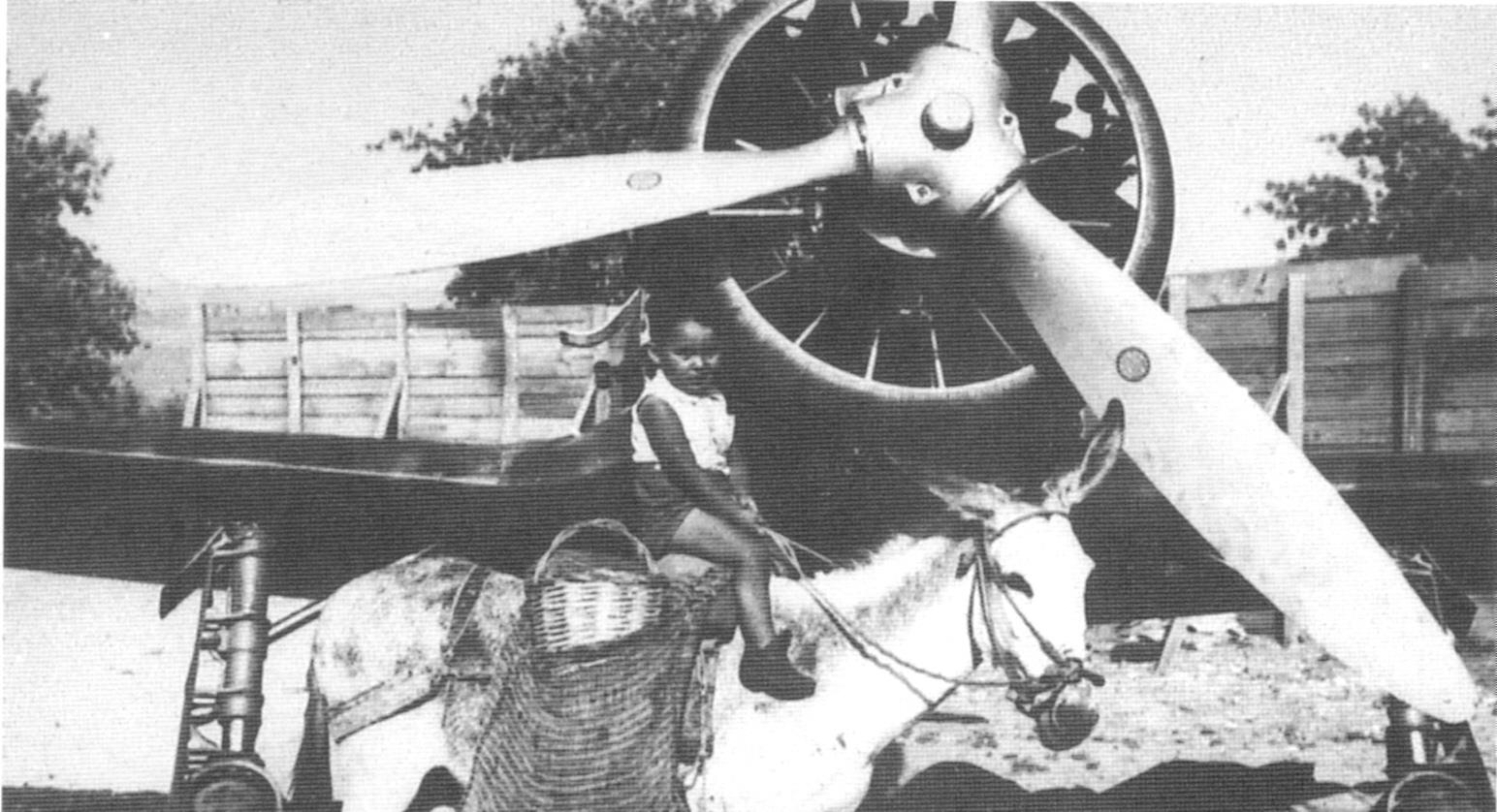
In the late models the propellers were painted entirely black, with the tips in yellow FS 33655. These often featured the logo of the three manufacturers. For Macchi and Piaggio,
as for FIAT-Hamilton, the logo was oriented with the upper part towards the direction of rotation of the propeller, for Breda the upper part was oriented towards the hub.
Macchi and Breda logos were placed approximately 1/3 of the length towards the hub (Photos 9, 10 and 49).
|
|
|
Photo 48 - A FIAT-Hamilton propeller with hubcap spinner, mounted on the first 25 examples built by Macchi.
|
|
|
|
Photo 49 - Rare application of the Breda logo on the propeller.
|
|
DEDICATION
 I owe a great deal of this work to my late friend Riccardo Trotta, who sadly left us last year. Well known as a modeler and a researcher - even on this site - he was an
expert in Regia Aeronautica colors and camouflage, and who greatly enriched my knowledge of this subject. Some of the photos exhibited here are from his collection.
This article is dedicated to him.
I owe a great deal of this work to my late friend Riccardo Trotta, who sadly left us last year. Well known as a modeler and a researcher - even on this site - he was an
expert in Regia Aeronautica colors and camouflage, and who greatly enriched my knowledge of this subject. Some of the photos exhibited here are from his collection.
This article is dedicated to him.
|
NOTES:
1 The DGCA document references an attachment with schemes that have not been found; the text itself acknowledges the impracticality
of repainting aircraft more times in a year during peacetime, and a compromise was proposed by adopting the spring scheme, considered intermediate between the three.
Lacking today that attachment, the CMPR study hypothesized the use of green, yellow, and brown for scheme A, green and yellow for scheme B, and green and brown for
scheme C. Virginio Tosco, who could have seen the above mentioned attachment at the time, stated that the colors were green on yellow for scheme A, dark green on
light green for scheme B, and dark green and brown on light green for scheme C.
2 For the C.200, initially, each factory numbered its production batches (or series) with Arabic numerals. So, we have the 1st to 7th Serie for Macchi,
until 5th for Breda and 6th for SAI. By June 1941 production series were now being numbered with Roman numerals. So then we get: XIX (Breda), XX (SAI), XXI (Breda), XXII (Macchi),
XXIII, XXIV and XXV (SAI).
3 In the Bollettino Tecnico Informativo no. 8, among other things, are specified the use of Verde Oliva Scuro 2 ("Dorsal and lateral surfaces of combat, training
and liaison seaplanes") and Nocciola Chiaro 4 ("When required, spots on the dorsal surfaces of airplanes used in the colony").
4 Note that in the C2 scheme, presumably preceding D2A- D2 and seen above at Breda point 3), the green spots instead seem to be more logically sprayed over a hazelnut
background (Photo 25).
5 Ali Antiche No. 103 (2014). Longoni claimed to have detected a further layer, believed to be the original, under the C8 scheme
and composed of only Verde Mimetico 3 (not defined by the author, but corresponding to FS 34102) and Giallo Mimetico 1 (FS 23594, but defined as FS 22563), and interiors
in Verde Anticorrosione FS 34491.
6 This info is reported, even if not necessarily specified for these structures, also by Virginio Tosco in the
Vitocharts ( 14 - Vernice trasparente anticorrosiva su alluminio).
7 The alphanumeric reference comes from the classification of the RA wing insignia in: Emiliani-Ghergo-Vigna Regia Aeronautica,
Colori e Insegne 1935-1943, Intergest, 1974, from which the drawings are taken.
8 The manual of the Breda Ba.65 with K-14 engine (1937) mentioned a " light blue propeller paint no. 2" for the front surfaces and a
" black propeller paint no. 3" for the rear surfaces, to be applied by spray gun.
9 Sometimes the Breda logo was present on only one blade.
|